
题目列表(包括答案和解析)
学习语言的关键在于应用。请你根据提示词语及句型,踊跃参加以下活动吧!相信你一定是佼佼者!
A.Who is Dr. Know?
Choose a problem from the list below. Ask your classmates for advice. Who gives the best advice is “Dr. Know”.
提示词语及句型:
1)Problems: toothache, stressed out, hungry, backache, cold, sorethroat, tired, headache, thirsty
2)What's the matter?
You should (shouldn't)…
3)lie down, go to bed, see a dentist, listen to music, go out, drink, eat, have a rest, exercise…
B.Who is the healthiest?
Make a survey about what some of your classmates do and how often they do on weekends. Tell it to your classmates. Take a vote:
Who is the healthiest?
提示词语及句型:
1)always, usually, often, sometimes, hardly ever, never, watch TV, read books, exercise, shop, surf the Internet, play football
2)What do you usually do on weekends?
How often do you watch TV?
C.Vacation Dreams
Imagine your dream vacation. On a piece of paper, write what you are doing for vacation, when you are going and how long you are staying there. Put your paper in a bag, then take another paper from the bag. Find the students who has your paper.
提示词语及句型:
1)go camping, go bike riding, go sightseeing, take walks, visit, on Monday, tomorrow, the day after tomorrow, on the 12th, next week, for a week, for three days
2)Where are you doing for vacation?
What are you doing for vacation?
When are you going?
How long are you staying there?
D.Find someone who…
Ask three of your classmates questions. Write their answers in the table below. The first student to fill in all the blanks wins.
提示词语及句型:
1)walk to, ride my bike, take the bus (train, subway), get to school
2)How do you get to school?
How long does it take?
How far is it from…to…?

E.Plan a party
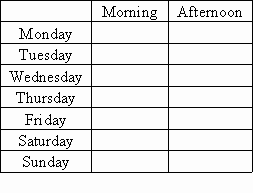
Write everything you have to do next week, and fill in the table below. Choose a day and time to have a party. Then invite classmates to your party.
提示词语及句型:
1)study, have a lesson, visit, help, play football, go to the movies, watch TV
2)Can you come to my party?
I have to…
What are you doing on Tuesday?
F.The same and different
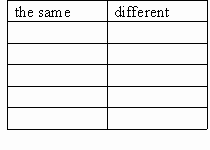
Write your name on a piece of paper and put it in a bag. Take a paper from the bag to find a partner. You have three minutes to make a list of things that are the same and different between you and your partner. The pair with the most items wins.
提示词语及句型:
1)tall, quiet, athletic, serious, intellectual, thin, funny
2)He is taller than me.
We are both girls.
Every morning, the newspaper chief editor(主编) holds a meeting with the reporters. They discuss the main events(事件) of the day. Reporters are then sent to cover the events.
As soon as the reporters know what to write about, they get down to work. They telephone people and fix a time for a face-to-face interview with them. Sometimes they do telephone interviews. Checking information is very important. They go to the newspaper's own library to look up any information that they need. This is called “doing one's homework”.
At the same time, the picture editor decides which photographs will be used for the next day's paper. All the people who work on a newspaper must be able to work fast. Reporters have to stop working on one story and start working at once on the important new one. They must find out the new information as quickly as possible. Later in the day, everything is put together at the news desk. Reporters return, type their stories into the computer and hand them to the editor.
The chief editor decides which will be the most important story on the front page. Sometimes this will have to be changed if something more important happens late in the day. Other editors read the stories which the reporters have written and make any necessary changes.
Finally, there is no more time left for adding new stories, and the time for printing(印刷) the newspaper has come. This is done on fast-moving printing machines. The newspapers are then delivered(发送) by truck, plane or rail. Speed is important. People want to buy the latest newspaper; nobody wants to buy yesterday's.
1.What is the work in a newspaper office like?
A. Interesting and confusing B. Important and patient.
C. Particular and necessary. D. Fast and busy.
2.According to the passage, the right order for a reporter's work is ____________.
a. writing stories b. doing interviews c. joining in a discussion
d. doing homework e. handing stories to the editor
A. c-b-a-d-e B. c-d-e-a-b C. c-b-d-a-e D. c-a-d-b-e
3.The front page contents(内容) are decided by ___________.
A. the importance of the events
B. how well the stories are written
C. the knowledge of the chief editor
D. whether they are the latest
4.Word editors' work is to ____________.
A. help the chief editor with the morning discussion
B. decide when and how the papers can be printed
C. read the stories and make necessary changes
D. get together information from reporters and photographers
5.The best title for this passage is “____________”。
A. How a newspaper is produced B. How newspapers are delivered
C. What kind of papers readers like D. Whose work is more important
阅读短文,判断正误。正确的写“T”,错误的写“F”。
Mr Jones and Mr Brown work in the same office (办公室).One day Mr Jones says to Mr Brown ,
“I will have a small party at our house on Monday evening . Would you and your wife like to
come ?”
Mr Brown says , “Thank you very much . I’d love to , but let me ask my wife first .”
So Mr Brown goes to the other room and telephones his wife . Then he comes back and looks very
worried .
“What’s the matter?” asks Mr Jones . “Is you wife there at home ?”
“No,” answers Mr Brown . “She isn’t there . My small son answers the telephone . I
say to him , ‘Is your mother there , David ?’ and he answers ‘No , she isn’t in the
house.’‘Where is she ?’ I ask ,‘She is somewhere outside(在外面) .’‘What’s she doing?’
‘She is looking for me .’”
1.There is a party at Mr Jones’s house on Monday evening . ( )
2.Mr Jones asks Mr Brown and his wife to go to the party . ( )
3.The telephone is in Mr Brown’s office. ( )
4.Mr Brown speaks to Mrs Brown on the telephone . ( )
5.Mrs Brown is looking for her son . ( )
完形填空
Time is very important in our lives. But it never had any importance in my life until I 1 a watch from my father that made me responsible(有责任). It 2 me the importance of time in my life.
I got this gift on a grey-sky day. I had to go to the 3 at 9:00 a.m. to pick up(接)my uncle Ali and take him to my father’s house. However, I forgot it 4 I was playing with my friends. Later on that day, around 11:00 a.m., I 5 my uncle, but I was late for him. He had got out of the plane and 6 a taxi to my father’s house.
I 7 my father’s house at 2:00 p.m. at the same day . My father looked at me angrily. I said “hi” to him and my 8 uncle. My father asked me to sit 9 him and handed me this watch which was a gift from 10 . It weighed 8 oz(盎司)and all of it was made of silver(银). Then he said, “Essa, did you have fun 11 your friends today? What you did was not very nice and you should be sorry for your 12 .” I felt sorry and told my father that I wouldn’t do it again. Then he said, “This watch will be a reminder(提醒物) for you. I hope today you have learned something 13 .”
I learned a lesson from my father: to respect(尊重) time and 14 be late. The watch is important to me, not because of its 15 , but because of the lesson that I learned from it.
| 【小题1】 |
|
| 【小题2】 |
|
| 【小题3】 |
|
| 【小题4】 |
|
| 【小题5】 |
|
| 【小题6】 |
|
| 【小题7】 |
|
| 【小题8】 |
|
| 【小题9】 |
|
| 【小题10】 |
|
| 【小题11】 |
|
| 【小题12】 |
|
| 【小题13】 |
|
| 【小题14】 |
|
| 【小题15】 |
|
I lost my sight when I was four years old by falling off a box and landing on my head. Now I am thirty-two. I can vaguely(模糊地) 1 the brightness of sunshine and what color red is. It would be wonderful to see things again, 2 a disaster can do strange things to people. It happened to me the other day that I might not have come to love 3 as I do if I hadn’t been blind. I believe in life now. I am not sure that I would believe in it so 4 . I don’t mean that I would prefer to go without my eyes. I 5 mean that the loss of 6 made me enjoy more of 7 I have now.
Life asks us to keep making 8 to reality. If a person is able to get ready for anything changeable his world will 9 more meaningful. I became blind, but I was 10 . My parents and my teachers saw 11 in me-a potential(潜力) to live, you might call it-which I didn’t see, and they make me fight it out with blindness.
The hardest 12 I had to learn was to believe in myself. That was what I had to do at least. If I hadn’t been able to do that, I would become a chair rocker for the 13 of my life. When I say I believe in myself I am not talking about simply the kind of self-confidence that helps me down an unfamiliar staircase 14 . That is part of it. But I mean something bigger than that: A belief that I could deal with anything alone; that somewhere in the 15 there is a special place where I can make myself fit.
1. A. imagine B. find C. remember D. guess
2. A. but B. though C. so D. because
3. A. myself B. life C. eyes D. blindness
4. A. that B. therefore C. happily D. deeply
5. A. seldom B. just C. hardly D. always
6. A. them B. it C. blindness D. light
7. A. that B. what C. which D. where
8. A. moments B. encouragements C. improvements D. changes
9. A. become B. change C. look D. end
10. A. brave B. lucky C. sad D. wise
11. A. something B. everything C. nothing D. anything
12. A. problem B. experience C. difficulty D. lesson
13. A. rest B. whole C. need D. last
14. A. lonely B. alone C. self D. person
15. A. company B. group C. society (社会) D. family
湖北省互联网违法和不良信息举报平台 | 网上有害信息举报专区 | 电信诈骗举报专区 | 涉历史虚无主义有害信息举报专区 | 涉企侵权举报专区
违法和不良信息举报电话:027-86699610 举报邮箱:58377363@163.com