
题目列表(包括答案和解析)
For questions 1 to 5 choose the phrase that is closest in meaning to the underlined words.
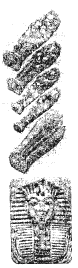
Egyptian MummiesIn ancient Egypt, kings and pharaohs were (1) revered as gods. Tutankhamen was a boyking. He was only nine years old when he became king in about 1347 BC. He died before he was twenty, and his body was (2) preserved as a mummy. His funeral took place in the Valley of the Kings, a burial centre near the ancient city of Thebes. When Tutankhamen's tomb was discovered in 1922, it was found to be filled with over five thousand objects: thrones, chariots, swords, statues, rings and even toys. The boy-king's coffin had been (3) entombed for over 3 200 years. A solid gold mask covered the head and shoulders of his mummified body. The (4) master craftsmen of the time must have created this mask, because no one else would have been allowed to (5) model the sacred face of the pharaoh.
1.
[ ]
A.treated with respect
B.remembered for centuries
C.protected by the people
D.famous and royal
2.
[ ]
A.dressed like
B.given preference
C.prevented from decaying
D.prepared for the ceremony
3.
[ ]
A.covered in jewels
B.kept in a burial chamber
C.undiscovered
D.celebrated
4.
[ ]
A.people who lived in the palace
B.people who knew the boy-king
C.people who were skilled at their trade
D.people who were religious
5.
[ ]
Long, long ago the Mouse King had a beautiful daughter. When she was old enough to be married, he called together the oldest and cleverest mice to talk about it.
“My daughter,” He said, “is far too beautiful to marry just anybody. I have decided to marry her to the greatest thing in the world. Now, who shall it be?”
“The sun,” the first mouse said at once, “is the greatest thing in the world. It shines over the whole world.”
“Well, then, I shall marry her to the sun,” said the Mouse King.
“But,” said the second, “a cloud can cover the sun.”
“Then, she must be married to the cloud.”
“But,” said the third, “the rain breaks through the clouds and puts an end to them.”
“That is true. I must marry her to the rain.”
“But,” cried the fourth, “no matter how hard the rain falls, it cannot wash away the trees.”
“Then she must be the tree's wife.”
“But,” shouted the fifth, “a strong wind can blow down the trees.”
“Very true. Then the wind must be her husband.”
“But,” remembered the sixth, “no matter how hard the wind blows, it cannot blow away the earth.”
“Then I must marry her to the earth.”
“But,” called out the seventh, “the earth is covered by the wooden floors of men's houses.”
“Then she shall marry the wooden floor at once.”
“But,” the last said slowly, “no matter how strong the wooden floor is, a mouse can bite his way through it.”
“It is clear that a mouse is the greatest thing in the world,” the happy Mouse King said, with a smile on his face.
And that was why the Mouse King's daughter married a mouse at last.
1. How many mice are mentioned in the passage?
A. Eight
B. Nine
C. Ten
D. Three
2. Which mouse had a beautiful daughter?
A. The old one
B. The cleverest one
C. The first one
D. The Mouse King
3. Who thought the wind should be the daughter's husband?
A. The second mouse
B. The fourth mouse
C. The fifth mouse
D. A and C
4. What was the result?
A. There was no result.
B. All those would be the daughter's husbands.
C. The daughter would be married to a mouse.
D. The daughter would live alone.
5. Why was the result so?
A. Because all the mice agreed.
B. Because all the mice wanted to have a rest.
C. Because the Mouse King thought a mouse was the greatest thing in the world.
D. Because the daughter was glad.
The Indians invented and developed the system of numbers from 1 to 9 and 0. We can use the ten numbers to make any number from the biggest to the smallest.
However, the ancient Romans invented a different system (系统) of numbers. They used symbols (符号) and replaced them. 1 is “Ⅰ” and 2 is “Ⅱ”. For larger numbers, they invented new symbols—5 is “Ⅴ”, 10 is “Ⅹ”, and so on. But they didn’t have a symbol for zero.
Here’s a table of the Roman numbers.
1 | 5 | 10 | 50 | 100 | 500 | 1,000 |
Ⅰ | Ⅴ | Ⅹ | L | C | D | M |
The Romans combined their symbols. In this way, “Ⅶ” means “5+1+1”, or 7. However, they found that “ⅡⅡ” (for 4) and “ⅤⅡⅡ” (for 9) were too confusing, so they thought out another idea.
If the “Ⅰ” comes after the “Ⅴ”, then you add it (Ⅵ is 6); if the “Ⅰ” comes before the “Ⅴ”, then you subtract (减去) it (Ⅳ is 4). The rule is that you are allowed to add up to three (e.g. Ⅷ is 8), but only subtract one (e.g. XL is 40).
How to remember the symbols?
Ⅰis like a finger. In a whole hand, the thumb (拇指) and the little finger make a V. Ten fingers are both hands, so the two Vs make an X..
Here is a way to remember the other symbols (L, C, D, M):Little Cats Drink Milk.
( ) 51. How many numbers can we make according to the Indians’ system ?
A. three: 0, 9, 1 B. ten C. eleven D. lots of
( ) 52. Which number was not in the ancient Roman’s number system?
A. 1 B. 9 C. 0 D. 5
( ) 53. What does the underlined word “combined” probably mean in the passage?
A. 合并 B. 分离 C. 增加 D. 削减
( ) 54. What does MD mean according to the Romans’ rule of calculating?
A. 500 B. 1000 C. 1500 D. 2000
( ) 55 Which sentence is NOT true according to the passage?
A. “Little Cats Drink Milk” can help us to remember some of the numbers symbols.
B. The Indians invented the system of numbers from 1 to 9 and 0.
C. You are not allowed to make a number like “XXL”
D. The ancient Romans repeated symbols to make any number.
湖北省互联网违法和不良信息举报平台 | 网上有害信息举报专区 | 电信诈骗举报专区 | 涉历史虚无主义有害信息举报专区 | 涉企侵权举报专区
违法和不良信息举报电话:027-86699610 举报邮箱:58377363@163.com