
Key sentences重点句子 How long has Ms. James been a teacher? Since 1998. How long have you studied Chinese? For a year. She’s studied it for a year. It is easier to learn a foreign language when you visit the country. In fact, since 1989 Project Hope has built schools all over China. Ability goals 能力目标 Enable students to listen to and talk about time and events. Teaching important/difficult points 教学重难点 How to listen to and talk about time and events, using the Present Perfect Tense with since and for. Teaching aids教具准备 A projector or some pictures a tape recorder Teaching procedures and ways教学过程与方式 Step I Lead-in In this procedure, present the word since and the sentence how long-? Give students a brief introduction to the sentence pattern and the word since in the present perfect. T: Hello. Boys and girls. Nice to see you again. S: Nice to see you. Draw a picture of a teacher on the blackboard to present the word since and how long-? T: Look at the blackboard, this is Mr. Li. He became an English teacher in 1998. He has taught English since 1998. Write the word since on the blackboard. Ask students to repeat. Make sure students understand the meaning of the word. T: What does since mean? It means from 1998 to the present time. Then ask the students: How long has he been a teacher? Help them to answer: He has been a teacher for eight years. Write the sentence on the blackboard. How long has he been an English teacher? He has been an English teacher since 1998. / He has been an English teacher for eight years. Ask the students to read the sentences. Then check some pairs to read the sentences. Step II Pair work In this procedure, create certain situations for students to practise since and how long-? Show another two pictures with a foreigner named Mr. James with 2001 and a student with 2002 on them. Ask students to practice the word since and How long-? by doing pair work. First make a model with an individual. Sample conversation: T: How long has Mr. James lived in China? S: He has lived in China since 2001. Step III Listening and pair work In this procedure, students will learn to talk about the “years and activities. Ask them to listen to the conversation and match the years and activities correctly. Pay attention to the present perfect tense and how long-? T: Boys and girls, how long have you studied English? S: We have studied English since 2002. T: Very good. Look at part one of your textbooks. You can see some years above and some activities below. Two people are talking about the years and the activities. Look at the first year 1995. What happened? Can you guess? Now I’ll play the recording. For the first tine, just listen. Match the years and activities when you listen again. Check the answers with some pairs. Then ask some pairs to repeat the six activities using the word since and how long-? Sample conversation: S1: How long has Ms. James been a teacher? S2: She has been a teacher since 1998./Since 1998. Step IV Listening and reading In this procedure, students will listen and read a dialogue, then they will answer some questions and do some exercises to find further information. At the same time, they will learn some new words and expressions. (1) Present the new words poor, project, foreign, difficult, get on well with, really, etc. Stress these words when talking to the students. T: OK. Let me tell you something about my friend Sally. I have known her since 2004 for two years. I haven’t met her, but I get on well with her because we love the same things. She can speak a little Chinese, but it’s really difficult to learn a foreign language. Sally wants to visit a school of Project Hope, a school for poor children. Read slowly to make sure the students understand the meaning of each word and write the new words and expressions on the blackboard. Ask the students to repeat. (2) Listen to the recording and answer the questions. T: Betty and Lingling are talking about my friend Sally. Now listen and find out what they are talking about. Books closed. After a few minutes. T: Have you got it? Now look at part 4, and then work in pairs, and ask and answers questions. One asks and the other answers. Then you’ll show your answers to the class. Sample conversation: S1: How long has Lingling known Sally? S2: Lingling has known Sally for two years. S1: Does she still know her? S2: Yes, she does. - Check some pairs of students. Then come to Activity 6. Ask students to read the conversation and complete the sentences. A few minutes later, check the answers. T: Have you finished? First, let’s do some chain work to check your answers. You’ll read the sentences in order from line one to line six. S1: Lingling knows Sally quite well, but she hasn’t met her. S2: Sally and Lingling get on well because they like the same things. S3: Sally hasn’t been to China, so speaking Chinese is difficult for her. S4: Sally is coming to China because her school orchestra has some concerts. S5: She has heard about the Hope School, so she wants to visit a school in Gansu or Qingdao. S6: Since 1989 Project Hope has built schools all over China. Step V Discussion In this procedure, practice the words and expressions in Activity 5. T: We have known something about Sally in the dialogue. You must want to know something about your friend. Now let’s look at part five, imagine you are a reporter, you’ll ask your friend some questions. Work in pairs! Start! Sample conversation: S1: What do you find difficult in learning English? S2: I find new words difficult in learning English. S1: How many foreign countries have you visited? S2: I have visited three foreign countries. - Check the answers. Ask some pairs to make a dialogue in the front of the class. Step VI Pronunciation and speaking In this procedure, encourage students to talk about themselves using how long- and since, for. T: Today, we have studied the word since and the sentence how long-? Now, let’s come back. Look at Activity 7. You’ll listen to some sentences and repeat. Play the tape recorder twice, give students a few minutes to read the sentences by themselves. T: Work in groups of four, asking and answering questions on your own activities. One of you asks and the others answer, then change your turns. Sample conversation: S1: How long have you studied English? S2: I have studied English for 3 years since 2003./Since 2003. How long have you lived here? S3: I have lived my hometown for 14 years since 1992. /Since 1992. How long have you been a student at our school? S4: I have been at this school for 2 years since 2005./Since 2005. How long have you known your best friend? S1: I have known my best friend for 4 years since 2002. - Check some groups. Then ask students to complete Activity 8. Step VII Homework 查看更多


题目列表(包括答案和解析)

阅读Fishing Can Be Dangerous

  Old Peter liked fishing.Whenever he had any free time he drove into the countryside, found a good place to fish, and spent a few hours fishing.The problem was that most of the best places to fish were on private land, and Peter often had to pull his rod out of the water quickly and run off with it when the owner of the land came along.

  One day he was sitting by a river that ran through a rich man's property when he fell asleep.

  He was awakened by a voice saying, “You'll never catch anything using that bait.”

  Peter looked up and saw a man standing behind him.

  “What do you mean?”Peter said.“There's nothing wrong with this bait.I always use it.I've caught thirty fish with it today already.”

  “How interesting!” the man said.“Do you know who I am?”

  Peter shook his head.

  “I'm the owner of this land.”

  Peter thought very quickly.

  “Do you know who I am?” he asked.

  The man shook his head.

  “I'm the biggest liar in the country,” Peter told him.

  And with these words he pulled his line out of the water and ran off as fast as he could.

  Notes:

  whenever/wen'ev+/adv.无论何时

  private/'praivit/adj.私人的

  rod/'r&d/n.竿

  owner/'+un+/n.所有者

  property/'pr&p+ti/n.财产

  awakened n.(awaken的过去分词…was awakened by…:……被……唤醒

  bait/beit/n.诱饵

  liar/'lai+/n.说谎者

  line/lain/n.线

Exercises

A.Choose the best answer to each question about the story.(根据故事内容,选择最佳答案)

1.Whenever Peter had some spare time he ________.

a)went for a drive in his car

b)visited his friends

c)went fishing

d)looked for some private land

2.Most of the best places to fish were ________.

a)owned by someone

b)a long way from Peter's home

c)difficult to find

d)near a river

3.Peter told the man ________.

a)not to use his bait

b)that his bait was very good

c)that he never used bait

d)that the bait wasn't any good

4.Why did Peter tell the man he was “the biggest liar in the country”?

a)He had lied to him about the fish.

b)He didn't know who he was.

c)He was using the wrong bait.

d)He wanted the man to believe he had lied(撒谎).

B.Complete sentences将句子a)、b)、c)、d)分别与短语e)、f)、g)、h)连线,使其成为完整的句子。)

a)Peter often spent a few hours

e)the most of the best places to fish were on private land.

b)He usually fished on private land because

f)the same kind of bait.

c)He always used

g)the owner of the land arrived.

d)He often had to run away when

h)fishing in the countryside.

C.What do you like doing in your free time?

1.列举业余时间你通常做的事:fishing, going for a drive, playing basketball, listening to the music________, ________, ________, ________, ________

2.What should we do in our spare time?Give comments评价所写的活动

如:We should go fishing in our spare time.It’s very relaxing.

3.写信给你的朋友告诉她/他,你业余时间喜欢做什么及原因(可以用I,…, you’ll…)。

查看答案和解析>>

阅读理解。

  What do you like most when you can get one of such things:freedom, true friends, love, honesty and so on? Here are some choices of students:

  Chen Cheng, 14, Jiangsu:I think I need a true friend.I had some friends before.However, it seemed that they didn't treat(对待)me well.I told them my secrets but they didn't share(分享)theirs with me.What's worse, they told my secrets to others, which made me very unhappy.I hope to find a true lifelong(终身的)friend who can share happiness and sadness with me and keep my secrets.

  Gan Xiaoning 14, Heilongjiang:Freedom is what I want most.I am a bird in two cages(笼子).In school, I have to follow the school's rules and listen to teachers.At home, my parents don't allow me to do what I like, either.I have to do everything that they tell me to do:study, study and study some more.So, freedom is the only thing I really want!

  Yuan Siyu, 15, Guangxi:I am a boy from a poor family.My father works very hard but only makes a little money every month to support(支撑)the family.I want to go to a key university(重点大学)so that I can find a good job in the future.Then, I can earn enough money to get my family out of poverty(贫困)and offer my parents a happy life.

  Qu Yi, 15, Hebei:I want a complete family.My parents got divorced(离婚)three years ago.Since then, I have had no chance to be together with both of them any more.Now, I am living with my mom and get her love, but I also want my dad's love.I am envious(羡慕)of my classmates who live with their parents.So, I would have a complete family if I could.

(1)

What is not mentioned in the passage?

[  ]

A.

freedom

B.

love

C.

a true friend

D.

hobby

(2)

Who is facing the problem of poverty and decides to fight?

[  ]

A.

Qu Yi

B.

Chen Cheng

C.

Gan Xiaoning

D.

Yuan Siyu

(3)

As for Chen Cheng, she wants a friend _________.

[  ]

A.

who often tells lies to her

B.

who only cares about her own happiness

C.

who can play with her

D.

who can share her feeling and keep secrets

(4)

Which of the following is true?

[  ]

A.

Qu Yi's father works very hard and makes much money to support his family.

B.

Chen Cheng gets along very well with his friends

C.

If Qu Yi's parents didn't get divorced, he would be much happier.

D.

Gan Xiaoning says he is a bird because he wants to fly like a bird.

查看答案和解析>>

下面是牛津译林版八年级英语下册 Unit 3 Online travel的重点句子,请结合提示完成句子
1. ________ ________ ________ (被设计) by Nancy Jackson.
2. These words________ ________ (写在) on it.
3. When you play the game,you will________  ________  ________  ________ (扮演角色)
    Itchy Feet.
4. ________ ________ (例如) , when you reach London,you will learn about the museum of London
    and many other interesting places.
5. Get it before it________ ________ ________ (卖光) .
6. I hope I can have more ________  ________ (空余时间) to play.

查看答案和解析>>

听对话和对话后的问题,选择正确的答案。
1. A. 7 years ago.  
    B. 6 years ago.  
    C. 6 years old.
2. A. It's hard to spell.  
    B. It's hard to write.  
    C. It's easy to learn.
3. A. She spoke English as much as possible.
    B. She read English as much as possible. 
    C. She wrote English as much as possible.
4. A. He understood everything.
    B. He couldn’t understand anything.  
    C. He only could understand something.
5. A. By drawing pictures.
    B. By remembering key sentences.
    C. By remembering the first letter of each sentence.

查看答案和解析>>

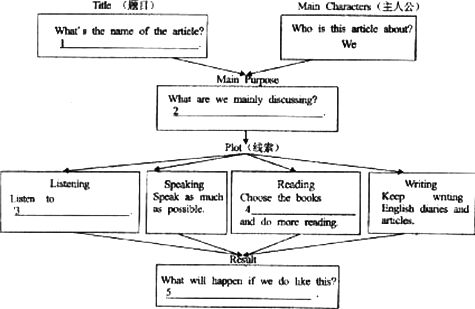
Swimming and English Learning

  Can you swim?Do you like swimming?Yes?Well, how can you learn to swim?I think the best way is to go into the water and learn.I' m afraid you'll never learn to swim just by reading books about swimming or look-ing at others swimming.It's the same with the English study for us kids today.We must practice, practice and practice.

  Listening and speaking are very important for beginners.The children in English-speaking countries first listen to others.Then they try to imitate(模仿)and speak.We can listen to English programs on radio.You may just understand a few words.It doesn' t matter.Just be relaxed, try to get the main topics(论题,话题), then the main ideas, then the main sentences(句子), then the key words, then the full meaning.As for speaking, speak as much as you can.

  Reading and writing are more important for school students.First we must choose the books we're interested in.A lot of reading will improve your language sense(语感).This is the most important.

  Keep writing English diaries(日记).We can also write English articles.You may even post them to English magazines.Don't be afraid of failure(失败).Failure is the mother of success.

  Easier said than done.Well, let's do more practice from now on.I' m sure you' ll learn English well in this way.
查看答案和解析>>


同步练习册答案