
(1) 反意疑问句的构成及回答 反意疑问句一般规律是“前否定后肯定,前肯定后否定 .构成反意疑问句的助动词应该和前面的一致.要注意时态.人称和数的变化. He plays the piano well, doesn’t he? They are listening to music, aren’t they? My brother won’t leave for America, will he? 但是情态动词的反意疑问句要注意.must表示“有必要 时.反意疑问句要用needn’t,表示“必须 时.用mustn’t. You must go home right now, needn’t you? The car must be locked, mustn’t it. 祈使句的反意疑问句要用will/won’t you? can/can’t you? could/would you? 否定祈使句的反意疑问句用will you? Have a cup of tea, won’t you?/will you? Don’t open the door, will you? Let’s的反意疑问句用shall we? Let us的反意疑问句用will/won’t you? Let’s take a rest, shall we? Let us do it, will you? 在“前否定.后肯定 形式的反意疑问句中.如果表示赞同前者说的话.和前面说的话相一致.用no回答.用汉语可翻译为“是的 ,如果表示不赞同前者说的话.用yes回答.用汉语可翻译为“不是 . He didn’t get up early this morning, did he? 他今天早上起床不早.对吗? Yes, he did. 不.他起得早. No, he didn’t (=He didn’t get up early) 是的.他起得不早. (2) not only-but also的含义及用法 not only A-,but also B-表示“不但,而且 .可连接两个并列成分.但强调后者,后面的also也可省略. He is not only clever but also hard - working.他不但聪明而且能干. not only-but also结构中.not only放在句首时.后面引导的句子要用倒装语序.引起部分倒装,但but also后的句子不倒装.用陈述语序. Not only did he work faster, he worked better also. 他不仅工作更快.而且更好. Not only did I know her, but I was her best friend. 我不仅认识她.而且是她最好的朋友. 查看更多


题目列表(包括答案和解析)

阅读理解

  The United States has many different kinds of climates(气候).On the northwest coast(海岸), the temperature changes very little between summer and winter, but the

north central(中部的)states have a very different kind of climate.In those states, people wear light clothes in summer, and they need heavy woollen clothes in winter.

  In the southwest coast, the climate is rainy and warm during the winter, but the summer is dry and hot.

  In the northeast of the United States, summer temperatures are very different from winter temperatures.Summer is usually hot, and winter is usually cold.Spring temperatures are warm, and fall temperatures are cool.

  Years ago, people in the cold parts of the United States didn't often get fresh(新鲜的)vegetables and fresh fruits during the summer.Today, however(然而), trucks and trains carry fruits and vegetables very quickly to all parts of the United States.In this way, Americans“send their climates”to people in other states.

(1)

The summer and winter temperatures are almost the same ________.

[  ]

A.

in the northeastern states

B.

on the north central states

C.

in the western states

D.

on the northwest coast

(2)

The word“fall”in this passage means ________.

[  ]

A.

drop

B.

down

C.

autumn

D.

spring

(3)

Today people ________ can get fresh vegetables and fruits.

[  ]

A.

in the north central states

B.

in every part of the USA

C.

in the cold parts of the USA

D.

in the southwest part of the USA

(4)

From this passage we know that the climate of the United States ________.

[  ]

A.

is always very cold

B.

is warm in winter

C.

is widely different

D.

changes very little between summer and winter

(5)

From Paragraph 2(第二段)we know that the climate of the southwest coast is ________.(请结合所学的地理知识回答)

[  ]

A.

Maritime(海洋性)climate

B.

Savanna(热带草原)climate

C.

Mediterranean(地中海)climate

D.

Tropical rainforest(热带雨林)climate

查看答案和解析>>

根据汉语意思,完成句子。

1. 我想给家里写信.    
    I want to ___ ___.   
2. 你什么时候到家?    
    When do you ___ ___?   
3. 该吃晚饭了.    
    It is time to ___ ___.   
4. He can spell his name. (改为一般疑问句,并做否定回答)    
    ___ he ___ his name? ___, he ___.   
5. I want to take some books to the classroom. (改为否定句)    
    I ___ want to take ___ books to the classroom.

查看答案和解析>>

书面表达。
    以 the Great Wall 为题写一篇短文。
要求:
1、写长城的景色及地理位置。
2、写游长城的感受。
3、字数在70-80。
     __________________________________________________________________________
_____________________________________________________________________________
_____________________________________________________________________________

查看答案和解析>>

听力技能(共三节,计20分)

第一节 听音选图 根据所听内容,选择相应的图画。听每个句子前,你将有时间阅读各个小题,每小题5秒钟;听完后,各小题将给出5秒钟的作答时间。(共5小题,每小题1分)

第二节 对话理解 听下面的对话,从题中所给的A、B、C三个选项中选出最佳答案。听每段对话前,你将有时间阅读各个小题,每小题5秒钟;听完后,各小题将给出5秒钟的作答时间。(共10小题,每小题1分)

听下面的对话,回答第6小题

6.What does Lucy's father do?

A.He is a teacher.

B.He is a doctor.

C.He is a scientist.

听下面的对话,回答第7小题

7.What does John collect?

A.Stamps.

B.Coins.

C.Shells.

听下面的对话,回答第8小题

8.How will Kate go to school today?

A.By bus.

B.By train.

C.By car.

听下面的对话,回答第9小题

9.When is Ed's father leaving for New York?

A.On January 1st.

B.On January 2nd.

C.On January 3rd.

听下面的对话,回答第10小题

10.What will the weather be like tomorrow?

A.Sunny.

B.Rainy.

C.Cloudy.

听下面的对话,回答第11-12小题

11.Where has Jim gone for his holiday?

A.To Hong Kong.

B.To Beijing.

C.To Paris.

12.Who did David go to Paris with?

A.His brother.

B.His parents.

C.His sister.

听下面的对话,回答第13-15小题

13.How long did Vince skate today?

A.About 4 hours.

B.About 6 hours.

C.About 5 hours.

14.When did Vince begin skating?

A.At the age of 5.

B.At the age of 6.

C.At the age of 7.

15.Who gave Vince the first pair of skates(滑冰鞋)?

A.His father.

B.His uncle.

C.His grandmother.

第三节 笔录要点 根据你听到的短文,将下面表格中第16至第20小题的信息补充完整,每小题不超过三个单词。(共5小题,每小题1分)
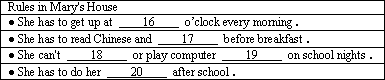
查看答案和解析>>

听力技能

第-节:根据所听到内容,选择相应的图。听每段材料前,你将有时间阅读各个小题,每小题5秒钟;听完后,各小题将给出5秒钟的作答时间。(共5小题,每小题1分)
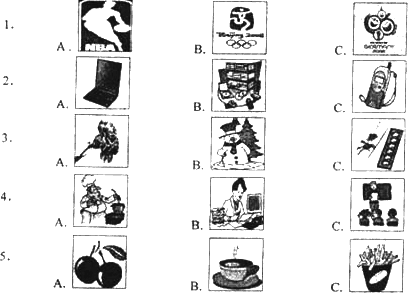
第二节:对话理解听下面的对话,从题中所给的A、B、C三个选项中选出最佳答案。听每段对话前,你将有时向阅读各个小题,每小题5秒钟,听完后,各小题将给出5秒钟的作答时间。(共12小题,每小题1分)

听下面的对话,回答第6小题。

6.What would Mr.Brown like to have?

A.Tea.

B.Coffee.

C.Milk.

听下面的对话,回答第7小题。

7.How does Tom's father usually go to work?

A.By car.

B.By bike.

C.on foot.

听下面的对话,回答第8小题。

8.How old is the man?

A.10.

B.15.

C.25.

听下面的对话,回答第9小题。

9.What does the woman want to borrow?

A.Jack's bike.

B.Jack's car.

C.Jack's pencil.

听下面的对话。回答第10小题。

10.Where are the woman and the man?

A.In a factory.

B.On a farm.

C.In a shop.

听下面的对话。回答11至12小题。

11.Where did the boy go?

A.Shanghai.

B.Beijing.

C.Changsha.

12.Who did the boy go with?

A.His farther

B.His mother.

C.His sister.

听下面的对话,回答13至14小题。

13.How long did John spend on his homework?

A.30 minutes.

B.40 minutes.

C.50 minutes.

14.What were his parents doing then?

A.Writing a letter.

B.Doing her homework.

C.Watching TV.

听下面的对话。回答15至17小题。

15.When did Jim begin to cough?

A.Last night.

B.Last week.

C.Last month.

16.What did the boy have for breakfast this morning?

A.A little milk and an egg.

B.A little coffee and some bread.

C.A little tea and an apple.

17.What are they talking about?

A.The food for breakfast.

B.The weather.

C.Jim's trouble.

第三节:笔录要点:报据你所听到的内容。填写下面的表格,每空不超过3个单词。(共3小题,每小题l分)
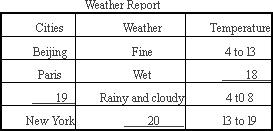
查看答案和解析>>


同步练习册答案