
learn Everyday English on page 57 by heart. 查看更多


题目列表(包括答案和解析)

Reading comprehension(阅读理解):

Answer the questions(根据短文内容回答下列问题):

  English is an important international language, but that doesn’t mean it’s easy to learn.Many experts have tried to make English easier to learn - but they weren’t always successful.

  In 1930, Professor C.K.Ogden of Cambridge University invented Basic English.It had only 850 words(and just eighteen verbs)and Ogden said most people could learn it in just thirty hours.The problem was that people who learned Basic English could write and say simple messages, but they couldn’t understand the answers in ‘real’ English!It was also impossible to explain a word if it wasn’t in the Basic English word list.

  R.E.Zachrisson, a university professor in Sweden, decided that the biggest problem for learners of English was spelling, so he invented a language with the name Anglic.Anglic was similar to English, but with much simpler spelling.‘Father’ became ‘faadher’, ‘new’ became ‘nue’ and ‘years’ became ‘yeerz’.Unluckily, Anglic never became popular.

  In the age of international communication through the Internet, who knows what will happen?…a new form of English might appear.A large number of the world’s e-mails are in English and include(包括)examples of ‘NetLingo’ like OIC(Oh, I see)and TTYL(Talk to you later).In another fifty years, English might not be used.We might all speak fluent Internetish!

1.Many experts have tried to make English easier to learn, haven’t they?

2.Who invented Basic English in 1930?

3.How long could most people learn Basic English according to Professor Ogden?

4.What was the biggest problem for learners of English according to Professor Zachrisson?

5.What might happen to English in another fifty years?

6.What do you think of the experts’ ideas of making English easier?

查看答案和解析>>

请从方框内选出与其次匹配的选项,并将序号填入空格内,是其意思完整。

  How to get on well with others?

  In everyday life, we always have problems with others.Do you know how to get on well with others? The following will help you.

    1  .Start a conversation with “Excuse me” or “Would you please…” when you want to ask others something.Say “Thank you” after others help you.

    2  .Try to do special things for others.Making some soup for a sick neighbour may seem a little thing to you, but it will make your neighbour feel a lot better.

    3  .People say the sweetest music to a person's ears is the sound of his or her own name.

    4  .Try to understand others’ ideas and prepare to learn something from them at any time.We are never too old to learn.

    5  .When someone is talking to you, look at him or her, listen carefully and say something when necessary.
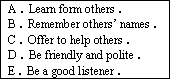
查看答案和解析>>

阅读理解

  E-mail is one of the biggest threats(威胁)to your home computer.By understanding how E-mail works, and by taking some steps in how you deal with reading and writing messages, you can keep this threat out of your computer.When you exchange E-mail with someone else, the messages sent between you and that person pass through several computers before they reach their places.Imagine this conversation as it is taking place in an Internet "room", a very, very big room.Anyone, or more exactly, any program can probably understand what is being said, because most Internet conversations are not hidden in any way.As a result, others may be listening in, capturing(捕获)what you send, and using it for their own good.

  E-mail-borne viruses often arrive in attractive, fantastic appearances, much like the beautiful ads we receive by way of traditional mail that is made to sell us something.By beautiful appearances, an infected(感染)E-mail message seems to be something we want to read from someone we know, not a mean virus ready to damage our computers.

  There are some steps that you can take to help you decide what to do with every E-mail message with an attachment(附件)that you receive.You should only read a message that passes all of these tests:

  1)The Know Test:Is the E-mail from someone that you know?

  2)The Received Test:Have you received E-mail from this sender before?

  3)The Expect Test:Were you waiting for E-mail with an attachment from this sender?

  4)The Meaning Test:Do the topic line of the E-mail message and the name of the attachment both have meanings?

  5)The Virus Test:Is the E-mail infected?

(1)

Which of the following is the main idea of the first paragraph?

[  ]

A.

We should not exchange our E-mail with someone else.

B.

It is dangerous to read and write E-mail messages at home.

C.

We should learn how E-mail works to take care of our computers.

D.

Our chats on computers are usually going on in a big Internet room.

(2)

As the Internet is open to anyone, we should _________.

[  ]

A.

not read and write messages in our home computers

B.

not allow nice advertisements to reach our computers

C.

stop our conversations while someone is listening in it

D.

be careful with the attractive E-mails sent by strangers

(3)

What is the passage mainly talking about?

[  ]

A.

The Threats of E-mail.

B.

The Safety of Home Computers.

C.

The E-mail-borne Viruses.

D.

The Steps to Receive E-mail Messages.

查看答案和解析>>

阅读下面的短文,然后根据短文内容,在每小题所给的四个选项中选出最佳选项。

  Martin had just finished high school.He would go to college at the far end of the city.He didn't want to live there, and he didn't want to take the bus either.So his father agreed to buy him a car.

  His father spent all his summer teaching him how to drive, from the ABC to the XYZ.Thinking of the great feeling of driving a new car, Martin learned very quickly, and received his driver's license(驾照)just before his eighteenth birthday.

  The second day, all the family, and their dog, went to a car shop.Martin spent almost all the morning going from one car to another.Finally he saw a red Blue Bird.He had a testing drive on the open ground, and called out, “This is what I want, Dad! ” When everything was done, they were ready to leave.

  Martin climbed into the front seat.He said excitedly, “It's my first day driving alone.Dad, Mom, and Poo! Enjoy it! ”

  His dad immediately took the back seat, right behind the new driver.Martin wondered why his father chose that seat, for his father always enjoyed looking in front.

  So he said, smiling, “I'm sure you’re back there to have a change after all those weeks of sitting in the front seat teaching me how to drive.”

  “No, ” Dad replied, “Do you remember what you did to me all those years when I took you to and from school? I am sitting here to hit and kick the back of your seat all the way! ”

(1)

Which of the following is NOT the reason why Martin's father agreed to buy him a car?

[  ]

A.

Martin would go to college and it was far from home.

B.

Martin preferred living at home to living at college.

C.

Martin didn't want to take the public transport.

D.

Martin was able to learn how to drive very quickly.

(2)

In which order(顺序)did Martin do the following things?

a.He finished his high school.

b.He tested driving the new car.

c.He got his driver's license.

d.He decided to buy the Blue Bird.

e.He kicked the front seat while his father was driving.

[  ]

A.

e-a-c-b-d

B.

a-c-b-d-e

C.

e-c-a-b-d

D.

a-c-d-b-e

(3)

How would the whole family probably feel on their way back home?

[  ]

A.

Angry

B.

Sad

C.

Cheerful

D.

Shocked

查看答案和解析>>

  Zheng He, the Columbus of the East, was an amazing man

  He was born in 1371 and, 11 years later, was caught by the army of a rich young man called Zhu Di and made to work for himOver time the rich man saw that Zheng He was very clever and strong and they became close friendsIn 1403 Zhu Di was made the King of China and he asked Zheng He to join his new government

  The King wanted to learn more about the world and show other countries his powerHe ordered many new ships to be built and made Zheng He their leaderBetween 1405 and 1433, Zheng He led seven sea trips to different parts of the worldHe certainly travelled to India, Africa and the Middle EastA few people think his ships may have even reached South America and Australia

  Each trip lasted between two and four years and it is believed he sailed more than 50 000 kms during the years of his travelsWith 28 000 men and over 300 ships, such as boats for food, water and even soldiers' horses, Zheng He led a fleet(舰队)whose size would not be equalled by Europeans for over 500 years I

  On these trips he brought with him many Chinese goods like silk and medicine to give to foreign kings or to sell for local goodsHe returned from each trip with boats filled with expensive things such as gold and jewellery, foreign guests and strange animals like a giraffe

  It is a pity that we may never learn everything about Zheng He s travelsAfter he died in 1433, the new king, who believed these trips were unlucky and too expensive, had them stopped and he burned almost all the books about Zheng He’s travelsIt is only in the last 50 years that historians have begun to carefully study the adventures of the great Zheng He

(1)

Why did the Chinese King want Zheng He to sail to many different countries?

[  ]

A.

To bring new countries under the control of China

B.

To show the world how strong the King was

C.

To receive gifts from the kings of other countries

D.

To discover unusual animals

(2)

What do we know about Zheng He from the passage?

[  ]

A.

He sailed to all seven continents

B.

Each of his trips lasted one year

C.

He died at the age of 62

D.

He was a successful businessman

(3)

Which of the following did Zheng He NOT bring with him from China?

[  ]

A.

Medicine

B.

Gold

C.

Animals

D.

Silk

(4)

What happened after Zheng He died?

[  ]

A.

He was forgotten for ever

B.

His ships were all burned

C.

The new king wrote a book about him

D.

Sea trips to other countries were stopped

(5)

In what order did the following happen?

aZhu Di became the King

bZheng He was caught by soldiers

cThe books about Zheng He were all burned

dForeigners were brought to China

eZheng He visited India

fNew ships were built

[  ]

A.

e, b, a, f, d, c

B.

b, a, e, d, c, f

C.

f, a, b, d, c, e

D.

b, a, f, e, d, c

查看答案和解析>>


同步练习册答案