
题目列表(包括答案和解析)
My father woke up early one summer morning when I was fourteen and announced, “Get up, you’re going with me to cut the grass in the garden.”
The idea that my father thought I was old enough to help him in his business made me feel proud and excited. From sunup to sundown, my father, my younger brother and I worked in the large garden. By the end of the day I was too tired to say a word but I felt happy. This was my first time to help my father in his business. I got $6 for my work that day.
One day my father found some leaves I had missed and pulled me aside. “Take away these leaves!” he said. “And don’t make me have to tell you to do it again.” The message was clear. Today I value the importance of doing job well the first time. I will never fail to impress (留下印象) the person I’m working for.
After two years, my father told me and my brother that he felt we were old enough to cut the grass by ourselves. Every Saturday during my last two years of high school, we set off early in the morning with the same wish we had gained while working under our father.
Looking after the garden was neither exciting nor high paying, but that didn’t matter. It taught me that any job was a good job and whatever I was paid was more than I had before.
A newspaper reporter once asked me how someone could possibly live with hard work and low pay. “If you’re only thinking about hard work and money, you probably don’t want to do better than you are doing,” I answered. In every job, from cutting the grass to washing dishes, I’ve learned much. I’ve learned something that helps me in my next job.
If you work hard enough, you can learn from any job you do.
7. The writer ______ from working in the garden.
A. learned to work hard to get money
B. found he could be well paid
C. felt he could impress others by working hard
D. learned any job was good though he might be paid less
8. When the writer finished high school, maybe he was ______ years old.
A. fourteen B. eighteen C. twenty D. twenty-two
9. The writer’s father was ______.
A. very strict but helpful
B. lazy and easy to get angry
C. careful and enjoyed working in the garden
D. funny and hard-working
10. Which is the most important to the writer according to the passage?
A. Finishing work as quickly as possible.
B. Asking no money for your work.
C. Keeping learning from any job you have.
D. Keeping on looking for different jobs.
My father woke up early one summer morning when I was fourteen and announced, “Get up, you’re going with me to cut the grass in the garden.”
The idea that my father thought I was old enough to help him in his business made me feel proud and excited. From sunup to sundown, my father, my younger brother and I worked in the large garden. By the end of the day I was too tired to say a word but I felt happy. This was my first time to help my father in his business. I got $6 for my work that day.
One day my father found some leaves I had missed and pulled me aside. “Take away these leaves!” he said. “And don’t make me have to tell you to do it again.” The message was clear. Today I value the importance of doing job well the first time. I will never fail to impress (留下印象) the person I’m working for.
After two years, my father told me and my brother that he felt we were old enough to cut the grass by ourselves. Every Saturday during my last two years of high school, we set off early in the morning with the same wish we had gained while working under our father.
Looking after the garden was neither exciting nor high paying, but that didn’t matter. It taught me that any job was a good job and whatever I was paid was more than I had before.
A newspaper reporter once asked me how someone could possibly live with hard work and low pay. “If you’re only thinking about hard work and money, you probably don’t want to do better than you are doing,” I answered. In every job, from cutting the grass to washing dishes, I’ve learned much. I’ve learned something that helps me in my next job.
If you work hard enough, you can learn from any job you do.
7. The writer ______ from working in the garden.
A. learned to work hard to get money
B. found he could be well paid
C. felt he could impress others by working hard
D. learned any job was good though he might be paid less
8. When the writer finished high school, maybe he was ______ years old.
A. fourteen B. eighteen C. twenty D. twenty-two
9. The writer’s father was ______.
A. very strict but helpful
B. lazy and easy to get angry
C. careful and enjoyed working in the garden
D. funny and hard-working
10. Which is the most important to the writer according to the passage?
A. Finishing work as quickly as possible.
B. Asking no money for your work.
C. Keeping learning from any job you have.
D. Keeping on looking for different jobs.
阅读下面短文,并借助图片和上下文补充所缺信息。每个空只能填写一个形式正确、与短文意思相符的英语单词,并将答案填写在答题卷上。
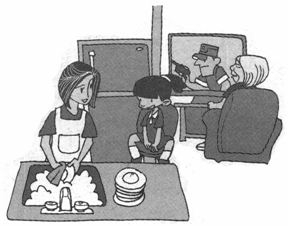 |
One day, Tina sat on the (71)__________ and watched her mother do the dishes in the (72) _________ . Tina noticed that her mother had some (73) hairs on her head. She looked at her mother and (74)__________ , “Why do you have some white hairs, Mom?”
Her mother answered, “Well, every time you do something wrong and make me (75)___________ , one hair turns white. If you don’t make me sad any more, I will have black (76)__________.”
The little (77)__________ thought for a while and then said, “Mom, I am going to listen to your words carefully from today on and I would like to be a (78)_________ kid. Then you will not have so many white hairs, will you?” Her mother smiled and nodded(点头).
Tina’s grandma was (79)_________TV in the living room. Tina glanced(看一眼)at her grandma and asked, “Mom, why is (80) _________ hair all white? Her children aren’t good ones, are they?”
湖北省互联网违法和不良信息举报平台 | 网上有害信息举报专区 | 电信诈骗举报专区 | 涉历史虚无主义有害信息举报专区 | 涉企侵权举报专区
违法和不良信息举报电话:027-86699610 举报邮箱:58377363@163.com