
题目列表(包括答案和解析)
阅读下面短文,回答问题
John lives in a small village. It's Sunday today and he doesn't go to school. After breakfast his parents went to work on the farm. He watched TV for an hour and then went out to play football with his friends. It got hot and they swam in the river until suddenly it began to rain. The five children stood in an old house by the river. About forty minutes later the rain stopped , they were all hungry and went home. It was difficult (困难的) for them to walk on the maddy (泥泞的) roads. When John got home, it was five past twelve.
Mrs Turner was in the kitchen at that time. She saw her son from the window. She was busy there and couldn't go out. She called out ,“You can't come in if your feet are dirty , John.”
“My feet are clean , mummy ,”said the boy.“Only my shoes are dirty. So I can go in , I think.”
1.What is John's father?
2.How many children swam in the river that day?
3.Why did they swim in the river?
4.Why didn't Mrs Turner let John in?
One day Daddy and I went out 1 a walk. On the way we 2 a lot of people. We went up and 3 a look. Oh, dear! 4 did we see? There 5 a donkey(驴) in the middle of the road. It would not move. The cars and buses could not get 6 .
Then a policeman came. " 7 donkey is this?" he asked. "It' s 8 ," said a farmer, "but I 9 move it. " The policeman and the farmer did 10 best to move the donkey, but it would not move. We laughed, but the 11 of the cars and the buses were 12 . "We can't move the donkey," the farmer and the policeman said. "What shall we do?"
"Give him a carrot," my father said.
" 13 a good idea!" said the farmer.
Soon he found a 14 and showed it to the donkey. When the donkey saw a carrot, it jumped up and walked after the farmer. 15 the cars and buses could get past at last.
| 【小题1】 |
|
| 【小题2】 |
|
| 【小题3】 |
|
| 【小题4】 |
|
| 【小题5】 |
|
| 【小题6】 |
|
| 【小题7】 |
|
| 【小题8】 |
|
| 【小题9】 |
|
| 【小题10】 |
|
| 【小题11】 |
|
| 【小题12】 |
|
| 【小题13】 |
|
| 【小题14】 |
|
| 【小题15】 |
|
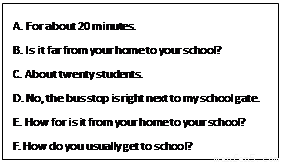
补全对话(每小题1分,共5分)
Dave:Can I ask you some questions, Sally?
Sally:Sure! What’s up?
Dave: 1.
Sally:Yes, it’s a little far.
Dave: 2.
Sally:First, I walk to the bus station and then I take the bus.
Dave:How long do you spend on the bus?
Sally: 3.
Dave:Do you need to walk after you get off the bus?
Sally: 4.
Dave:How many students in your class take the bus to school?
Sally: 5.
Dave:Thanks a lot.
Social customs and the ways of behaving change. Things that were considered impolite many years ago are acceptable . Just a few years ago, it was considered to be impolite behavior for a man to smoke on the street . No man who thought of himself as being a gentleman would make fool of himself by smoking when a lady was in the room.
Customs are also different from country to country. Does a man walk on the left or on the right of a woman in your country? Or doesn’t it matter? What about table manners?
The Americans and the British not only speak the same language but also share a large number of social customs. For example, in both America and England people shake hands when they meet each other for the first time. Also, most Englishmen will open a door for a wonman or offer their seat to a woman , and so will most Americans. Promptness is important both in England and in America. That is , if a dinner invitation is for 6 o'clock , the dinner guest either arrives close to that time or calls up to explain his delay.
The important thing to remember about social customs is not to do anything that might make other people feel uncomfortable especially if they are your guests. There is an old story about a man who gave a very formal dinner party. When the food was served, one of the guests started to eat his peas with a knife. The other guests were amused or greatly surprised , but the host calmly picked up his knife and began eating in the same way. I t would have been bad manners to make his guest feel foolish or uncomfortable.
1.The underlined phrase” make fool of himself” in the first passage means____
A.make himself strong B.make himself rich
C.make himself comfortable D.cause himself to seem like a fool
2.According to the passage , the American and British _____
A.don’t speak the same language
B.don’t have social custom in common
C.do share a lot of social customs
D.do have the exactly same social customs
3.If a dinner invitation is for six o’clock , the guest is supposed to arrive at ____ six
A.nearly a minute or two later than B.a quarter to
C.a quarter to D.much later than
4.The last example in the passage shows____
A.The correct way to use a knife at table
B.that it is good manners not to make your guests feel foolish or uncomfortable
C.that social customs and ways of behaving change too fast
D.promptness is important both in England and in America
5.Which of the following do you think is the best title for this passage?
A.Social Customs and Customs B.Social Life
C.American and British Customs D.Promptness is Important
A wise man used to go to the ocean to do his writing. He had a habit of walking on the beach every morning.
One day, when he was walking along the shore(海岸), he saw a young man moving like a
dancer. He smiled to himself at the thought that someone would dance on the beach. So he began to walk faster to catch up.
As he got closer, he saw that the young man wasn’t dancing, but instead he was reaching down to the shore, picking up something and very gently throwing it into the ocean.
He called out, “Good morning! What are you doing?” The young man stopped, looked up and replied, “Throwing starfish in the ocean.” “I guess I should have asked, why are you throwing starfish in the ocean?”
“The sun is up and the tide(潮汐)is going out. And if I don’t throw them in, they’ll die.”
“But, young man, don’t you realize that there are miles and miles of beach and starfish all along it. You can’t possibly make a difference!”
The young man listened politely. Then he bent down, picked another starfish, and threw it into the sea, and said, “It made a difference for that one.”
There is something very special in each and every one of us. We have all been gifted(赋予)
with the ability to make a difference.
We must each find our starfish. And if we throw starfish wisely and well, the world will be better.
【小题1】What was the wise man used to doing every morning?
| A.Taking a walk on the shore. |
| B.Watching the young man dance. |
| C.Meeting up with the young man. |
| D.Helping the young man pick up starfish. |
| A.To have fun. |
| B.To study starfish. |
| C.To feed some fish. |
| D.To save starfish. |
| A.Each of us should learn to protect starfish. |
| B.People living on the shore always try to save starfish. |
| C.Each of us has the ability to make an important effect on something. |
| D.People can come up with some good ideas when walking on the shore. |
湖北省互联网违法和不良信息举报平台 | 网上有害信息举报专区 | 电信诈骗举报专区 | 涉历史虚无主义有害信息举报专区 | 涉企侵权举报专区
违法和不良信息举报电话:027-86699610 举报邮箱:58377363@163.com