
题目列表(包括答案和解析)
完形填空(共20小题; 每小题1.5分,满分30分)
阅读短文, 掌握大意, 然后从各题所给的A、B、C、D四个选项中, 选出一个最佳答案,并在答题卡将该项涂黑。
For Chinese students, the end of their senior year is filled with studying and 36 when they prepare for the college entrance exams in June. But for American high school seniors, the experience 37 be more different. It is a celebration of their time in high school and 38 parties, games and fun.
Seniorities is a commonly used 39 . It means seniors have a disease which 40 them unable to do work. This starts in April, 41 seniors find out whether they have been accepted to university.
Unwilling to do school work, seniors have plenty of 42 activities to focus on.
Many school have a “Senior Show”. Only seniors are allowed to perform in it. Some seniors sing 43 dance but many of them perform skits (滑稽短剧).They 44 their favorite teachers or their friends. For example, a group of boys may 45 and imitate a group of their friends. It is all 46 .
The “Senior Show” is just a part of Senior Week — the week 47 intended for seniors. During this week, seniors usually get academic or athletic 48 for their wonderful jobs in high school. They also vote 49 one of their male and female classmates who they believe 50 the best-looking or funniest or most involved, etc. These are then 51 in the yearbook.
The yearbook is an important part of high school for seniors. There are all their pictures and some words from them in it. Seniors will 52 to get 53 signed by their friends so they can always remember their time together.
The end of 54 is a truly special and wonderful time for American students. It’s 55 they will remember for the rest of their lives.
| A. attitudes | B. stress | C. difficulty | D. experience |
| A. shouldn’t | B. needn’t | C. couldn’t | D. mustn’t |
| A. consists of | B. makes up | C. makes for | D. forms |
| A. translation | B. explanation | C. expression | D. depression |
| A. allows | B. asks | C. means | D. makes |
| A. that | B. which | C. what | D. when |
| A. another | B. others | C. other | D. the other |
| A. or | B. and | C. also | D. nor |
| A. play with | B. make fun of | C. take in | D. act as |
| A. put up | B. dress up | C. pack up | D. stand up |
| A. open-mouthed | B. tongue-tied | C. hand-emptied | D. light-hearted |
| A. specially | B. normally | C. doubtfully | D. obviously |
| A. jobs | B. positions | C. chances | D. awards |
| A. against | B. with | C. for | D. over |
| A. were | B. are | C. was | D. is |
| A. written | B. appeared | C. published | D. signed |
| A. go around | B. go away | C. go through | D. go over |
| A. them | B. it | C. these | D. one |
| A. senior show | B. senior week | C. senior year | D. senior students |
| A. something | B. anything | C. nothing | D. everything |
Ⅲ. 阅读理解 (共两节,满分40分)
第一节(共15小题;每小题2分,满分30分)
阅读下列短文,从文后各题所给的A、B、C、D四个选项中,选出一个最佳答案。
Habits, whether good or bad, are gradually formed. When a person does a certain thing again, he is driven by some unseen force to do the same thing repeatedly, then a habit is formed. Once a habit is formed, it is difficult, and sometimes impossible, to get rid of. It is therefore very important that we should pay great attention to the formation of habits. Children often form bad habits, some of which remain with them as long as they live. Older persons also form bad habits lasting as long as they live, and sometimes become ruined by them.
There are other habits which, when formed in early life, are of great help. Many successful men say that much of their success has something to do with certain habits in early life, such as early rising, honesty and so on.
Among the habits which children should not form are laziness, lying, stealing and so on. These are all easily formed habits. Unfortunately older persons often form habits which could have been avoided.
We should keep away from all these bad habits, and try to form such habits as will be good for ourselves and others.
36. ________ are formed little by little.
A. Good habits
B. Bad habits
C. Both good habits and bad habits
D. Either good habits or bad habits
37. Generally speaking, it's difficult for one___and easy for them____which should be avoided.
A. to form bad habits; to form good habits
B. to form good habits; to form bad habits
C. to form such habits as will be good; to get rid of bad habits
D. to get rid of bad habits; to form good habits
38. Why should we pay much attention to the formation of habits?
A. Because habits are of great help to every one of us.
B. Because a man can never get rid of a habit.
C. Because it's hard and sometimes even impossible to throw away bad habits.
D. Because we are forced to do them again and again .
39. According to the passage, early rising ________.
A. has something to do with success
B. is an easily formed habit
C. is such a habit as should have been avoided
D. is such a habit as will be kept
阅读下列短文,掌握其大意,然后从各题所给的四个选项(A、B、C和D)中,选出最佳选项.
Animals and Their LanguagesAnimal, ___1___insects, do not have a language like ___2___. They do not talk to each other in words sentences. But if we watch them, we can see that they do have ways of communicating with ___3___.
Can you see the rabbits' tail? When rabbits see this white tail ____4____ up and down, they run too. They know that there is danger. The rabbit ____5____ them something ____6___ making a sound. It has given them a signal(信号).
Many other animals use this kind of language. When a cobra(眼镜蛇)is angry, it raises its hood(头罩)and makes itself look fierce. This warns other animals. When a bee has found some food, it ___7____ to its home. It cannot tell the other bees where the food is by speaking to them, but it does ___8___ dance in the air. This tells the bees ___9____ the food is.
Some animals say things by making sound. A dog barks(吠), for example, when a stranger comes near. A cat purrs(咕噜咕噜叫)when ___10___. Some birds make several different sounds, each with its own meaning. Sometimes we human beings speak ____11___.
We make sounds like “Oh”or “Ah!” when we are frightened or pleased or when we drop something on our toes.
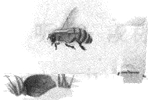
___12____ we have something that no animals have ____13____ words which have the meanings of things, actions, feelings or ideas. We are able to give each other all kinds of different information in words and sentences, ___14____ no other animals can do. No other animals have ___15____ language as we have.
短文改错
此题要求改正所给短文中的错误。对标有题号的每一行作出判断:如无错误,在该行右边横线上画一个勾(√);如有错误(每行只有一个错误),则按下列情况改正:
此行多一个词:把多余的词用斜线(\)划掉,在该行右边横线上写出该词,并也用斜线划掉。
此行缺一个词:在缺词处加一个漏字符号(∧),在该行右边横线上写出该加的词。
此行错一个词:在错的词下划一横线,在该行右边横线上写出改正后的词。
注意:原行没有错的不要改。
When our six children were young,suppertime is always 1.________
being interrupted by neighborhood children ring the bell.2.________
They wanted one child or another to come out and played.3. ________
Finally we had good idea. We hung a sign on the front4. ________
door that was read:“We’re having dinner. Come back5. ________
later.” That night,we sat down to what they thought would6. ________
be a pleasant,uninterrupted meals. But as soon as we7. ________
began dinner,the doorbell rang. On the front door stood a8. ________
five—year—old boy from across the street. He looked up9. ________
at us and said,“I just want to know what the sign say.”10________.
阅读下列短文,掌握其大意,然后从各题所给的四个选项(A、B、C和D)中,选出最佳选项.
Animals and Their LanguagesAnimal, ___1___insects, do not have a language like ___2___. They do not talk to each other in words sentences. But if we watch them, we can see that they do have ways of communicating with ___3___.
Can you see the rabbits' tail? When rabbits see this white tail ____4____ up and down, they run too. They know that there is danger. The rabbit ____5____ them something ____6___ making a sound. It has given them a signal(信号).
Many other animals use this kind of language. When a cobra(眼镜蛇)is angry, it raises its hood(头罩)and makes itself look fierce. This warns other animals. When a bee has found some food, it ___7____ to its home. It cannot tell the other bees where the food is by speaking to them, but it does ___8___ dance in the air. This tells the bees ___9____ the food is.
Some animals say things by making sound. A dog barks(吠), for example, when a stranger comes near. A cat purrs(咕噜咕噜叫)when ___10___. Some birds make several different sounds, each with its own meaning. Sometimes we human beings speak ____11___.
We make sounds like “Oh”or “Ah!” when we are frightened or pleased or when we drop something on our toes.

___12____ we have something that no animals have ____13____ words which have the meanings of things, actions, feelings or ideas. We are able to give each other all kinds of different information in words and sentences, ___14____ no other animals can do. No other animals have ___15____ language as we have.
湖北省互联网违法和不良信息举报平台 | 网上有害信息举报专区 | 电信诈骗举报专区 | 涉历史虚无主义有害信息举报专区 | 涉企侵权举报专区
违法和不良信息举报电话:027-86699610 举报邮箱:58377363@163.com