A. parent B. adult C. teacher D. guide 查看更多


题目列表(包括答案和解析)

The position of children in American family and society is no longer what is used to be. The 36 family in colonial(殖民时期的) North America was mainly concerned with survival and 37 that, its own economic prosperity. Thus, children were 38 in terms of their productivity(生产能力), and they played the role of producer quite early. 39 they fulfilled this role, their position in the family was one of subordination(附属).

With the 40 of the society, the position of children in the family and in the society became more important. In the complex and technological society 41 the United Stated has become, each 42 must fulfill a number of personal and occupational 43 and be in contact with many other member. 44 , viewing children as necessary members of society means that they are 45 more as people in their own right than as those of subordination. This acceplance of children as 46 participants in the family is reflected in various laws 47 the rights of children and in the social and public welfare programs.

This new 48 of children and the frequent contact between the members of society has also 49 an increasing interest in child-raising techniques. People today spend much time 50 the proper way to  51 children.

Nowadays, the socialization of the child in the United States is a 52 transaction(事务) between parent and child 53 a one-way, parent-to-child training 54 . As a consequence, socializing children and 55 with them over a long period of time is for parents a mixture of pleasure, satisfaction, and problems.

36. A. poor      B. ordinary     C. happy       D. wealthy

37. A. except     B. for        C. beyond       D. through

38. A. supported    B. received     C. encouraged     D. valued

39. A. Until      B. After      C. Although      D. When

40. A. movement   B. achievement    C. development     D. requirement

41. A. that      B. where      C. when        D. what

42. A. parent     B. member      C. family       D. relative

43. A. purposes    B. promises     C. roles        D. tasks

44. A. Besides     B. However     C. Instead       D. Therefore

45. A. admired     B. regarded     C. made        D. respected

46. A. willing     B. equal       C. similar       D. common

47. A. enjoying     B. preventing    C. considering      D. protecting

48. A. view      B. faith       C. world        D. study

49. A. led in      B. brought in     C. resulted in      D. taken in

50. A. seeking     B. making      C. fighting       D. working

51. A. nurse      B. praise      C. understand      D. raise

52. A. one-sided    B. many-sided    C. round-way      D. two-way

53. A. more than    B. rather than     C. better than      D. less than

54. A. manner     B. method      C. program       D. guide

55. A. talking      B. living       C. playing        D. discussing

查看答案和解析>>

阅读理解

ISC(HS)Reference No.S006864            New South Wales

Student Date of Birth:19/08/1988   Department of Education and Training

                     International Students Centre

Hong Xue              827-839 George Street PO Box 707

60 Waratah Street                Broadway NSW 21007

Croydon Park NSW 2133       Phone:(612)9217 4801 1300 302 456

                        Fax:(612)9212 6721

                 http://www.tafensw.edu.au/international/

WARNING LETTER

Dear Hong Xue,

  As you are aware, your student visa regulations set out a number of conditions applying to your visa.It has come to our attention that you are failing to meet the following conditions:You must maintain accommodation, support and general welfare arrangements that have been approved by your education provider if you:

  ●have not turned 18; and

  ●are not staying in Australia with:

  -a parent

  -a custodian(监护人); or

  -a relative who has been nominated(指定)by your parent or a custodian, is aged at least 21 and is of good character.

  Note:You must not change those arrangements without the written approval of your education provider.

  You must obey the following rules:

  1.During term time you must:

  a)remain in your homestay during the school term;

  b)come home every night; and

  c)inform your guardian at all times of your whereabouts.

  2.On weekends you must:

  a)have your guardian's permission to stay with friends; and

  b)inform your guardian of the name, address and phone numbers of people you are visiting.

  3.You must return your guardian's telephone calls.

  This will be your only warning.If you continue to breach(违反)your student visa regulations we will report you to the Department of Immigration and Multicultural and Indigenous Affairs.Such action may lead to the cancellation(取消)of your student visa.Please contact me on(612)9217 4801 or fax(612)9212 6721 if you have questions about your enrolment.

                   Yours sincerely

                   Tracey Carlon

                   Student Advisor

                   International Students Centre

NSW Department of Education and Training

(1)

What's the purpose of writing this letter?

[  ]

A.

To remind the recipient of the conditions for applying for a student visa.

B.

To warn the recipient not to do anything against his student visa regulations again.

C.

To tell the recipient how to contact his student advisor.

D.

To inform the recipient of the student visa regulations.

(2)

What can be learned about the recipient from this letter?

[  ]

A.

He is under 18 and studies in Australia with his parents.

B.

He is required to come home every night according to the rules.

C.

He can stay with his friends on weekends if permitted.

D.

His student Visa has been cancelled.

(3)

To which address should the recipient reply if he feels like answering the letter?

[  ]

A.

Hong Xue at 60 Waratah Street, Croydon Park NSW 2133.

B.

Tracey Carlon at the Department of Immigration and Multicultural and Indigenous Affairs.

C.

Hong Xue at NSW Department of Education and Training.

D.

Tracey Carlon at 827-839 George Street, PO Box 707, Broadway NSW 21007.

查看答案和解析>>

阅读理解

  Boss or parent? It’s difficult to tell when Chan Laiwa sits with farmers on her new high-tech farm or migrant workers at building sites, eating, talking and laughing together.

  Inside her company Fu Wah International Group(Hong Kong) the grandmotherly chairwoman with a smile for everyone is called “Boss Mum” for her kindness and affability

  As a leading business figure, she has made the Forbes List of China Rich for the last three years and served on various boards of Chinese philanthropies(慈善事业).

  Fu Wah is a private Hong Kong-registered multinational company established in 1988 involved in real estate development, the hotel business, tourism and electronics.The company’s key business is in Beijing, where fixed assets exceed 5 billion yuan(US$625 million).

  The company is not only like a big family but has been praised by the government for its contributions to society.

  “I should be responsible for everybody around me, ” says Chan, 65, who believes the basic responsibility for an entrepreneur(企业家)is taking care of staff as well as corporate social responsibility.

  As for her own family, Chan is married, with one son, two daughters and grandchildren.After living in Hong Kong, she moved to Beijing and now lives in her Chinese Red Sandalwood Museum.

  “Boss Mom” is low key about her contributions, saying, “It is a natural thing to give money to those most in need.”

  The successful private businesswoman indicates that she does not keep track of how much she spends on philanthropy.

  For more information about Fu Wah, please click here.

(1)

Why can’t we tell whether Chan Laiwa is a boss or a parent?

[  ]

A.

Because she looks ordinary.

B.

Because she is a successful entrepreneur as well as a kind grandmother.

C.

Because she is more a kindly parent than a boss to her staff.

D.

Because she looks like a farmer.

(2)

The underlined word “affability” is the closest in meaning to _________.

[  ]

A.

serious

B.

respectable

C.

admirable

D.

pleasant

(3)

Chan Laiwa is a worthy woman mainly because _________.

[  ]

A.

she is on Forbes List of China Rich for the last three years

B.

she is kindly to her staff as well as her relatives.

C.

she is responsible for her staff as well as social philanthropies

D.

she is the only successful and oldest woman boss in business field.

(4)

The sentence “Boss Mom is low key about her contributions” makes us think that _________.

[  ]

A.

she thinks it a duty to give away money to those in need

B.

she is content with herself by giving money to those in need

C.

she is determined to devote herself to social philanthropies

D.

she thinks that contributions is a key toward success

(5)

This passage is taken from _________.

[  ]

A.

a magazine named China Women?

B.

the “People and Life” column of a newspaper

C.

the magazine named Business World?

D.

E-newspapers

查看答案和解析>>

阅读理解

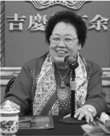
  Boss Mum(China Daily)

  Chan Laiwa, head of Fu Wah

  International Group(Hong

  Kong), gestures at a press

  conference in Beijing in this

  November, 2006 file photo.

  A boss or a parent? It’s difficult to tell when Chan Laiwa sits with farmers on her new high-tech farm or migrant workers at building sites, eating, talking and laughing together.

  Inside her company Fu Wah International Group(Hong Kong)the grandmotherly chairwoman with a smile for everyone is called “Boss Mum” for her kindness and affability

  As a leading business figure, she has made the Forbes List of China Rich for the last three years and served on various boards of Chinese philanthropies(慈善事业).

  Fu Wah is a private Hong Kong-registered multinational company established in 1988 involved in real estate development, the hotel business, tourism and electronics.The company’s key business is in Beijing, where fixed assets exceed 5 billion yuan(US$625 million).

  The company is not only like a big family but has been praised by the government for its contributions to society.

  “I should be responsible for everybody around me,” says Chan, 65, who believes the basic responsibility for an entrepreneur(企业家)and is taking care of staff as well as corporate social responsibility.

  As for her own family, Chan is married, with one son, two daughters and grandchildren.After living in Hong Kong, she moved to Beijing and now lives in her Chinese Red Sandalwood Museum.

  “Boss Mum” is low key about her contributions, saying, “It is a natural thing to give money to those most in need.”

  The successful private businesswoman indicates that she does not keep track of how much she spends on philanthropies.

(1)

Why can’t we tell whether Chan Laiwa is a boss or a parent?

[  ]

A.

Because she looks ordinary.

B.

Because she is a successful entrepreneur as well as a kind grandmother.

C.

Because she is more a kindly parent than a boss to her staff.

D.

Because she looks like a farmer.

(2)

The underlined word “affability” is the closest in meaning to ________.

[  ]

A.

seriousness

B.

respect

C.

admiration

D.

friendliness

(3)

Chan Laiwa is a worthy woman mainly because ________.

[  ]

A.

she is on Forbes List of China Rich for the last three years

B.

she is kindly to her staff as well as her relatives.

C.

she is responsible for her staff as well as social philanthropies

D.

she is the only successful and oldest woman boss in business field.

(4)

The sentence “Boss Mum is low key about her contributions” makes us think that ________.

[  ]

A.

she thinks it a duty to give away money to those in need

B.

she is content with herself by giving money to those in need

C.

she is determined to devote herself to social philanthropies

D.

she thinks that contribution is a key toward success

(5)

This passage is taken from ________.

[  ]

A.

a magazine named China Women

B.

the “People and Life” column of a newspaper

C.

the magazine named Business World

D.

E-newspapers

查看答案和解析>>

完形填空。

阅读下面短文,掌握其大意,然后从每小题所给的四个选项中,选出一个最佳答案。

  Although the Alice Springs School of the Air teachers are located in Alice Springs, none of the school's students 1 there. In fact, most students live 2 three hours drive away.

  The students at this very special school live in 3 areas of central Australia and all do their schoolwork by correspondence(通信). Every day students listen to their teachers giving a lesson by high frequency 4 . Then for the rest of the day they 5 on the lessons their teachers 6 to them by post. Every 7 is supervised(监护) by a tutor, usually a parent.

  A few times a year all the students in the school travel to Alice Springs to 8 school camps and sports days. Once a year children who live in the 9 area go to their nearest town for a week they are taught together in a normal 10 .

1.

[  ]

A.live
B.study
C.work
D.play

2.

[  ]

A.at last
B.at least
C.at most
D.at first

3.

[  ]

A.south
B.north
C.nearby
D.remote

4.

[  ]

A.television
B.radio
C.recorder
D.music

5.

[  ]

A.spend
B.look
C.work
D.insist

6.

[  ]

A.get
B.take
C.send
D.bring

7.

[  ]

A.student
B.teacher
C.girl
D.boy

8.

[  ]

A.join
B.take place
C.take the place of
D.take part in

9.

[  ]

A.same
B.special
C.quiet
D.large

10.

[  ]

A.dining room
B.classroom
C.reading room
D.living room

查看答案和解析>>


同步练习册答案