
题目列表(包括答案和解析)
Listening Comprehension
Directions:
In Section A, you will hear ten short conversations between two speakers.At the end of each conversation, a question will be asked about what was said.The conversation and the question will be spoken only once.After you hear a conversation and the question about it, read the four possible answers on your paper, and decide which one is the best answer to the question you have heard.1.A.At a car shop.
B.In a garage.
C.At a gas station.
D.In a parking lot.
2.A.Guest and receptionist.
B.Passenger and air hostess.
C.Customer and shop assistant.
D.Guest and waitress.
3.A.Writing his term paper.
B.Having a coffee break.
C.Playing computer games.
D.Attending an online school.
4.A.To the bank.
B.To a book store.
C.To a shoe store.
D.To the grocery.
5.A.Touring around.
B.Looking for a job.
C.Visiting a couple.
D.Attending a meeting.
6.A.He's better.
B.He's feeling worse.
C.He's sick in bed.
D.He has recovered.
7.A.He works as a gardener.
B.He is too busy at work to play.
C.He prefers sports to gardening.
D.He lives in the countryside.
8.A.Buy a road map.
B.Drive to the beach.
C.Go back home.
D.Ask the way.
9.A.The film was disappointing.
B.The leading actor was outstanding.
C.The acting was worth seeing.
D.The plot was attractive.
10.A.He is always late for work.
B.He is having some financial problem.
C.He is not careful enough with his work.
D.He loses his temper easily.
Directions:In Section B, you will hear two short passages, and you will be asked three questions on each of the passages.The passages will be read twice, but the questions will be spoken only once.When you hear a question, read the four possible answers on your paper and decide which one would be the best answer to the question you have heard.
Questions 11 through 13 are based on the following passage.
11.A.Her husband had got a higher position.
B.Her husband had lost his job.
C.She wanted to have a cleaner house.
D.She wanted to move to New York.
12.A.His watch went out of order.
B.The buyers had to leave soon.
C.He began to work at 8 a.m.
D.He wanted to give the speaker a surprise.
13.A.Because the husband told a joke.
B.Because they were amazed at the house.
C.Because the woman looked funny.
D.Because they saw something familiar.
Questions 14 through 16 are based on the following passage.
14.A.80 per cent.
B.73 per cent.
C.68 per cent.
D.19 per cent.
15.A.The drivers have little time to do many things.
B.The drivers may risk people's lives by doing this.
C.The drivers can't concentrate on every thing they do.
D.The drivers may break the traffic regulations.
16.A.Young people should not be allowed to multi-task.
B.Americans have no choice but multi-task to save time.
C.people should do no more than drive while driving.
D.People can only multi-task in their homes and offices.
Directions:In Section C, you will hear two longer conversations.The conversations will be read twice.After you hear each conversation, you are required to fill in the numbered blanks with the information you have heard.Write your answers on your answer sheet.
Blanks 17 through 20 are based on the following conversation.

Complete the form.Write ONE WORD for each answer.
Blanks 21 through 24 are based on the following conversation.
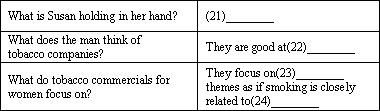
Complete the form.Write NO MORE THAN THREE WORDS for each answer.
Listening Comprehension
Section A Short conversations
Directions:In section A, you will hear ten short conversations between speakers.At the end of each conversation, a question will be asked about what was said.The conversations and the questions will be spoken only once.After you hear a conversation and the question about it, read the four possible answers on your paper, and decide which one is the best answer to the question you have heard.
1.A.10∶00
B.10∶10
C.10∶20
D.10∶30
2.A.A cook.
B.A waitress.
C.An airhostess.
D.A customer.
3.A.On the bus.
B.In the theatre.
C.In the classroom.
D.In a cafeteria.
4.A.It will probably rain this afternoon.
B.She likes to watch the rain come down
C.She will play even if it rains.
D.It has rained a lot lately.
5.A.Stop worrying.
B.Go out more.
C.Talk to a friend.
D.Get counseling.
6.A.She thought it was extremely difficult.
B.She thought it was okay even though she usually dislikes essay exams.
C.She thinks essay exams are boring and especially this one.
D.She thinks she will fail this test.
7.A.She wasn’t able to attend the reception.
B.She is an honor student.
C.She likes flowers very much.
D.She is a teacher.
8.A.Because she has walked a long distance.
B.Because she is tired out.
C.Because she is all wet.
D.Because she is careless.
9.A.Bob has been married for a long time.
B.He plans to go to the wedding.
C.He hasn’t been to California for a long time.
D.The woman should go to California.
10.A.Make the woman another lunch.
B.Get the woman a coffee.
C.Buy the woman a lunch.
D.Help look for the woman’s lunch box.
Section B passages,
Directions:In part B, you will hear two short passages, and you will be asked three questions on each of the passages.The passages will be read twice, but the questions will be spoken only once.When you hear a question, read the four possible answers on your paper and decide which one would be the best answer to the question you have heard.
Questions 11 through 13 are based on the following passage.
11.A.Basic health.
B.Special training.
C.Nothing.
D.Special skill.
12.A.Steadily
B.Gently.
C.As long as possible
D.Fast
13.A.When you have any health worries.
B.When you decide to jog.
C.When you require more information.
D.When you decide to jog alone.
Questions 14 through 16 are based on the following news.
14.A.Her mother doesn’t love her as much as her grandfather did.
B.Her mother was the subject of talks with her grandfather.
C.Her mother will misunderstand her problems.
D.She missed her grandfather.
15.A.Co-workers cannot be your close friends.
B.People will be pleased if you call them at 2∶00 a. m..
C.You can’t discuss your problems with a distant family member.
D.The one you can call at 2∶00 a. m. is someone close to you in spirit.
16.A.Parents should understand their kids.
B.The earth is an inhabited garden if you have close friends.
C.There are many ways to make friends.
D.There is a difference between a lonely desert and an inhabited garden.
Section C longer conversations.
Directions:In part C, you will hear two longer conversations.The conversations will be read twice.After you hear each conversation, you are required to fill in the numbered blanks with the information you have heard.Write your answers on your answer sheet.
Blanks 17 through 20 are based on the following conversation:

Complete the form.Write ONE WORD for each answer.
Blanks 21 through 24 are based on the following conversation:

Complete the form.Write NO MORE THAN THREE WORDS for each blank.
Listening Comprehension
Section A
Directions:In Section A; You will hear ten short conversations between two speakers.At the end of each conversation, a question will be asked about what was said.The conversations and the questions will be spoken only once.After you hear a conversation and the question about it, read the four possible answers on your paper, and decide which one is the best answer to the question you have heard.
1.A.At a train station.
B.At an airport.
C.At a travel agency.
D.At a bus station.
2.A.$5.
B.$10.
C.$15.
D.$50.
3.A.Receptionist and guest.
B.Salesperson and customer.
C.Doctor and patient.
D.Waiter and diner.
4.A.Excited.
B.Dissatisfied.
C.Bored.
D.Exhausted.
5.A.Her hair has changed.
B.She isn’t satisfied with her hair style.
C.She prefers to wear long hair.
D.The man has changed his hair style.
6.A.It is too early to watch the Talent Show.
B.He will go to bed in five minutes.
C.He would rather watch TV than go to bed.
D.He is old enough to stay up.
7.A.She has got everything ready.
B.She never hesitates over what to take.
C.She hates packing by herself.
D.She needs more time for packing.
8.A.They should wait for John for a while.
B.They should stay here for the night.
C.They should start the meeting right away.
D.They should call John at once.
9.A.She is unwilling to move into a new flat.
B.Her neighbors get along well with her.
C.She can’t tell the man why she is moving.
D.Her neighbors usually play their TV loud.
10.A.Ask for directions.
B.Try a different route.
C.Go back for the map.
D.Cancel their trip.
Section B
Directions:In Section B, you will hear two short passages, and you will be asked to questions on each of the passages.The passages will be read twice, but the questions will be spoken only once.When you hear a question, read the four possible answers on your paper and decide which one would be the blest answer to the question you have heard.
Questions 11 through 13 are based on the following passage.
11.A.A political system.
B.Religion.
C.Working language.
D.Race.
12.A.Discuss current issues.
B.Join in a writing competition.
C.Attend an arts and crafts competition.
D.Celebrate their friendship.
13.A.The Commonwealth Games.
B.An important holiday.
C.The Commonwealth members.
D.An international association.
Questions 14 through 16 are based on the following news.
14.A.Equipping students with knowledge.
B.Qualifying students for certain jobs.
C.Developing students’ habits of mind.
D.Helping students to go to graduate school.
15.A.The ability to have critical analysis.
B.Creative use of leisure time.
C.Logical use of information.
D.Willingness to accept uncertainty.
16.A.Goals to reach in a college education.
B.Roles of knowledge in students’ growth.
C.Qualifications needed for a job.
D.Importance of after-class activities.
Section C
Directions:In Section C, you will hear two longer conversations.The conversations will be read twice.After you hear each conversation, you are required to fill in the numbered blanks with the information you have heard.Write your answers on your answer sheet.
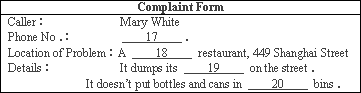
Blanks 17 through 20 are based on the following conversation.
Complete the form.Write ONE WORD for each answer.
Blanks 21 through 24 are based on the following conversation.
Complete the form.Write NO MORE THAN THREE WORDS for each answer.

Listening Comprehension
Section A
Directions:In Part A, you will hear ten short conversations between two speakers.At the end of each conversations, a question will be asked about what was said.The conversation and the question will be spoken only once.After you hear a conversation and the question about it, read the four possible answers in your paper, and decide which one is the best answer to the question you have heard.
1.A.In a drugstore.
B.In a warehouse.
C.In a department store.
D.In a fashion designer's studio
2.A.She's spending time going over her accounts.
B.She's going home for only a few days.
C.She's excited about going home.
D.She's counting the number of vacation days.
3.A.150.
B.135.
C.100.
D.15.
4.A.When he was sixteen.
B.When he was thirty-nine.
C.When he was thirteen.
D.When he was thirty.
5.A.He can't go to the lab this week.
B.He thinks the woman is being unfair.
C.He agrees that the workload is too heavy.
D.He feels the assignment is reasonable.
6.A.The woman asks the man to help her manage her money.
B.The woman helps the man leam to manage his money.
C.The woman pays for the seminar.
D.The woman will go to the seminar with the man.
7.A.It is not his affair.
B.He is too busy to answer her.
C.It has been two weeks since he met Charles last time.
D.He doesn't know Charles well.
8.A.Lawyer and client.
B.Secretary and patient.
C.Shop assistant and customer.
D.Waiter and customer.
9.A.The woman should have some sleep.
B.The woman should get some physical exercise,
C.The woman should finish the report immediately.
D.The woman should concentrate more on the report.
10.A.She finds her handbag missing,
B.She forgets where she put the keys.
C.She can't find her keys.
D.She left her keys in the office.
Section B
Directions:In part B, you will hear two short conversations, and you will be asked three questions on each of the passages.The passage will be read twice, but the question will be spoken only once.When you hear a question, read the four possible answers in your paper and decide which one would be the best answer to the question you have heard.
Questions 11 through 13 are based on the following passage.
11.A.Wu is an award-winning dancer.
B.Wu is an old woman.
C.Wu is a hip-hop dancer.
D.Wu is a collector of awards.
12.A.When her own children were middle-aged.
B.When she was young.
C.When she was 48.
D.When she won several awards.
13.A.The grannies sing all kinds of hip-hop.
B.Hip-hop's rhythms kept their body healthy.
C.People don't like these old hip-hop dancers.
D.They sing songs which are like sunshine and encouragement.
Questions 14 through 16 are based on the following passage.
14.A.Someone set the fire on purpose.
B.The fires killed 10 people on average.
C.Half a million people have to move from their homes.
D.There were 18 fires these years.
15.A.Australia.
B.America.
C.Africa.
D.England.
16.A.Melting mountain glaciers.
B.Droughts.
C.Powerful hurricanes.
D.Wildfires in California
Section C
Directions:In Part C, you will hear two longer conversations.The conversations will be read twice.After you hear each conversation, you are asked to fulfill the task by filling in the numbered blanks with the information you hear.
Blanks 17 through 20 are based on the following conversation.

Complete the form.Write ONE WORD for each answer.
Blanks 21 through 24 are based on the followmg conversation.

Complete the form.Write NO MORE THAN THREE WORDS for each answer.
Listening Comprehension
Section A
Directions:In Section A, you will hear ten short conversations between two speakers.At the end of each conversation, a question will be asked about what was said.The conversations and the questions will be spoken only once.After you hear a conversation and the question about it, read the four possible answers on your paper, and decide which one is the best answer to the question you have heard.
1.A.At 5∶00.
B.At 5∶15.
C.At 5∶30.
D.At 5∶45.
2.A.In Washington.
B.In New York.
C.In Michigan.
D.In Boston.
3.A.He is careful.
B.He is nervous.
C.He is humorous.
D.He is brave.
4.A.He is ready to stay for another cup of coffee.
B.He is unwilling to stay longer for lack of money.
C.He can’t stay longer for lack of time.
D.He doesn’t enjoy the coffee.
5.A.18.
B.38.
C.30.
D.48.
6.A.Look for the pen.
B.Write the letter.
C.Paint the shelf.
D.Fix the shelf.
7.A.She doesn’t like to work with Mr.Clinton at all.
B.She thinks Mr.Clinton is the best person.
C.She thinks she’d better work alone.
D.She’d like Mr.Clinton to work with her at last.
8.A.It will take about one month to repair the camera.
B.It costs too much to have the camera repaired.
C.The camera is no longer worth repairing.
D.He doesn’t have the ability to repair the camera.
9.A.Teacher and student.
B.Nurse and patient.
C.Boss and secretary.
D.Father and daughter.
10.A.Professor Smith is going to speak some other night.
B.He’s never heard of Professor Smith.
C.He didn’t know Professor Smith was speaking tonight.
D.Professor Smith is giving his speech in this room.
Section B
Directions:In Section B, you will hear two short passages, and you will be asked three questions on each of the passages.The passages will be read twice, but the questions will be spoken only once.When you hear a question, read the four possible answers on your paper and decide which one would be the best answer to the question you have heard.
Questions 11 through 13 are based on the following passage.
11.A.A record of the school year.
B.A book that is just for seniors.
C.A book designed specially to print students’ titles.
D.A record of students’ development.
12.A.Students’ photos.
B.Teachers’ photos.
C.Descriptions of students’ academic results.
D.Descriptions of after-school activities.
13.A.All the students and teachers vote.
B.Students sign each other’s yearbooks.
C.Students in a yearbook club choose.
D.Students who are soon graduating vote.
Questions 14 through 16 are based on the following report.
14.A.Chinese.
B.Mathematics.
C.English.
D.Physics.
15.A.Four hours.
B.Seven hours.
C.Eight hours.
D.Nine hours.
16.A.Homework, especially in mathematics, leads to high school students’ lack of sleep.
B.Mathematics is the most difficult subject in high schools.
C.Mathematics courses in China are more difficult than those in the USA.
D.Mathematics is one of the three most important subjects for Chinese students.
Section C
Directions:In Section C, you will hear two longer conversations.The conversations will be read twice.After you hear each conversation, you are required to fill in the numbered blanks with the information you have heard.Write your answers on your answer sheet.
Blanks 17 through 20 are based on the following conversation.
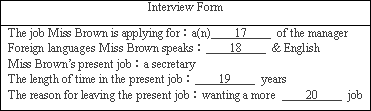
Complete the form.Write ONE WORD for each answer.
Blanks 21 through 24 are based on the following conversation.
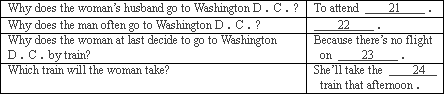
Complete the form.Write NO MORE THAN THREE WORDS for each answer.
湖北省互联网违法和不良信息举报平台 | 网上有害信息举报专区 | 电信诈骗举报专区 | 涉历史虚无主义有害信息举报专区 | 涉企侵权举报专区
违法和不良信息举报电话:027-86699610 举报邮箱:58377363@163.com