
题目列表(包括答案和解析)
Being a senior student, I always think of my future.To be exact, the thoughts of the future have kept me up countless nights and made me worry enough to do poorly on more than one test. Because of this, words of wisdom are a source of comfort. Steve Jobs gave a speech to Stanford’s graduating class in 2005 and his words resound repeatedly in my mind whenever I think about my future.
It was not always like that, though.It started when I became a junior, when college cams into view.It's the first big step to making your life your own.So when Jobs discussed his life as a student, some fears were eased.He also felt the need to attend college to make something of himself.He faced what many are extremely afraid of: uncertainty.His lack of understanding paused him attending college and focus on what he felt was important.His story had a happy ending, of course, since he certainly turned out well.
This does not mean that students should not attend college, but rather that they should not worry so much.You'll get where you need to go, even if your path is a bit more winding than you'd like.
Jobs talked about the hardships in his work.His love of his work helped him carry on and he got where he was meant to be, which restates the point: don’t panic.
One particular part of his speech stayed with me.Steve Jobs quoted the saying "Stay hungry, stay foolish" and it has become my motto.Staying foolish is realizing that you are still a fool, no matter how much you have learned or experienced.There is always more to explore.Staying hungry is wanting to find those things about which you are still uneducated.
Steve Jobs's level of success is attainable, and I aim to prove that.With the will power to go into the world living every day like it and allowing the future to take care of itself, I will do great things.In the last moments of my Site, D! be proud of what I have done and hope to have all the wisdom a person could wish for.
56.The author felt worried when .
A.he had to take tests at school
B.he thought about his future
C.he had lots of sleepless nights
D.he searched for words of wisdom
57.What did the author gain from Jobs’s speech?
A.Courage to drop out of school.
B.Confidence in defeating Jobs.
C.Bravery to face uncertainties.
D.Interest in computer industry.
58.Which of the following suggestions was NOT mentioned in Job’s speech?
A.Having the desire to learn more.
B.Being modest so as to learn more.
C.Staying calm in the face of hardships.
D.Being content with what they know.

听力(共两节,满分30分)
第一节(共5小题;每小题1.5分,满分7.5分)
听下面5段对话。每段对话后有一个小题,从题中所给的A、B、C三个选项中选出最佳选项。听完每段对话后,你都有10秒钟的时间来回答有关小题和阅读下一小题。每段对话仅读一遍。
W:I think it is going to rain.
M:Going to rain?The ground is already wet!
1.What does the man mean?
A.It won’t rain.
B.It is raining.
C.It’s going to rain.
W:What happens in the first part of the film?
M:To tell the truth, I don’t exactly remember because it almost put me to sleep.
2.What does the man think of the film?
A.Frightening.
B.Interesting.
C.Boring.
M:I’d like to have this film developed.
W:Just write down your name and address here please.
M:Oh…, it’s for a friend.I don’t know his address.I guess I’ll have to make a phone call and come back later.
3.What will the man do when he comes back?
A.He will make a telephone call.
B.He will write down his friend’s address.
C.He will get his photos back.
M:Hi, Jane.Long time no see!
W:Hi, George.How are you doing?
M:Not so well.I’ve been working overtime a lot.Besides, I go to night classes, and I’m on my way to school now.
W:That’s terrible!Why don’t you take it easy for a while?
4.What does George need most of all?
A.Having a rest.
B.Going to school.
C.Keeping on working.
W:Tickets, please.
M:We want to catch the eighteen to London.
W:You’ve just missed it!
M:Goodness me!What should we do then?
W:You can come in the afternoon and catch the three sixteen.
5.Where does this dialogue take place?
A.At the cinema.
B.At the police station.
C.At the railway station.
第二节(共15小题;每小题1.5分,满分22.5分)
听下面5段对话或独白。每段对话或独白后有几个小题,从题中所给的A、B、C三个选项中选出最佳选项。听每段对话或独白前,你将有时间阅读各个小题,每小题5秒钟;听完后,各小题将给出5秒钟的作答时间。每段对话或独白读两遍。
听第6段材料,回答第6~8题。
M:I’d like to book a ticket to Los Angeles for next Monday.
W:Just a second.
M:I’ll need a ticket with an open return.
W:TWA has a flight leaving at 9:25.
M:I guess that’s OK.What time should I check in?
W:You have to be there half an hour before it leaves.
6.What does the man want to do?
A.Buy a ticket.
B.Book a ticket.
C.Book a room.
7.When will the man go to Los Angeles?
A.Next Monday.
B.This Monday.
C.Not settled.
8.When should the man check in?
A.9∶25.
B.9∶55.
C.8∶55.
听第7段材料,回答第9~11题。
W:Having visited so many different countries you must be able to speak several different languages.
M:I wish I could, but French and English are the only ones that I have ever learned to speak.
W:Have you ever tried Chinese?
M:Yes, but I gave up halfway.The Chinese characters are too difficult to practise.
W:How about Japanese?
M:I attended class for two or three months, but the more I learned, the more difficult the grammar became.
W:Do you like travelling?
M:No, I don’t, but I have to.I work in the sales department.
W:If only all the countries used the same language, then I would be able to work in different countries.
M:But to tell you the truth, I hope not.As a matter of fact, I am quite interested in language learning.
9.How many languages can the man speak?
A.One.
B.Two.
C.Three.
10.What’s the man’s job?
A.A doctor.
B.A businessman.
C.A teacher.
11.What does the woman wish?
A.She wishes she could speak French.
B.She wishes she could speak Japanese.
C.She wishes there were just one language in the world.
听第8段材料,回答第12~14题。
W:Have you been chased by a dog?
M:No, I haven’t.But by a bull.
W:Really?
M:Yes, a couple of years ago.When I was walking in the country, the field was full of bulls.And I was wearing a bright red coat.They suddenly jumped up and down and started chasing me.
W:What happened then?
M:I just ran for the nearest fence and jumped over it.
W:You’re lucky.But I know a man who was bitten by a dog while he was jogging.
M:How did that happen?
W:He was running past a farm when a sheepdog started barking at him.He tried to kick it out of the way.But the dog jumped up and bit him in the leg.
12.When was the man chased by bulls?
A.A couple of years ago.
B.A couple of months ago.
C.A couple of weeks ago.
13.What was the man doing when he was chased by a dog?
A.He was walking.
B.He was working.
C.He was running.
14.Why did the bulls chase the man?
A.He was wearing a red coat.
B.He ran past a farm.
C.He walked in the country.
听第9段材料,回答第15~17题。
M:Have you ever eaten here before?
W:Only in the evenings.I didn’t know until now that they served breakfast too.
M:That’s what the Carolina Coffee Shop is famous for.People have been coming here for over 60 years for breakfast before going to the university football and basketball games.It’s a tradition.
W:Oh, what’s good here?
M:The best is their French toast.They take some pieces of French bread and dip them in eggs.Then they bake them.It’s delicious.
W:I think I’ll try it.
M:OK.Since this is your first visit to the Carolina Coffee Shop in the morning, I’ll buy you breakfast.
W:Thanks.
15.What time of day is the conversation taking place?
A.In the morning.
B.In the afternoon.
C.In the evening.
16.What does the man suggest the woman have?
A.French bread.
B.French toast.
C.French eggs.
17.Who will pay the breakfast?
A.The man.
B.The woman.
C.It will be free.
听第10段材料,回答第18~20题。
“We are not training future poets.”said a school’s headmaster.“We just hope the class makes students more creative.”The class has 56 poem-loving students in it.They get half a day’s teaching every week from Zhu Tiewu, a poet from the Shanghai City Poets Group.Zhu has a three-term teaching plan for the class.He will ask them to study many poems in the first two terms.They will only get to write poems in the final term.Students will study both old and new poems.These will come from both China and foreign countries.But are students interested in poems today?Yes.According to a study of 90 students at the school, about half of them read poems and about a third want to be poets.They are learning about poems not because they want to be poets, but because poems teach them a lot about life.
18.What’s the purpose of teaching poems to students in this school?
A.To train them into future poets.
B.To make the class more lively.
C.To make the students more creative.
19.What’s Mr.Zhu’s three-term teaching plan for the class?
A.He will ask them to study poems in the first two terms and then get to write.
B.He will ask them to study Chinese poems for two terms and then to study foreign poems.
C.He will ask them to study poems in the first term and then write in the following terms.
20.How many students in this school want to be poets?
A.About 1/2.
B.About 1/3.
C.About 1/4.
Part I Listening Comprehension(30 marks)
Section A(22.5 marks)
Directions:In this section, you'll hear six conversations between two speakers.For each conversation, there are several questions, and each question is followed by three choices marked A, B and C.Listen carefully and then choose the best answer for each question.You will hear each conversation TWICE.
Conversation 1
1.How long does the woman need to work every day?
A.Three hours.
B.Four hours.
C.Five hours.
2.How much can the woman earn each day?
A.5 dollars.
B.10 dollars.
C.20 dollars.
Conversation 1
M:Do you have any work experience?
W:No, I’ve never worked in a restaurant before.
M:Do you think you can get along will with customers?
W:Yes, I think so.
M:Can you make sure to be here from four to eight in the afternoon?
W:Yes, I'm always on time.
M:Then you can start tomorrow.Monday through Friday.Five dollars an hour.
W:That's fine.
Conversation 2
3.What's the possible relationship between the speakers?
A.Boss and employee.
B.Mother and son.
C.Teacher and student.
4.When will the man come back?
A.This Monday.
B.This Wednesday.
C.This Friday.
Conversation 2
M:Mrs.Sharon, I say…, I have to …
W:What's the matter, Richard?
M:Er, I'd like to take two days off.My mother's ill.I need to stay with her.
W:I'm sorry to hear that.You mean you will be back here this Wednesday?
M:Yes, I hope I can come back earlier.
W:That's all right.By the way, don't worry about your lessons.I'll certainly help you with them.
Conversation 3
5.What can we know about Nancy and Steve?
A.They will divorce soon.
B.They have two daughters.
C.They divorced last year.
6.Who will help Nancy out in the woman's opinion?
A.Her daughter.
B.Her parents.
C.Her friends.
Conversation 3
M:Kate, Nancy and Steve are breaking up.
W:It's really a shame.I’ve heard that they quarrel, but they’ve always made up afterward.
M:Things are not working out this time.They are getting a separation soon.
W:What will happen to their daughter, Bonnie?
M:Nancy is going to take her.
W:The cost of living is so high.It will be difficult for her to take te responsibility.
M:She seems to have made up her mind.She said she would rather be a single parent than cope with an unhappy marriage.
W:Well, I hope her parents will be able to help her out.
Conversation 4
7.How often does the woman pay the tax?
A.Once a month.
B.Twice a year.
C.Once a year.
8.Why does the woman have to pay more taxes?
A.The government has raised the tax rate.
B.She didn't pay taxes last year.
C.She has got extra money.
9.What can we know about the woman?
A.She is an accountant.
B.She taught in a night school.
C.She lives upon a small income.
Conversation 4
W:Henry, our income tax is due soon.Did you call our accountant?
M:He's figuring out our taxes right now.I gave him all the records on our income and expenses last week.
W:The government has taken away taxes from our paychecks all year.I hope we get some of that money back or at least that we won't have to pay more.
M:Remember the money your aunt left us when she died, and the money you made when you taught in a night school?
W:Yes.
M:Well, that's all taxable income.That money has put us in a higher tax bracket.
W:What does that mean?
M:It means we have to pay more taxes.
W:Well, it looks like we'll have to make more money this year just to pay last year's taxes.
Conversation 5
10.What can we know about the kid from Haiti?
A.He doesn't get on well at school.
B.He is often late for school.
C.He doesn't speak much English.
11.How many countries are mentioned in the conversation?
A.Six.
B.Five.
C.Four.
12.How does the woman help the immigrant kids?
A.She has spent much time with them after class.
B.She gives them more lessons than other kids.
C.She pays more attention to them at class.
Conversation 5
M:Kate, how's the new student in your class doing?
W:The kid from Haiti? He's having a rough time communicating since he doesn't speak much English.However, the other kids seem to involve him pretty well.
M:Our students are used to new kids who don't speak much English since we have had so many new immigrant families moving into our school district.
W:Don't I know it! This year I have had a Vietnamese, an Ethiopian, a Cuban and the kid from Haiti in my class.I spend a lot of time with them after class so that they can catch up.
M:It must have been hard for you since you have to give them special attention in order to help them.
W:It has been.Nevertheless, it's really rewarding to see them progress and make friends.
Conversation 6
13.When will the speakers have the exams?
A.In one week.
B.In two weeks.
C.In three weeks.
14.What will the woman do this summer?
A.Teach English.
B.Find a job.
C.Study Chinese.
15.How did the man learn Chinese?
A.By speaking.
B.By reading.
C.By listening.
Conversation 6
M:Well, Jenny.The school year is almost over.We just have two weeks before exams.What are you going to do this summer?
W:I'm going to teach English to some immigrants in the university's community service program.
M:That sounds interesting.Don't you need to speak a foreign language for the job?
W:No.You just have to present the language simply and give the students a chance to practice speaking.
M:But that's the way I was taught to speak Chinese.But speaking Chinese didn't help me learn to read and write Chinese.
W:My students don't want to read and write English.They are more interested in speaking.
M:You sound very knowledgeable about all this.How do you know so much?
W:I took teaching English as a second language course last year when you were in China.I’ve also talked with the program administrators quite a lot.I think I would like to be an ESL teacher when I graduate.
SECTION B
Directions:In this section, you'll hear a mini-talk.Listen carefully and then fill in numbered blanks with the information you’ve got.Fill each blank with NO MORE THAN 3 WORDS.
You'll hear the mini-talk TWICE.
About friendship
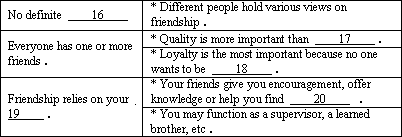
Section B
We often say, “A friend in need is a friend indeed.” But what is the exact meaning of friendship? No one can really offer a definite concept, because different people hold various views on friendship.
Everyone has his own friendship and some have a lot of friends.But in fact, quantity is not so important as quality.Loyalty is the most important for friendship.No one wants to make friends with those who will betray them.
No matter whether you are married or not, no matter where you live and work, your friends are your friends.It is not based on bloodline.It relies on your intention.To you, some friends are fun-loving, some give encouragement, some offer knowledge, and others help you to find your own identity.Before your friends, you may act as a supervisor, a learned brother, a lovely child, a gentleman or a playmate.In a word, friendship helps you to be a full person.So friendship can benefit.
Keys:
Listening Comprehension
Section A
Conversation 1
1.What's wrong with the man?
A.He took the wrong direction.
B.He lost his way.
C.He missed the bus.
2.Which bus should the man take?
A.No.30.
B.No.2.
C.No.13.
Conversation 1
M:Excuse me.I'm going to the National Museum.Which stop should I get off at?
W:I'm afraid you're going in the wrong direction.This No.30 bus is bound for the airport.You should have caught a bus on the opposite side of the road.
M:Then which bus should I change to? Should I take bus No.2?
W:No.Just get off at the next stop, cross the road and take No.13 in the opposite direction.
Conversation 2
3.What can't the man believe?
A.That he hurt his arm.
B.That his team missed the goal.
C.That his team lost the game.
4.What's the man's attitude towards his team?
A.Confident.
B.Disappointed.
C.Surprised.
Conversation 2
W:I heard you hurt your arm in the football match last weekend.Are you OK?
M:It's nothing serious.I just can't believe that we lost to Class 2.After we scored the goal, we had a good chance to win, but we lost the game.
W:Don't take it so hard.Failure always makes us try harder next time.
M:You're right.I am confident that we will beat them next time.
Conversation 3
5.What time is it now?
A.5∶45
B.5∶55
C.7∶55
6.Where will the speakers probably go first?
A.A cinema.
B.A shopping center.
C.A restaurant.
Conversation 3
M:How about seeing a movie tonight, Helen?
W:That sounds great.I haven't been to a movie for quite a long time.
M:OK.Let me see.The movie starts at 7∶55.We still have two hours and ten minutes.Why don't we go out and have a quick dinner near the cinema?
W:Fine, but I have to stop at the shopping center first.
Conversation 4
7.What does the woman complain about?
A.The bill is not clear enough.
B.The bill is sent to a wrong address.
C.The bill she received is wrong.
8.Why do the mistakes occur?
A.The man is careless.
B.The old computer doesn't work well.
C.The man doesn't use the computer correctly.
9.What does the man promise to do finally?
A.Get a new computer.
B.No such mistake will happen again.
C.Send the presents to the woman.
Conversation 4
W:I'm afraid I have a complaint to make.
M:Please take a seat and tell me what is the matter.
W:I'm sorry to say that the bill you sent me is not right.
M:Not right, madam? That's strange.
W:Yes, I know.What's more, this isn't the first time.
M:Really? That's hard to believe.
W:It has happened five or six times in the past three months.
M:Well, I must apologize, madam.Maybe it's the old computer.
W:Well, don't you think it's about time you got it working properly? It's caused me a lot of inconvenience.
M:I agree entirely.I promise it won't happen again.
Conversation 5
10.Where does the conversation take place?
A.At home.
B.In a factory.
C.In a store.
11.What is the man so nervous?
A.He's been waiting for the call for a long time.
B.He's failed to answer the phone several times.
C.He's missed an important phone call.
12.What's the call about?
A.The man's company.
B.The man's new work.
C.The man's music.
Conversation 5
M:Linda, could you please turn down the music a little more?
W:OK.What's the matter?
M:Well, I'm expecting an important phone call, which has something to do with my new work.
W:You mean you've found a new job?
M:Yes, it's with a big company, so I don't want to miss the opportunity.
W:Don't worry.You'll be fine.
M:Was that the telephone?
W:I didn't hear anything.
M:I thought I heard it ring two or three times.
W:Sometimes when the windows are open you can hear the neighbor's phone ringing.
M:I've been waiting so long now.It's making me quite nervous.
W:Well, why not go outdoors to calm down and do what you want to do outside? I'll call you if the phone rings.
M:Thanks a lot.
Conversation 6
13.What's the man's reaction to his trip?
A.Optimistic.
B.Excited.
C.Nervous.
14.What will the man do when he checks in?
A.Examine his hand luggage.
B.Bring a boarding pass with his seat number.
C.Show his ticket and passport.
15.When should the man pay the departure tax?
A.When he checks in.
B.When he buys the ticket.
C.When he boards the plane.
Conversation 6
W:Mr.Jones, are you ready for the trip?
M:Oh, yes.I'm really excited about it, but could you tell me what I have to do at the airport? I've never flown before in my life.
W:I see.Now, as you enter, on your left you'll see a lot of check-in desks.You should go to your airline desk, okay? Actually that's very close to the entrance.
M:You mean as soon as I enter the airport, I will see the airline desk?
W:That's right.Once you are at the airline desk, show your ticket and passport to the clerk and place your luggage on the scales.
M:Is there any limit of my luggage?
W:Yes.Try not to have more than 25 kilograms altogether.Oh…and don't check in your hand luggage, as you'll bring it along with you on the plane.
M:Well.What should I do after checking in my hand luggage?
W:Then, the clerk will give you a boarding pass with your seat number printed on it.
M:A friend of mine told me something about a departure tax.What's that? Have I paid for it?
W:Don't worry.It's included in the price of your ticket.
M:Oh, thank you.
Section B
There are two types of people in the world.Although they have equal degrees of health and wealth and the other comforts of life, one becomes happy, the other becomes unhappy.This arises from the different ways in which they consider things, persons, and events, and the resulting effects upon their minds.
The people who are to be happy fix their attention on the conveniences of things, the pleasant parts of conversation, the well-prepared dishes, the goodness of the wines, and the fine weather.They enjoy all the cheerful and positive things.They are in good spirits all the time.People like to make friends with them and are happy when they are successful.It can make you popular among your classmates and strengthen the relationship with others.
Those who are to be unhappy always think and speak the negative things.So they are continually discontented.Those people tend to criticize and offend others, which makes themselves disagreeable everywhere.No one loves them and treats them as their friends.No one shows respect to them, either.They should change this bad habit, or they would not live a happier life.

听力测试
听下面5段材料。每段材料后有几个小题,从题中所给的A、B、C三个选项中选出最佳选项。听每段材料前,你将有时间阅读各个小题,每小题5秒钟;听完后,各个小题将给出5秒钟的作答时间。每段材料读两遍。
听第1段材料,回答第1~3题。
W:Don’t you have any good news?
M:No.Yesterday, I had to stay after school, because I was talking during my biology teacher’s class.
W:You’d better keep quiet during class.
M:Sometimes I do.The day before yesterday, I was very quiet during my history teacher’s class and I still had to stay after class.
W:I don’t understand.
M:Because I fell asleep during his class, but it wasn’t my fault.The lesson was very dull.
W:I advise you to take school more seriously.If you don’t pass your exam, you’ll have to go out and work as a result.
M:I don’t see that it makes much difference.If I have a job, I have to do dull work every day, but if I’m in school I must listen to dull teachers every day.
1.What is the possible relationship between the man and woman?
A.Good friends.
B.Mother and son.
C.Teacher and student.
2.What did the boy often do at school?
A.He was often late for school.
B.He often fell asleep in class.
C.He often stayed after class.
3.Which of the following statements is true?
A.The boy prefers to go out and work.
B.The boy has neither interest in school nor in work.
C.The boy is discouraged because he hasn’t passed the exam.
听第2段材料,回答第4~6题。
M:How long have you been studying English?
W:For about six years.I started when I was ten.My teacher was from America.He was a very good teacher.I enjoyed studying English with him.
M:Are you still studying English?
W:Yes, I go to an evening school now.
M:How often do you have classes?
W:Twice a week usually.
M:Do you find English difficult?
W:Yes, it’s rather difficult, I think.Do I make many mistakes?
M:No, your English is very good.Do you often listen to the radio?
W:Yes, I listen to the radio every night.
M:Do you enjoy reading English books?
W:Yes, I read a lot of English books.But I prefer conversation.I like talking to foreigners.
4.How old is the girl?
A.Fifteen.
B.Sixteen.
C.Seventeen.
5.What does the woman think of the study of English?
A.Interesting.
B.Easy.
C.Hard.
6.What did the woman enjoy most?
A.Listening.
B.Writing.
C.Talking.
听第3段材料,回答第7~9题。
M:You look worried.Is anything the matter?
W:It’s my son.He hasn’t come home yet.I can’t understand him being so late.
M:Where’s he gone?
W:To visit a friend.I didn’t want him to go.I don’t like him going out at night.
M:Well, it isn’t very late.
W:It’s nine o’clock.I expected him to be back about eight.And it’s already dark.
M:Well…
W:I can just imagine him losing his way.Or falling off his bicycle.
M:Er…how old is your son?
W:Thirty-five.
7.Why does the woman look worried?
A.Her son has lost his way.
B.Her son hasn’t come back yet.
C.Her son has gone out at night.
8.Where has her son gone?
A.To school.
B.For a ride.
C.To visit a friend.
9.What do you think has happened to the woman’s son?
A.He has got lost.
B.He has fallen off his bicycle.
C.We don’t know.
听第4段材料,回答第10~12题。
W:We’re thinking about putting on a show this spring.
M:Do you think you’ll be able to make some money?
W:Oh, no, we just want to do it for the fun of it.You know there are a lot of us who like to get up a stage and perform.
M:What kind of show?
W:A musical play.
M:Have you decided who to do it?
W:We have three in mind, and of course we’ve been thinking about you.
M:Me? Why me?
W:You sing, don’t you? Everyone says you have a wonderful voice.
M:Well, I have sung a little, but I’ve never really appeared on a stage.
W:I thought you sang in church every Sunday.
M:That’s different.There are so many others singing too.
W:Then here’s your chance to find out how good you are.And not just to sing but to act and dance too.
M:Oh, it might be exciting.
10.What will they put on a show for?
A.For money.
B.For fun.
C.For others.
11.What can we conclude from the dialogue?
A.They want to put on three shows in all.
B.Three people will appear in the play.
C.They will sing three songs in the play.
12.What can we learn about the man?
A.He’ll sing and dance in the show.
B.He often gets up a stage.
C.He sings pop songs for money.
听第5段材料,回答第13~15题。
Now back to the news.
Ten people died yesterday morning when a boat sank off the Gold Sand Coast.Eight were able to swim to the shore and were saved by the coast guard.The boat was on its way to Beill Island.
Police are looking for a man and a woman in their early twenties who broke into a bank in the early hours this morning.This was reported by people working in the shop opposite who heard the breaking of glass.Two people were seen running away.The man is said to be very well-built, with dark hair which is very long.The woman with him is said to be small with short hair cut very close to her head.She was wearing blue trousers and a brown jacket.Anyone who has any information please gives further details to the police.
13.What were the eight people doing after the boat sank?
A.Saving the others.
B.Swimming to the shore.
C.Helping the captain.
14.When did the robbers break into the bank?
A.In the afternoon.
B.At midnight.
C.Early in the morning.
15.What was said about the man?
A.Tall and strong.
B.Strong with long hair.
C.Fat and well built.
湖北省互联网违法和不良信息举报平台 | 网上有害信息举报专区 | 电信诈骗举报专区 | 涉历史虚无主义有害信息举报专区 | 涉企侵权举报专区
违法和不良信息举报电话:027-86699610 举报邮箱:58377363@163.com