
题目列表(包括答案和解析)
Elizabeth and I are 18 now, and about to graduate.I think about our elementary-school friendship, but some memories have blurred (模糊).What happened that day in the fifth grade when Beth suddenly stopped speaking to me? Does she know that I've been thinking about her for seven years? If only we could go back, and discover what ended our relationship.
I have to speak with Beth.I see her sometimes, and find out school is "fine".It's not the same.It never will be.Someone says that she's Liz now.What happened to Beth?
I can't call her.Should I write? What if she doesn't answer me? How will I know what she's thinking?
Yes, I'll write her a letter.These things are easier to express in writing." Be-," no, " Li-," no, " Elizabeth," I begin.The words flow freely, as seven year old memories are reborn.I ask her all the questions that have been left unanswered in my mind, and pray she will answer.I seal my thoughts in the perfect white envelope, and imagine Beth looking into her mailbox.Will she know why I'm writing? Maybe she once thought of writing the same letter.
As the mailman takes my envelope from me forever, I wonder if I've made the right decision.Do I have the right to force myself into Beth's life again? Am I simply part of the past? I have taken the first step.Beth has control of the situation now.
One day has passed.Are my words lying on the bottom of the post office floor?
Two days are gone.I'm lost in thought and don't even hear the phone ting.
"Hello? It's Elizabeth."
1.What can we learn about Beth?
A.She had a quarrel with the author in the fifth grade.
B.She moved to another school in the fifth grade.
C.She is now called Liz instead of Beth.
D.She hasn't seen the author for seven years.
2.Why does the author decide to write a letter instead of calling?
A.She is sure that Beth will not answer.
B.She's afraid that they'll quarrel on the phone.
C.She doesn't know Beth's telephone number.
D.It is easier to express her feelings in writing.
3.Which of the following the author might NOT mention in her letter?
A.Their elementary-school friendship.
B.Her future plan after graduation.
C.Her expectations for Beth's reply.
D.The questions about the endings of their friendship.
4.What might happen at the end of the story?
A.Beth answers her letter two days later.
B.The letter doesn't reach Beth at all.
C.They make up their friendship.
D.Beth refuses to make peace with her.
Elizabeth and I are 18 now, and about to graduate.I think about our elementary-school friendship, but some memories have blurred (模糊).What happened that day in the fifth grade when Beth suddenly stopped speaking to me? Does she know that I've been thinking about her for seven years? If only we could go back, and discover what ended our relationship.
I have to speak with Beth.I see her sometimes, and find out school is "fine".It's not the same.It never will be.Someone says that she's Liz now.What happened to Beth?
I can't call her.Should I write? What if she doesn't answer me? How will I know what she's thinking?
Yes, I'll write her a letter.These things are easier to express in writing." Be-," no, " Li-," no, " Elizabeth," I begin.The words flow freely, as seven year old memories are reborn.I ask her all the questions that have been left unanswered in my mind, and pray she will answer.I seal my thoughts in the perfect white envelope, and imagine Beth looking into her mailbox.W ill she know why I'm writing? Maybe she once thought of writing the same letter.
As the mailman takes my envelope from me forever, I wo nder if I've made the right decision.Do I have the right to force myself into Beth's life again? Am I simply part of the past? I have taken the first step.Beth has control of the situation now.
One day has passed.Are my words lying on the bottom of the post office floor?
Two days are gone.I'm lost in thought and don't even hear the phone ting.
"Hello? It's Elizabeth."
【小题1】What can we learn about Beth?
| A.She had a quarrel with the author in the fifth grade. |
| B.She moved to another school in the fifth grade. |
| C.She is now called Liz instead of Beth. |
| D.She hasn't seen the author for seven years. |
| A.She is sure that Beth will not answer. |
| B.She's afraid that they'll quarrel on the phone. |
| C.She doesn't know Beth's telephone number. |
| D.It is easier to express her feelings in writing. |
| A.Their elementary-school friendship. |
| B.Her future plan after graduation. |
| C.Her expectations for Beth's reply. |
| D.The questions about the endings of their friendship. |
| A.Beth answers her letter two days later. |
| B.The letter doesn't reach Beth at all. |
| C.They make up their friendship. |
| D.Beth refuses to make peace with her. |
Nursing at Beth Israel Hospital produces the best patient care. If we are to solve the nursing shortage. hospital administration and doctors everywhere would do well to follow Beth Israel's example .
At Beth Israel each patient is assigned to a primary nurse who visits at length with the patient and constructs a full-scale health account that covers everything from his medical history to his emotional state. Then she writes a care plan centered on the patient's illness but which also includes everything else that is necessary.
The primary nurse stays with the patient through his hospitalization. keeping track with his progress and seeking further advice from his doctor. If a patient at Beth Israel is not responding to treatment. it is not uncommon for his nurse to propose another approach to his doctor. What the doctor at Beth Israel has in the primary nurse is a true colleague.
Nursing at Beth Israel also involves a decentralized (分散的) nursing administration; every unit is a self-contained organization. There are nurse-managers instead of head nurses; in addition to their medical duties they do all their own hiring and dismissing, employee advising, and they make salary recommendations. Each unit's nurses decide among themselves who will work what shifts and when.
Beth Israel's nurse-in-chief ranks as an equal with other vice presidents of the hospital. She is also a member of the Medical Executive Committee. which in most hospitals includes only doctors.
1.Which of the following best characterizes the main feature of the nursing system at Beth Israel Hospital?
A. The doctor gets more active professional support from the primary nurse.
B. Each patient is taken care of by a primary nurse day and night.
C. The primary nurse writes care plans for every patient.
D. The primary nurse keeps records of the patient's health conditions every day.
2.It can be inferred from the passage that_____.
A. compared with other hospitals, nurses at Beth Israel Hospital are more patient
B. in most hospitals, patient care is inadequate from the professional point of view
C. in most hospital, nurses get low salaries
D. compared with other hospitals, nurses have to work longer hours at Beth Israel Hospital
3.A primary nurse can propose a different approach of treatment when
A. the present one is refused by the patient
B. the patient complains about the present one
C. the present one proves to be ineffective
D. the patient is found unwilling to cooperate
4.The main difference between a nurse-manager and a head nurse is that the former
A. is a member of the Medical Executive Committee of the hospital
B. has to arrange the work shifts of the unit's nurses
C. can make decisions concerning the medical treatment of a patient
D. has full responsibility in the administration of the unit's nurses
5.The author's attitude towards the nurse system at Beth Israel Hospital is___
A. negative B. neutral C. critical D. positive
How do you feel about watching other people work?
 Nothing is more refreshing on a warm summer day than watching someone else work.
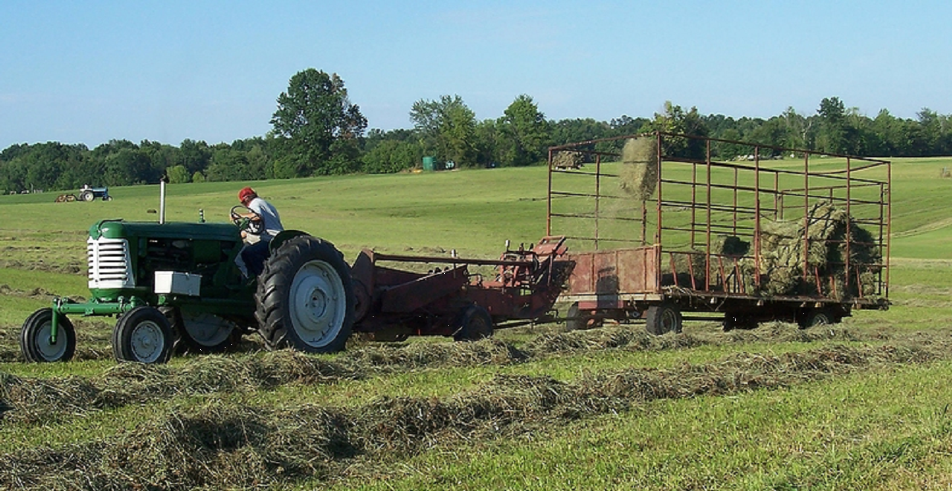
Right now, I’m sitting on my porch and watching young Beth baling(打捆)the big field on top of the hill. She’s been haying that field for over ten years. I know: I put her on the tractor when she was just twelve years old.
She picked a great day for baling. It’s not too hot, and there’s a nice breeze. On Monday, when she cut the field, it was so hot I thought the corn would start popping in the field. Didn’t stop her, though. She just stuck that big hat on her head, wrapped a wet handkerchief around her neck, and set to work. I remember when I would have done the same thing.
While I’m here sucking a lemonade, Beth is driving the “hay(干草) train,” a tractor pulling a baler and an old wagon. You’d think someone her size would never be able to see over the tractor. But somehow she manages. When she’s finished, her tracks are very straight.
The whole time she’s haying, that dog of hers is working just as hard, running along beside her like he’s afraid she’ll drive away without him. Beth sure knew what she was doing when she trained him.
The way the machine works is pure poetry. Each row is pushed into shape. When just enough hay is in a bale, it is wrapped up and fastened together. A second or so later, the bale comes flying out and into the old wagon. The person who invented that machine sure was some kind of genius.
That’s not to say it works perfectly. Every once in a while a bale misses the mark, especially when you are turning the machine at the end of a row. That means, of course, that you have to go back and pick up those bales and throw them into the wagon.
I can remember when Beth’s mother was her age. She looked an awful lot like Beth does now. Makes a man proud to see his daughter and granddaughter taking such good care of themselves.
Well, I suppose I should get up and fill this glass again. Not much fun sitting here with an empty glass.
56. We can learn from the passage that at some time in the past the author ______.
A. bought the tractor for Beth B. forced Beth to work at an early age
C. worked in the field like Beth D. trained the dog to help Beth work
57. In the eyes of the author, the sight of Beth baling hay is _______.
A. uncommon B. beautiful C. unforgettable D. changeable
58. Before thrown into the wagon, the hay must be _______.
A. tied up B. dried up C. cut up D. lined up
59. Who do you think is telling this story?
A. Beth’s mother. B. Beth’s father. C. Beth’s grandmother. D. Beth’s grandfather.
湖北省互联网违法和不良信息举报平台 | 网上有害信息举报专区 | 电信诈骗举报专区 | 涉历史虚无主义有害信息举报专区 | 涉企侵权举报专区
违法和不良信息举报电话:027-86699610 举报邮箱:58377363@163.com