
题目列表(包括答案和解析)
第一节:听独白或对话(共5小题;每小题1.5分,满分22.5分)
听下面5段对话或独白。每段对话或独白后有几个小题,从题中所给的A、B、C三个选项中选出最佳选项,并标在试卷的相应位置,听每段对话或独白前,你将有时间阅读各个小题,每小题5秒钟;听完后,各小题将给出5秒钟的作答时间。每段对话或独白读两遍。
听第1段对话,回答第1-3题。
1.Where does Jane ask Tom to meet her at first?
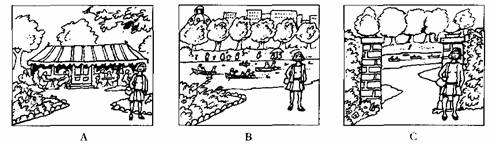
2.When and where do they agree to meet finally?
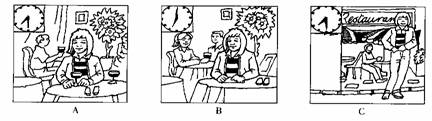
3.What does Jane have to do before going out to meet Tom?
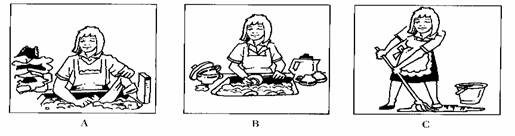
听第2段对话,回答第4-6题。
4.According to Peter, what is the problem with the building?
A. The air-conditioning is too strong.
B. The air-conditioning is out of order.
C. The air-conditioning stops working sometimes.
5.Why did Peter miss the breakfast yesterday morning?
A. He overslept.
B. He couldn't fall asleep the night before.
C. He talked with his roommates late into the night.
6.How many students will be staying in this room?
A. Two. B. Three. C. Four.
听第3段对话,回答第7-9题。
7.Which subject (s) does David find particularly difficult?
A. Math. B. English. C. The sciences.
8.What does David do to help his uncle with the cows?
A. He milks the cows on Sundays and cleans the cowshed sometimes.
B. He drives the tractor on Sundays and does the milking sometimes.
C. He cleans the cowshed on Sundays and drives the tractor sometimes.
9.What is David going to do now?
A. He is going to work on his own farm.
B. He is preparing to attend an agricultural college.
C. He is going to study hard to pass the exams.
听第4段对话,回答第10-12题。
10.What is the probable relation between the man and woman?
A. A research student and a stranger.
B. A social worker and a businessman.
C. A businessman and a research student.
11.What made the woman begin to smoke at the age of 17?
A. Her boyfriend offered her a cigarette.
B. She often went to parties with her friends.
C. She wanted to follow her friends’ example.
12.What was the result of the woman's first attempt to stop smoking?
A. She stopped smoking for a while.
B. She managed to give up smoking completely.
C. She began to smoke fewer cigarettes than before.
听第5段对话,回答第13-15题。
13.What do the students come to the school for?
A. Visiting the school.
B. Attending summer courses.
C. A sightseeing tour of the area.
14.How long has the school been open?
A. Twenty years. B. Five years. C. Twenty-five years.
15.What could the students do in the study center if they were out late the night before?
A. Talk to the teachers. B. Use the equipment. C. Do the homework.
第二节:听取信息(共5小题;每小题1.5分,满分7.5分)
听下面1段对话。请根据题目要求,从所听到的内容中获取必要的信息,填入答题卡 标号为16—20的空格中。听录音前,你将有10秒钟的阅题时间,录音读两遍。你有80秒钟的作答时间。
|
Caller information |
|
|
Name of caller |
John Smith |
|
Where to go |
London |
|
When to go |
(16.) |
|
What to do there |
(17.) |
|
How long to stay |
A week or so |
|
Ticket information |
||||
|
Class |
Airline |
Price |
When to leave |
When to arrive |
|
Economy |
(18.) |
RMB 5600 |
7:40 a.m. |
In the morning |
|
Pacific Airline |
(19.) |
11:40 a.m. |
(20.) |
Medalists of the 1948 London Olympic Games look back on their summer of victory.
SAMMY Lee, 91, U.S.
GOLD AND BRONZE, DIVING
I first had my Olympic dream at 12, when they held the 1932 Olympics in Los Angeles. My father and I were at a grocery store, and I asked, “What are all the flags doing here?” He said, “We are having the Olympic Games. That’s where they honor the greatest athletes in the world.” I said, “Papa, someday I’m going to be an Olympic champ.”
Walking up the 10-meter platform, I thought to myself, “I’ve waited 16 years for this moment. Am I going to win?” So I prayed to God that I was most deserving of winning the Games.
DAVID BOND, 90, BRITAIN
GOLD, SAILING
During the war, I spent six years in Royal Air Force. I think in general, the 1948 Olympics meant very little to most people. We were too busy after the war to be worried about sport very much anyway.
Our team had about six weeks before the Olympics down at Torquay and we went out sailing every day.
Winning gold was quite something. It was nice to stand on the platform with lots of people cheering. We celebrated by going to a big dance.
MICHAEL LAPAGE, 88, BRITAIN
SILVER, ROWING
I started rowing when I was 14. I joined the navy in 1942. In 1945 the war came to an end and I started rowing again.
In 1948 we were still on rations (配给供应): 4 oz. of red meat a week. But the United States had all the meat they wanted. They were the favorites to win.
On the day of the final, we led the Americans at the start, but their stronger staying power took them through to win. There were no ribbons on the medals, so we just showed them round the family.
THOMAS GODWIN, 91, BRITAIN
BRONZE, CYCLING
At 14 I left school and got a job delivering groceries on a bicycle, which excited my interest in cycling. When the war broke out, I volunteered but was held back, so I continued riding.
After my team won our bronze medals, we went home just round the corner and had a sit-down and a chat and a laugh. It was a different world. Money was never, never thought about.
【小题1】 According to the passage, Sammy Lee ___________.
| A.was 28 when he attended the 1948 Olympics |
| B.never thought he could win medals in diving |
| C.found that he has a talent for sports at age 12 |
| D.prepared for the 1948 Olympics for 16 years |
| A.weak will | B.poor skill |
| C.poor nutrition | D.hurried preparation |
| A.They both took part in a team event. |
| B.A lot of money was awarded to them. |
| C.The 1948 Olympics meant little to them. |
| D.They both served in the army during World War II. |
| A.Long-lived medalists | B.The 1948 Olympics |
| C.Famous athletes | D.Great in 1948 |
When Paul was a boy growing up in Utah, he happened to live near a copper smelter(炼铜厂),and the chemicals that poured out had made a wasteland out of what used to be a beautiful forest.One day a young visitor looked at this wasteland and called it an awful area.Paul knocked him down.From then on, something happened inside him.
Years later Paul was back in the area, and he went to the smelter office.He asked if they had any plans or if they would let him try to bring the trees back.The answer from that big industry was “No”.
Paul then went to college to study the science of plants.Unfortunately, his teachers said there weren't any birds or squirrels to spread the seeds.It would be a waste of his life to try to do it.Everyone knew that, he was told.Even if he was knowledgeable as he had expected, he wouldn’t get his idea accepted.
Paul later got married and had some kids.But his dream would not die.And then one night he did what he could with what he had.As Samuel Johnson wrote, “It is common to overlook what is near by keeping the eye fixed on something remote.Attainable good is often ignored by minds busied in wide ranges.” Under the cover of darkness, he went secretly into the wasteland and started planting.
And every week, he made his secret journey into the wasteland and planted trees and grass.For fifteen years he did this against the plain common sense.Slowly rabbits appeared.Later, as there was legal pressure to clean up the environment, the company actually hired Paul to do what he was already doing.
Now the place is fourteen thousand acres of trees and grass and bushes, and Paul has received almost every environmental award Utah has.It took him until his hair turned white, but he managed to keep that impossible vow he made to himself as a child.
When Paul was a boy,______________.
A.he had decided never to leave his hometown
B.the economy of Utah depended wholly on the copper smelter
C.no laws were made to protect the environment against pollution
D.he had determined to stop the copper smelter polluting the area
Why did Paul go to college to study the science of plants?
A.Because he wanted to find out the best way to save the area himself.
B.Because he was interested in planting trees since he was young.
C.Because he wanted to get more knowledgeable people to help him.
D.Because he thought his knowledge would make his advice more persuasive.
What does the underlined phrase “the plain common sense” probably refer to?
A.That it was impossible for trees to grow on the wasteland.
B.That his normal work and life would be greatly affected.
C.That no one would like to join him in the efforts.
D.That he had to keep everything he did secret.
The company hired Paul to plant trees and grass because___________.
A.they realized the importance of environmental protection
B.What Paul was doing moved them
C.Paul persuaded them to help him
D.they had legal pressure
The message of the passage is that _____________.
A.action speaks louder than words
B.perseverance(持之以恒)will work wonders
C.God helps those who help themselves
D.many hands make light work
O. Henry was a pen name used by an American writer of short stories. His real name was William Sydney Porter. He was born in North Carolina in 1862. As a young boy he lived an exciting life. He did not go to school for very long, but he managed to teach himself everything he needed to know. When he was about 20 years old, O. Henry went to Texas, where he tried different jobs. He first worked on a newspaper, and then had a job in a bank, when some money went missing from the bank O. Henry was believed to have stolen it. Because of that, he was sent to prison. During the three years in prison, he learned to write short stories. After he got out of prison, he went to New York and continued writing. He wrote mostly about New York and the life of the poor there. People liked his stories, because simple as the tales were, they would finish with a sudden change at the end, to the reader’s surprise.
1.In which order did O. Henry do the following things?
a. Lived in New York. b. Worked in a bank. c. Traveled to Texas.
d. Was put in prison. e. Had a newspaper Job. f. Learned to write stories.
A.c. e. b. d. f. a B.e. c. f. b. d. a
C.e. b. d. c. a. f. D.c. b. e. d. a f
2.People enjoyed reading O. Henry’s stories because __________.
A.they had surprise endings
B.they were easy to understand
C.they showed his love for the poor
D.they were about New York City
3.O. Henry went to prison because_____________.
A.people thought he had stolen money that was not his
B.he broke the law by not using his own name
C.he wanted to write stories about prisoners
D.people thought he had taken money from the newspaper
4.What do we know about O. Henry before he began writing?
A.He was well-educated. B.He was not serious about his work.
C.He was devoted to the poor. D.He was very good at learning.
第三部分:阅读理解(共20小题;每小题2分,满分40分)
阅读下面短文,从每题所给的四个选项(A、B、C、D)中,选出最佳选项,并在答题卡上将该 项涂黑。
Reina wrote in her blog (博客);“a few months ago I took my cat to the vet(兽医)because she was old and very sick . The vet injected her in the stomach and said she would die .She tried to stand but she couldn't .It took at least twenty minutes for her to die . I sat in the room with her and the vet came in a couple of times and finally he said she was gone . I will never forget how she died .Was she frightened ? What was wrong with the old way ?"
Dear Reina
My beloved cat Bugle was very sick with kidney (肾)failure and I took him to the vet . I stayed with him for 10 minutes , holding him in my arms and loving him as we always did ,and he look at me ,as if to say ,"It's ok ....I'm ready." After that the vet came in and injected him with the shot that would put him into a quiet sleep .All the while I held him and told him I loved him , then the vet said his heart stopped beating .They placed him in a little box and I took him home and buried him in the yard where we always run and played ,right under his favourite bush .I still cry myself to sleep ,even though I am a grown man of 65 years of age ! That cat means everything to me .I have a little stone on his grave and it says ,"Bugle ,my beloved cat ,you were so smart and loving ,I shall miss you every day for the rest of my life !"
I am sorry for your loss and I know you must feel.I hope this comforts you some .
Love COL Bright .
56 Why did Reina go to the vet ?
A To get some advice on pet care B To give her cat some medical care
C TO have her cat's stomach examined D To have her cat's life ended in Comfort
57. It seemed that Bright treated his pet cat as ______
A a close neighbour B a good helper C a part of his family D a new friend
58 According to the passage , we can learn that Reina and Bright ________
A both suffered pet loss B both had an old sick pet cat
C are close friends D have similar life experience
59 Bright replied to Reina in order to _______
A comfort her B share his story
C encourage her D tell her to forget her past
湖北省互联网违法和不良信息举报平台 | 网上有害信息举报专区 | 电信诈骗举报专区 | 涉历史虚无主义有害信息举报专区 | 涉企侵权举报专区
违法和不良信息举报电话:027-86699610 举报邮箱:58377363@163.com