
题目列表(包括答案和解析)


请仔细阅读题的信息和A-F 的内容,选出相匹配或对应的最佳答语或选项。(其中有一个为多余项)
1.li Jia, a 13-year-old girl, is studying in a middle school of Wenchuan. She lost her legs in the earthquake(地震). She goes to school by lying prone(趴) on the backs of her classmates.
2.My father goes to work at about 7:00 every morning. He doesn’t like driving a car. He takes a bus to his office every day.
3.Mike is a cool boy. He doesn’t take the bus or ride a bike to school. He doesn’t go to school on foot either. Do you know how he goes to school?
4.Li Guilin and Lu Jian fen are teachers in Sichuan. They teach and live in the mountains.
5.I live in a small town. There is only one middle school in our town. My home is far away from school. It takes a long time to go to school.
A. I know the teachers. They have taught the children there for many years, and have helped them out of the poor village and live a happy life.
B. I often walk to school or ride a bike to school. I don’t think it’s good for students to go to school in cars.
C. Does your school have a dormitory(宿舍) for students? I think you can live in your school.
D. I think he might go skateboarding. That is a special way of getting to school.
E. I feel sorry to hear the girl’s story. Let’s buy a wheelchair(轮椅) for her.
F. Me, too. So I often meet your father at the bus stop.
听力(共四节,满分30分)
第一节 听句子,选出与句子内容相关的图画。每个句子听两遍。(共5小题,每小题1分,满分5分)
1.
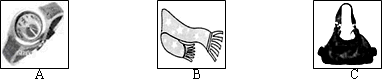
2.
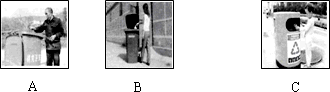
3.
4.
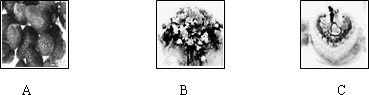
5.
第二节 听句子,选出与所听句子内容相符的正确答语。每个句子听两遍。(共5小题,每小题1分,满分5分)
6.A.I’m 14.
B.Thank you.
C.I’m very well.
7.A.It’s new.
B.It’s raining.
C.It’s red.
8.A.By bus.
B.By memorizing the words.
C.By the way.
9.A.Japanese.
B.Tokyo.
C.China.
10.A.In the library.
B.It’s my favorite.
C.On Wednesday.
第三节 听对话,选出能回答问题的正确选项。每段对话听两遍(共10小题,每小题1分,满分10分)
听第一段对话,回答第11~13小题。
11.What’s wrong with the boy?
A.He had a headache.
B.He had a toothache.
C.He had a stomachache.
12.What did the boy have for supper?
A.Ice cream.
B.Nothing.
C.Some bread.
13.What did the doctor ask the boy to do?
A.Take the medicine three times a day.
B.Drink more water.
C.Have a good rest.
听第二段对话,回答第14~15小题。
14.How long does it take Jack to go to school every day?
A.20 minutes.
B.15 minutes.
C.10 minutes.
15.How does the girl go to school every day?
A.On foot.
B.By bus.
C.By bike.
听第三段对话,回答第16~18小题。
16.When is Linda’s birthday?
A.August 26th.
B.August 27th.
C.August 28th.
17.Who is Linda’s best friend?
A.Jim.
B.Tom.
C.Alice.
18.How old will Linda be?
A.13.
B.20.
C.12.
听第四段对话,回答第19~20小题。
19.What does Cindy want to borrow?
A.A book.
B.An umbrella.
C.A watch.
20.What does Tom need?
A.A CD.
B.A nice clock.
C.A watch.
第四节 听短文,完成下列信息表格。短文听两遍(共5小题,每小题2分,满分10分)
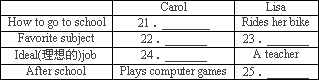
21.A.Rides her bike
B.Takes the subway
C.Takes the bus
22.A.Music
B.Computer games
C.Science
23.A.Math
B.Science
C.History
24.A.A doctor
B.A teacher
C.A singer
25.A.Plays computer games
B.Plays the guitar.
C.Plays the piano
How do you get to school? Do you walk or ride a bike? Do you go by bus or by train? For many students, it is easy to get to school. But for the students in one small village in China, it is difficult. There is a very big river between their school and the village. There is no bridge and the river runs too quickly for boats. So these students go on a ropeway to cross the river to school. One 11-year-old boy, Liangliang cross the river every school day. But he is not afraid.“ I love to play with my classmates. And I love my teacher, He’s like a father to me.” Many of the students and villagers never leave the village. It is their dream to have a bridge. Can their dream come true? I think they can! Do you think so?
【小题1】How do the students in one small village in China go to school?
| A.By bus | B.By boat |
| C.By train | D.Go on a ropeway. |
| A.Because they like to go on a ropeway. |
| B.Because there is a river and no bridge. |
| C.Because there is no boat. |
| D.Because they don’t like boat. |
| A.10 | B.11 | C.12 | D.13 |
| A.Yes, he does. | B.No, he isn’t. |
| C.Yes, he is. | D.No, he doesn’t. |
| A.To have a bus. | B.To have a train |
| C.To have a bridge. | D.To have a car. |
湖北省互联网违法和不良信息举报平台 | 网上有害信息举报专区 | 电信诈骗举报专区 | 涉历史虚无主义有害信息举报专区 | 涉企侵权举报专区
违法和不良信息举报电话:027-86699610 举报邮箱:58377363@163.com