
科目:高中英语 来源: 题型:阅读理解
To Whom It May Concern:
My husband and I got married in 1965 and for the first ten years of our marriage I was very happy to stay home and raise our three children. Then four years ago, our youngest child went to school and I thought I might go back to work.
My husband was very supportive and helped me to make my decision. He emphasized all of the things I can do around the house, and said he thought I could be a great success in business.
After several weeks of job-hunting I found my present job, which is working for a small public relations firm. At first, my husband was very proud of me and would tell his friends , "My clever little wife can run that company she's working for."
But as his joking remark approached reality, my husband stopped talking to me about my job.I have received several promotions and pay increases , and I am now making more money than he is. I can buy my own clothes and a new car. Because of our combined incomes, my husband and I can do many things that we had always dreamed of doing , but we don't do these things because he is very unhappy.
We fight about little things and my husband is very critical of me in front of our friends. For the first time in our marriage, I think there is a possibility that our marriage may come to an end.
I love my husband very much, and I don't want him to feel inferior, but I also love my job.I think I can be a good wife and a working woman, but I don't know how .Can you give me some advice? Will I have to choose one or the other or can I keep both my husband and my new career?
Please help.
"Distressed"
The letter was most probable written ________.
A.in 1975 B.around 1980 C.four years ago D.in 1965
Her husband ________ when she first found her present job.
A.was very critical of her B.felt disappointed
C.was proud of her D.was happy but critical
What does the underlined word "promotion" mean?
A.scolding B.criticism C.prize D.advancement
As her income increased, ________.
A.she found a gap emerged between her and her husband
B.she bought more clothes and a house
C.she did the many things she and her husband dreamed of
D.she felt very proud of herself
查看答案和解析>>
科目:高中英语 来源:2013届福建省高二下学期期末联考英语试卷(解析版) 题型:阅读理解
Have you ever picked a job based on the fact that you were good at it but later found it made you feel very uncomfortable over time? When you select your career, there’s whole lot more to it than assessing your skills and matching them with a particular position. If you ignore your personality, it will hurt you long-term regardless of your skills or the job's pay. There are several areas of your personality that you need to consider to help you find a good job. Here are a few of those main areas:
1) Do you prefer working alone or with other people?
There are isolating (使孤立) jobs that will drive an outgoing person crazy and also interactive jobs that will make a shy person uneasy. Most people are not extremes in either direction but do have a tendency that they prefer. There are also positions that are sometimes a combination of the two, which may be best for someone in the middle who adapts easily to either situation.
2) How do you handle change?
Most jobs these days have some elements of change to them, but some are more than others. If you need stability in your life, you may need a job where the changes don't happen so often. Other people would be bored of the same daily routine.
3) Do you enjoy working with computers?
I do see this as a kind of personality characteristic. There are people who are happy to spend more than 40 hours a week on a computer, while there are others who need a lot of human interaction throughout the day. Again, these are extremes and you'll likely find a lot of positions somewhere in the middle as well.
4) What type of work environment do you enjoy?
This can range from being in a large building with a lot of people you won't know immediately to a smaller setting where you'll get to know almost all the people there fairly quickly.
5) How do you like to get paid?
Some people are motivated by the pay they get, while others feel too stressed to be like that. The variety of payment designs in the sales industry is a typical example for this.
Anyway, these are a great starting point for you. I've seen it over and over again with people that they make more money over time when they do something they love. It may take you a little longer, but making a move to do what you have a passion for can change the course of your life for the better.
1.This passage mainly talks about the importance of __________.
A. different jobs B. personalities C. personal skills D. job’s pay
2.Which of the following is TRUE according to the passage?
A. Isolating jobs usually drive people mad.
B. Interactive jobs make people shy easily.
C. Extreme people tend to work with others.
D. Almost everyone has a tendency in jobs.
3.What is the missing word about a job search in the following chart?
A. Design B. Skills C. Cooperation D. Hobbies
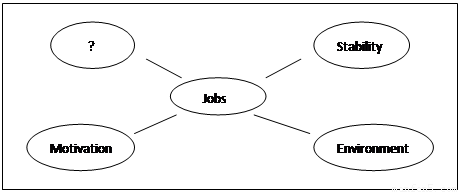
4.What is the best title for this passage?
A. Lifestyles and Job Pay
B. Jobs and Environment
C. Job Skills and Abilities
D. Personalities and Jobs
查看答案和解析>>
科目:高中英语 来源:2014届安徽宿松复兴中学高一下学期第三次月考英语试卷(解析版) 题型:阅读理解
Fluency(流利) in another language is one of the most important aims of a newcomer to another country. In addition, understanding the culture and learning to communicate comfortably with people of that culture are as important as learning the rules of the language. Language learning and culture learning go together and may take a long time.
Sometimes people feel that they understand a culture after a few weeks or months. People do learn a lot when they first begin living in another culture, but this is only the first stage of learning. It usually involves(含包) things like learning everyday activities and some basic customs.
To really understand another culture, people have to go beyond the first stage, This is challenge because it is often difficult to know what to learn. Much of what we call “culture” is hard to see.
Culture is like an iceberg. Picture in your mind a huge iceberg in the ocean. The only part of the iceberg that you see is the tip. You don’t see the rest of the iceberg because it is hidden from sight in the water. It is easy to forget that it is there. Most of the iceberg is deep within the ocean, just as much of a culture is deep within its people.
When you meet someone from another culture, certain culture differences are obvious: You hear another language or you hear your own language spoken with an accent. You see different foods, clothes and sometimes physical characteristics of people. You observe new customs or habits, such as the use of chopsticks, and, bowing or kissing on both cheeks as a greeting. These differences are interesting and important, but they are usually not too difficult to understand. They are visible so they are seen easily and quickly.
The part of culture that is like the underwater part of the iceberg consists of assumptions(设想), communication styles, values, and beliefs about what is right and wrong. The hidden part of culture affects much of a person’s way of thinking and communicating. It is the meaning behind his or her verbal (言语的) and nonverbal language. Learning to communicate well with people from another culture involves becoming aware of the hidden part of culture.
1.What’s the subject of this passage?
|
A.Learning about culture. |
|
B.Language learning. |
|
C.The hidden part of the iceberg. |
|
D.Fluency in another language. |
2.What is learning about culture?
|
A.Learning the hidden part of the iceberg, which is underwater. |
|
B.Learning everyday activities and some basic customs. |
|
C.Learning the culture of an iceberg. |
|
D.Learning the visible as well as the hidden differences of culture. |
3.What’s the writer’s opinion?
|
A.Communication styles can be easily seen and learned. |
|
B.Language learning is more important than culture learning. |
|
C.Learning about culture is not easy and may take a long time. |
|
D.People usually learn a culture after a few weeks or months. |
4.The underlined phrase “consists of” can be replaced by “______”.
|
A.lies in |
B.is made up of |
C.agrees with |
D.is different from |
5.What conclusion can we draw after reading this passage?
|
A.Values and beliefs are like the tip of the iceberg. |
|
B.People often become aware of the hidden part of culture. |
|
C.The tip of the iceberg is larger than the hidden part. |
|
D.The hidden part of culture has a great effect on people’s communication styles. |
查看答案和解析>>
科目:高中英语 来源:安徽省淮北市2010届高三下学期第二次模拟考试英语试卷 题型:阅读理解
The GUARANTEE ON THIS WATER HEATER IS IN EFFECT ONLY WHEN THE HEATER IS INSTALLED AND OPERATED IN ACCORDANCE WITH THESE INSTRUCTIONS. READ THESE INSTRUCTIONS THOROUGHLY BEFORE STARTING.
LOCATION:
Select a location accessible to water lines and power supply. Do not locate the heater where water lines could be subjected to(受…影响) freezing temperatures. It is recommended that the heater be located near the center of greatest hot water usage to prevent heat loss through the pipes.
ELECTRICAL CONNECTIONS:
Before any electrical connections are made, be sure that the heater is full of water and that the valve(阀门) in the cold water supply line is open.
OPERATION
When the switch is closed, the operation of this electric water heater is automatic. The thermostats are preset to the "HOT" setting to provide a water temperature of approximately 120oF to reduce the risk of being burnt.
MAITENACE
Shut off the electric power whenever the water supply is turned off.
Shut off the electric power, water supply and drain the heater completely to prevent freezing whenever the building is left unoccupied during the cold weather months.
SERVICE
The trip–free devices on this heater will cut off all power if temperature of water is above 190F. If there is no hot water after a reasonable period of time, check the main fuse(保险丝) box. In the event that the fuses have not blown, call a serviceman.
72.The location of the water heater shall ___________.
A. be close to water lines and power supply
B. be subjected to low temperature
C. be in the centre of the house
D. have a longer distance to hot water usage.
73.Before any connection of power , make sure that one thing you have to do is _____.
A. to have the heater in the water B. to open the cold water inlet valve.
C. to shut off the thermostats D. to replace wiring diagram
74.When you are not using the heater in winter months, it is better for you to________.
A. have the tank full of clear water B. drain the heater
C. to leave it untouched D. prevent it from losing heat
75. What will happen to the heater when the temperature of water is above 190F?
A. it will cause damage B. It will break off automatically.
C. It will produce cold water. D. It will blow the fuse.
查看答案和解析>>
科目:高中英语 来源:安徽省2009-2010学年度高一下学期第三次月考试卷(英语) 题型:完型填空
第二节:完形填空(共20小题,每小题1.5分,满分30分)
阅读下面短文,掌握其大意,然后从36~55各题所给的四个选项(A、B、C和D)中,选出最佳选项。
I had a very special teacher many years ago whose husband died suddenly of a heart attack. About a week after his 36 , she shared her insights(顿悟) with the students. When the class was nearly over, she 37 and said, “I would like to 38 with all of you a thought that has 39 to do with class, but which I feel is very 40 .
“Each of us is put here on the 41 to learn, share, love and appreciate ourselves. None of us knows when this 42 will end. At any moment it can be 43 . Perhaps this is life’s way of telling us that we must make good 44 of every day.” Her eyes beginning to 45 ,she went on saying, “So I would like you all to 46 me. From now on, on your way home, find something 47 to notice. It doesn’t have to be something you see- it could be scent(香味) of fresh bread, or it could be the 48 of the wind slightly rustling(发出沙沙声) the leaves.”
“Please look for these things, and 49 them. The little things we are put here on the earth to enjoy. They are 50 observing , for at any time they can all be taken away.”
The class was totally quiet. We all picked up our books and went out of the room 51 . That afternoon, on my way home I noticed 52 things than before. Every time I think of that teacher and remember what a(n) 53 she made on all of us, I try to 54 all of those things that sometimes we all ignore. For as we get older, it is not the things we did that we often regret, 55 the things we didn’t do.
36. A. disease B. death C. arrival D. appearance
37. A. paused B. continued C. focused D. broke
38. A. argue B. communicate C. share D. whisper
39. A. something B. nothing C. everything D. anything
40. A. improper B. important C. attractive D. unbelievable
41. A. earth B. farm C. road D. ground
42. A. disaster B. schedule C. experience D. custom
43. A. put away B. gone out C. handed out D. taken away
44. A. fun B. difference C. sense D. use
45. A. smile B. shut C. water D. glare
46. A. permit B. promise C. forgive D. respect
47. A. strange B. beautiful C. powerful D. different
48. A. signal B. sound C. action D. direction
49. A. support B. receive C. remember D. value
50. A. easy B. harmful C. worth D. puzzling
51. A. silently B. curiously C. slowly D. secretly
52. A. more B. smaller C. fewer D. larger
53. A. result B. chance C. pain D. impression
54. A. produce B. taste C. appreciate D. change
55. A. or B. and C. for D. but
查看答案和解析>>
湖北省互联网违法和不良信息举报平台 | 网上有害信息举报专区 | 电信诈骗举报专区 | 涉历史虚无主义有害信息举报专区 | 涉企侵权举报专区
违法和不良信息举报电话:027-86699610 举报邮箱:58377363@163.com
