
Hurry up _________ you won't catch up the train.
[ ]
A. and B. unless C. until D. or
科目:高中英语 来源:英语教研室 题型:050
阅读理解
In the 1970s, with ever-increasing international travel and tourism, the United States Department of Transportation decided to design a set of symbols(符号)for airports, stations, and public facilities(设施). The aim was to design symbols that would be clear to people in a hurry and to those who can not read English. Therefore, the set of symbols shown below was designed. Then the designers planned an experiment with an international sample(抽样调查) of 8-year-old children from Sweden. Japan, France, Canada, and Britain. The purpose of the experiment was to determine how clear the symbols would be to the children, who were not experienced international travelers.
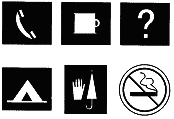
The children were shown the set of sample symbols, and were then asked to explain to the experimenters what the symbols meant. The researchers thought that if the international sample of children could understand them, the grown-up travelers would probably also recognize their meanings. The following graph(图表) shows the percentages of correctly explained symbols.
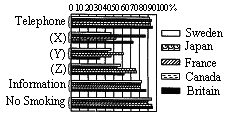
The experiments discovered that most of the children easily understand the telephone receiver and cigarette symbols. However, there were some interesting differences in their answers to the other four symbols. The Japanese children most easily understood the symbol standing for“coffee shop”. The experimenters thought that this fact showed children in Japan are more familiar with such shops than children in Sweden and Canada. The Japanese, French, and Canadian children all equally recognized the idea of“information”showed by the question mark.
Interestingly, the French and Canadian children understood the symbol referring to“campground(露营地)”better than the other children. Again, the researchers thought that recognition of a symbol shows how common the activity is in a country.
One particularly difficult symbol was that of the umbrella and glove used for“lost and found”, which was correctly explained by less than 50% of the children in four of the five countries. On the basis(基础) of this finding, the experimenters decided to add a question mark to make this symbol easier to understand.
1.Which of the following shows the correct meaning of(X), (Y), and (Z) in the graph above?
[ ]
A.Campground, Coffee Shop, Lost and Found.
B.Lost and Found, Campground, Coffee Shop.
C.Coffee shop, Lost and Found, Campground.
D.Telephone, No smoking, Information.
2.If we compare the Japanese and French children's understanding of the question mark and cigarette symbols, then we can find a difference of _____ between these symbols.
[ ]
A.0% B.10%
C.80% D.90%
3.The _____ symbol was the most difficult for the Japanese children to understand.
[ ]
A.cup B.question mark
C.tent D.umbrella and glove
4.Which of the following statements is TRUE?
[ ]
A.The experimenters thought Japanese children drink coffee.
B.The most difficult symbol was changed to make it clearer.
C.The question mark symbol is the least difficult in all five countries.
D.The researchers thought children would know as much as grown-ups.
查看答案和解析>>
科目:高中英语 来源: 题型:阅读理解
One day,Raul was miles away from the small ranch(牧场) house in a large valley. 36 seemed to be all right, yet he felt strange and somewhat uneasy.The wind had picked up, and angry, dark clouds 37 across the sky. He could smell the rain coming. And it did. 38 ,the lightning flashed through the clouds, nearly 39 Raul. The thunder(雷声) was so loud that he buried his 40 in his hands and rubbed his eyes. Then he heard it. Hoofbeats(蹄声).He 41 .There before him stood a tall, white 42 . An old man stared down at him from its back.
“Wh-wh-who are y-y-you?” asked Raul. “My name is Gray Cloud,” the old man answered 43 . “Come with me.”
Raul followed on his horse. A 44 feeling came over him. All 45 them the rain was pouring down, 46 not a drop fell on them. They seemed to be 47 back toward Raul’s home. Raul lost track of time. Then all at once he found 48 at the ranch gate. The old man turned his horse, 49 his hand, and smiled. Lightning flashed again. The old man and his horse were 50 .
Raul’s father ran out across the yard to 51 him. “we have been 52 sick about you. Are you okay? Hurry. Let’s get in out of the 53 .”
“Wait,” said Raul. “Have you ever heard of an old man called Gray Cloud?”
“Can’t say I … wait. I 54 my great-grandfather used to tell storied about a man called Gray Cloud. He died a long time ago. They say he was 55 by lightning during a terrible thunderstorm. Why do you ask?”
36. A.Something B.Everything C.Anything D.Nothing
37.A.dropped B.fell C.rolled D.covered
38.A.Suddenly B.Strongly C.Quickly D.Hardly
39.A.beating B.blinding C.burning D.touching
40.A.nose B.hair C.neck D.head
41.A.looked up B.woke up C.lay down D.sat down
42.A.tiger B.horse C.lion D.elephant
43.A.lazily B.angrily C.coldly D.slowly
44.A.natural B.common C.strange D.bad
45.A.around B.beside C.through D.above
46.A.yet B.for C.so D.or
47.A.walking B.leading C.heading D.returning
48.A.them B.themselves C.him D.himself
49.A.shook B.waved C.held D.took
50.A.gone B.left C.followed D.lost
51.A.see B.meet C.beat D.ask
52.A.waited B.thought C.worried D.excited
53.A.yard B.wind C.grass D.rain
54.A.believe B.consider C.doubt D.forget
55.A.defeated B.caught C.damaged D.struck
查看答案和解析>>
科目:高中英语 来源: 题型:阅读理解
The only way to travel is on foot
The past ages of man have all been carefully labeled(标记)by anthropologists(人类学家). Descriptions like ‘Palaeolithic(旧石器时代) Man’, ‘Neolithic Man’, etc., neatly(干净地;整洁地) sum up whole periods. When the time comes for anthropologists to turn their attention to the twentieth century, they will surely choose the label ‘Legless Man’. Histories of the time will go something like this: ‘in the twentieth century, people forgot how to use their legs. Men and women moved about in cars, buses and trains from a very early age. There were lifts and escalators(自动电梯,自动扶梯)in all large buildings to prevent people from walking. This situation was forced upon earth dwellers(居民) of that time because of miles each day. But the surprising thing is that they didn’t use their legs even when they went on holiday. They built cable railways, ski-lifts and roads to the top of every huge mountain. All the beauty spots on earth were marred (糟蹋)by the presence of large car parks. ’
The future history books might also record that we were deprived(剥夺) of the use of our eyes. In our hurry to get from one place to another, we failed to see anything on the way. Air travel gives you a bird’s-eye view of the world – or even less if the wing of the aircraft happens to get in your way. When you travel by car or train a blurred image of the countryside constantly smears the windows. Car drivers, in particular, are forever obsessed with the urge to go on and on: they never want to stop.
Is it the lure of the great motorways, or what? And as for sea travel, it hardly deserves mention. It is perfectly summed up in the words of the old song: ‘I joined the navy to see the world, and what did I see? I saw the sea.’ The typical twentieth-century traveler is the man who always says ‘I’ve been there. ’ You mention the remotest, most evocative place-names in the world like El Dorado, Kabul, Irkutsk and someone is bound to say ‘I’ve been there’ – meaning, ‘I drove through it at 100 miles an hour on the way to somewhere else. ’
When you travel at high speeds, the present means nothing: you live mainly in the future because you spend most of your time looking forward to arriving at some other place. But actual arrival, when it is achieved, is meaningless. You want to move on again. By traveling like this, you suspend all experience; the present ceases to be a reality: you might just as well be dead. The traveler on foot, on the other hand, lives constantly in the present. For him traveling and arriving are one and the same thing: he arrives somewhere with every step he makes. He experiences the present moment with his eyes, his ears and the whole of his body. At the end of his journey he feels a delicious physical weariness. He knows that sound. Satisfying sleep will be his: the just reward of all true travellers.
1. Anthropologists label nowadays’ men ‘Legless’ because
A . people forget how to use his legs. B people prefer cars, buses and trains.
C lifts and escalators prevent people from walking. D there are a lot of transportation devices.
2. Travelling at high speed means
A people’s focus on the future. B a pleasure.
C satisfying drivers’ great thrill. D a necessity y of life.
3. Why does the author say ‘we are deprived of the use of our eyes’ ?
A People won’t use their eyes. B In traveling at high speed, eyes become useless.
C People can’t see anything on his way of travel. D People want to sleep during travelling.
4. What is the purpose of the author in writing this passage?
A Legs become weaker. B Modern means of transportation make the world a small place.
C There is no need to use eyes. D The best way to travel is on foot.
5. What does ‘a bird’s-eye view’ mean?
A See view with bird’s eyes. B A bird looks at a beautiful view.
C It is a general view from a high position looking down. D A scenic place.
查看答案和解析>>
科目:高中英语 来源:2012-2013学年浙江省温州中学高二上学期期末考试英语试卷(带解析) 题型:完型填空
One day, Raul was miles away from the small ranch (牧场)house in a large valley. Everything seemed to be all right, yet he felt strange and somewhat uneasy. The wind had picked up, and angry, dark clouds 31 across the sky. He could smell the rain coming. And it did. 32 , the lightning flashed through the clouds, nearly 33 Raul. The thunder (雷声) was so loud that he buried his head in his hands and rubbed his eyes. Then he heard it — hoof beats (蹄声). He 34 . There before him stood a tall, white horse. An old man stared down at him from its back.
“Wh-wh-who are y-y-you?” asked Raul. “Oh, my name is Gray Cloud,” the old man answered 35 , “come with me.”
Raul followed on with his horse. A 36 feeling came over him. All 37 them the rain was pouring down, 38 not a drop fell on them. They seemed to be 39 back toward Raul’s home. Raul lost track of time. Then all at once, he found 40 at the ranch gate. The old man turned his horse, waved his hand, and smiled. Lightning flashed again. The old man and his horse were 41 .
Raul’s father ran out across the yard to 42 him. “We have been 43 about you. Are you okay? Hurry. Let’s get in out of the 44 .”
“Wait,” said Raul. “Have you ever heard of an old man called Gray Cloud?”
“Can’t say I … wait. I believe my great-grandfather used to tell stories about a man called Gray Cloud. He died a long time ago. They all say he was 45 by lightning during a terrible thunderstorm. Why do you ask?” At this, Raul was really more shocked than puzzled.
| 【小题1】 |
|
| 【小题2】 |
|
| 【小题3】 |
|
| 【小题4】 |
|
| 【小题5】 |
|
| 【小题6】 |
|
| 【小题7】 |
|
| 【小题8】 |
|
| 【小题9】 |
|
| 【小题10】 |
|
| 【小题11】 |
|
| 【小题12】 |
|
| 【小题13】 |
|
| 【小题14】 |
|
| 【小题15】 |
|
查看答案和解析>>
科目:高中英语 来源:2014届浙江省高二上学期期末考试英语试卷(解析版) 题型:完型填空
One day, Raul was miles away from the small ranch (牧场)house in a large valley. Everything seemed to be all right, yet he felt strange and somewhat uneasy. The wind had picked up, and angry, dark clouds 31 across the sky. He could smell the rain coming. And it did. 32 , the lightning flashed through the clouds, nearly 33 Raul. The thunder (雷声) was so loud that he buried his head in his hands and rubbed his eyes. Then he heard it — hoof beats (蹄声). He 34 . There before him stood a tall, white horse. An old man stared down at him from its back.
“Wh-wh-who are y-y-you?” asked Raul. “Oh, my name is Gray Cloud,” the old man answered 35 , “come with me.”
Raul followed on with his horse. A 36 feeling came over him. All 37 them the rain was pouring down, 38 not a drop fell on them. They seemed to be 39 back toward Raul’s home. Raul lost track of time. Then all at once, he found 40 at the ranch gate. The old man turned his horse, waved his hand, and smiled. Lightning flashed again. The old man and his horse were 41 .
Raul’s father ran out across the yard to 42 him. “We have been 43 about you. Are you okay? Hurry. Let’s get in out of the 44 .”
“Wait,” said Raul. “Have you ever heard of an old man called Gray Cloud?”
“Can’t say I … wait. I believe my great-grandfather used to tell stories about a man called Gray Cloud. He died a long time ago. They all say he was 45 by lightning during a terrible thunderstorm. Why do you ask?” At this, Raul was really more shocked than puzzled.
1. A.dropped B.fell C.rolled D.covered
2. A.Suddenly B.Strongly C.Quickly D.Hardly
3. A.beating B.blinding C.burning D.touching
4. A.looked up B.woke up C.lay down D.sat down
5. A.lazily B.angrily C.freely D.slowly
6. A.natural B.common C.strange D.sad
7. A.around B.beside C.through D.above
8. A.yet B.for C.so D.or
9. A.reaching B.leading C.heading D.returning
10. A.them B.themselves C.him D.himself
11. A.gone B.left C.followed D.lost
12. A.see B.meet C.beat D.ask
13. A.waited B.thought C.worried D.excited
14. A.yard B.wind C.grass D.rain
15. A.defeated B.caught C.damaged D.struck
查看答案和解析>>
湖北省互联网违法和不良信息举报平台 | 网上有害信息举报专区 | 电信诈骗举报专区 | 涉历史虚无主义有害信息举报专区 | 涉企侵权举报专区
违法和不良信息举报电话:027-86699610 举报邮箱:58377363@163.com
