
科目: 来源:高中英语复习题 题型:050
Look at Column A and Column B in the following four problems, and decide which is bigger. If Column A is bigger than Column B, choose (A). If Column B is bigger than Column A, choose (B) . If the two columns are the same in quantity, choose (C). If you can’t decide which is larger, or which is smaller, choose (D).
Column A Column B Choose answers
(1)2´ 6 2+6 (A)(B)(C)(D)
(2)--(4) refer to Ñ PQR

(2) PN NQ (A)(B)(C)(D)
(3)X° Y° (A)(B)(C)(D)
(4)W° +Z° 180° (A)(B)(C)(D)
查看答案和解析>>
科目: 来源:高中英语复习题 题型:050
Sales of a company tells us the value of goods or even service in money such as dollars the company sells at a certain time. Earnings of a company shows how much money the company makes by selling goods or service at a certain time. The following two graphs are

1.For the years 1991 to 1996 , what was the amount of the greatest increase in sales from one year to the next ?
A.5,000 B. 10,000 C. 12,000 D. 30,000
2.For the period from 1990 to 1994 , what were the salesper year?
A.57,000 B. 58,000 C. 59,000 D. 60,000
3.In which of theyears from 1991 to 1996 did earnings change by the greatest percent over the year before?
A.1991 B. 1992C. 1994D. 1995
4.If at the end of l990 Company X sold 30,000 shares of common stock (普通股票) for 35 times Company X’s earnings for the year, what was the price of a share of common stock at that time?
A.7.00 B.10.00 C. 17.50 D. 35.00
5.If Company X considered a good year to be any year in which earnings were at least 20 percent of sales, how many of the years shown were good years?
A.None. B. One . C. Two. D. Three.
6.Which year was the good year mentioned in Question 5, if there was any?
A.1990. B. 1991. C. 1992. D. 1993.
查看答案和解析>>
科目: 来源:高中英语复习题 题型:050
The word “ Employment ” refers to how many people have jobs and incomes. Some people are employed in public service, that is to say, they work in government offices or hotels owned by the government, but others may be employed in private service;i.e. they may work for certain shops or hotels or even homes owned by certain people as their bosses or masters. But most people are usually employed in goods producing factories;i.e. they work in factories that produce such goods as machines, cars , clothing and foods. The line graph below shows the employment (in millions of persons) in Country C from 1968-1997.

1.At the end of 1985 , about what total employment, in millions , in both service and goods- producing industries?
A.51 B.54C.63D.66
2.For the entire period shown in the graph , the increase in employment in service was about how many times greater than the increase in employment in goods-producing industries ?
A.2 B.3C.4D. 5
3.At the end of 1990 , about what was the ratio (比例) of the number of service workers to workers in goods-producing industries ?
A.2:1 B.3: 2C.5:3 D. 5:2
4.In what year did the number of service workers show an increase of 100% over that number at the start of 1968?
A.1990 B.1992C.1994 D.1995
查看答案和解析>>
科目: 来源:高中英语复习题 题型:050
The total value of a certain country's yearly production is called GNP== Gross National Product. Now look at the graph and answer the questions below it:
Total and Percent of Country A Gross National Product Spent on Health 1980-1993Billions of Dollars ( percent of GNP )

1.About what is the ratio (比例) of total health spendings in 1993 to that in 1980?
A.3:1B. 4:1 C. 3:2 D. 7:3
2.If the population of Country A was 215 million in 1993 , what was the cost per person for health and medical care that year?
A.465B. 510 C. 550 D. 590
3.About what was the Gross National Product , in billions of dollars in 1985?
A.500B. 550 C. 590 D. 680
4.During what 3-year period did the proportion (比例) of the Gross National Product taken by health care costs remain almost unchanged?
A.1985-1987 B. 1987-1989 C. 1989-1991 D.1991-1993
5.What was the percent increase in health care costs from 1992 to 1993?
A.8.9% B. 9.6% C. 10.4% D.11.2%
查看答案和解析>>
科目: 来源:高中英语复习题 题型:050
In 1995 ten of the largest cities in the world have a total population of 152.5 million. How does it spread out ? How does it distribute? Let's have a look at the circle below. We divide the ten cities into five groups : Group A : Tokyo in Japan and Seoul in Korea. Group B: Sao Paulo in Brazil and Mexico City in Mexico. Group C: New York and Los Angeles in the U.S.A. Group D: Bombay and Calcutta in India. Group E: Shanghai and Beijing in China. If l52.5 million is supposed to be 100% in 360° circle, then each group’s population takes a certain percent of the 152.5 million in total, a certain part of the circle, a certain number of degrees in a central angle in the 360 ° circle.

1.What was the total population in Shanghai and Beijing in 1995?
A.24. 7 million. B. 25.7 million. C. 26.7 million. D. 27.7 million
2.What was the total population in Sao Paulo and Mexico City in 1995?
A.31 million. B. 32 million. C. 33 million. D. 34 million.
3.How many more million of people were there in Group A than in Group C?
A.6.15 million. B. 7.25 million. C. 8.15 million. D. 9.15 million.
4.How many degrees are there in the central angle of the part for the total population of Bombay and Calcutta?
A.64.8° .B. 74.8° . C. 44.8° . D. 54.8° .
5.What is the ratio (比例) of the total population of New York and Los Angeles to the total population of Tokyo and Seoul?
A.1/5 B.2/5 C.3/5 D. 4/5
查看答案和解析>>
科目: 来源:高中英语复习题 题型:050
Sociologists ( 社会学家 ) tell us that we are heading for a society of leisure. The trend is unmistakable. One hundred years ago, they point out, a worker put in twelve or thirteen hours a day, six days a week, and week followed week without an annual (年度的) vacation. But over the years the picture has changed. Today the typical (典型的) work week has five eight-hour days, and workers enjoy about three weeks of paid vacation every year, with the result that today we spend less than half as much time on the job as people did before.
In spite of this, today's worker may not feel that he has a great deal of leisure time. This is because a lot of the non-work time is taken up with fulfilling family and social obligations (义务) For example, he feels that he should spend some time with his children every day, and if a man does physical exercises to make up for any lack of physical activity in his job, that too cuts into his free time.
Nevertheless, the final result is that we do have more leisure —more time free from the obligation of work or any other social requirement. Leisure is time not used to earn money or to do things around the house which save money. It is time spent only in seeking satisfaction, and we give up what we are doing when it no longer satisfies us. Leisure gives us the opportunity (机会) to recover (恢复) from the physical and mental fatigue (疲劳) of work and it frees our creative talents from the pressure and the form placed on us by the job.
Before the industrial era (时代) — and in non-industrialized regions this is still the case —people had a lot of non-work time too, but it was largely taken up with other obligations. Today’s leisure, however, is time programmed for doing what you want to. This is something new. It really frees a person from the workshop to enjoy, for a time, things in which he is interested.
1.The trend in the last hundred years has been toward
A.more work and less leisure.
B.more work and more leisure.
C.less work and more leisure.
D.less work and less leisure.
2.Leisure refers to
A.the state of doing nothing.
B.the state of having no job.
C.time when you don't work.
D.a period programmed for your own use.
3.Leisure is free time that we use
A.to do something that gives us satisfaction.
B.to earn extra money for our family.
C.to rest our bodies for the next day's work.
D.to do money-saving jobs around the house.
4.Before the industrial era, workers
A.had hardly any time off.
B.had a lot of time off, which they usually spent on family or social obligations.
C.had a lot of time off, which they spent freely.
D.had nothing to do in their free time.
5.A best title for this text would be
A.Leisure. C. Different Ways to Enjoy Oneself.
B. Work and Leisure. D. Man's Obligations.
查看答案和解析>>
科目: 来源:高中英语复习题 题型:050
If you ask some people, ‘How did you learn English so well?’ you may get a surprising answer: ‘In my sleep!’
These are people who have taken part in one of the recent experiments to test learn-while-you-sleep methods, which are now being tried in several countries, and with several subjects, of which English is only one.
Specialists say that this sleep-study method speeds language learning tremendously. They say that the average person can learn two or three times as much during sleep as in the same period during the day --- and this does not affect his rest in any way. A word of warning, however: sleep-teaching will only hammer into your head what you have studied already while you are awake.
In one experiment, ten lessons were broadcast over the radio at intervals (间歇) of a fortnight. Each lesson lasted twelve hours ---- from 8 p.m. to 8A.m. The first three hours of English grammar and vocabulary were given with the student awake. At 11 p.m. a soothing lullaby (使人镇静的催眠曲) was broadcast to send the student to sleep and for the next three hours the radio whispered the lesson again into his sleeping ears. At 2A. m. a sharp noise was sent over the radio to wake the sleeping student up for a few minutes of revision. Then he was lulled back to rest again while the radio purred on. At 5 o'clock his sleep ended and he had to go through the lesson again for three hours before breakfast.
1. Compared with other methods of learning the learn-while-you-sleep method is
A. slower. B. quicker. C. very easy. D. very tiring.
2.During sleep-teaching you can
A. learn grammar and vocabulary you never learned before.
B. learn how to sleep better
C. listen to lessons again to know them better
D. learn how to sleep less.
3. How long did the experiment take to complete ?
A. two weeks B. twelve hours C. Twenty weeksD. forty nights
4. Sleep-teaching means listening to _______
A. a soothing lullaby. B. a lesson of English grammar and vocabulary.
C. a sharp noise. D. a whispered lesson.
5. The sleep-study method is being tried in many countries to teach
A. English. B. grammar and vocabulary.
C a number of subjects. D. languages.
查看答案和解析>>
科目: 来源:高中英语复习题 题型:050
Pedro knew that he would soon have to leave school again. He had been here for about seven weeks. Now the days were getting long and warm. He and his family would soon be taking off (离开). Every year it was the same. All his people had to go where they could work the crops in the fields.
Every year Pedro went to at least five schools. He had been to so many schools he couldn't think of their names. He couldn't even remember the towns where they were.
However, he enjoyed staying with his people. He liked the days when they let him stay home from school and work. He was proud of his brothers and sisters, and his father and mother. He liked all the other people who went from place to place with them.
To Pedro they were like a big, happy crowd of friends. They would come home tired each night after working long hours. Sometimes they had to work on wet ground all day. But they would come home and laugh and joke with each other.
When they moved, they put everything they had on an old truck and took off. Sometimes the truck would break down on the road. Then they had to stop by the roadside and fix it. But that's the way they all lived. Pedro didn't mind it too much. But he did hope that someday things would change. He wanted to stay in the same school for a while so that he could make some friends with kids his own age.
1.Pedro was
A.from a factory worker's family..
B.from a farmer's family.
C.from afarm worker's family.
D.a homeless child.
2.Pedro went to several schools every year because
A.he could not remember the names of the schools.
B.he did not like going to school.
C.his family did not want him to stay at the same school.
D.his family had to move about and find work in different places.
3.Did Pedro like to move along with his people?
A.Yes, he did. B. Yes, but not too much.
C.No, he didn't.D. No, but he had to go with them.
4.He did hope thatsomeday things would change. This means:
A.he hoped that someday his family would settle down in one place.
B.he hoped that someday his family would not have to take him along with them.
C.he hoped that someday he would enjoy going to school more.
D.he hoped that someday he would make friends with his schoolmates.
查看答案和解析>>
科目: 来源:高中英语复习题 题型:050
Bats are the only flying mammals (哺乳动物) in the world. They can't see very well, but they have no trouble flying on the darkest nights and catching the insects (昆虫) that they eat. How do bats manage to fly and see at night? They fly by radar (雷达) !
The bat's radar system works the same way as the one that ships and planes use. Like the radio signals (信号) sent by a ship or plane, the bat also sends signals that bounce (反射) back when they hit an object.
As a bat flies through the air, he sends out a series of sounds, thirty to sixty per second. The sounds cannot be heard by the human ear. If the sounds hit an object, they bounce back. The bat's ears pick up the sounds. These returned sound signals tell the bat where the object is.
The bat's radar system is very good. Tests have been made with bats in a crowded room. Blind in the light, the bats could fly about the room and never touch any object.
1.This article tells us how ________
A.radar systems work.
B.bats send out soundsignals.
C.sound signals bounce back.
D.bats manage to fly and see at night.
2.Bats have no trouble flying on the darkest nights because _______
A.they have very poor sight.
B.they have to catch insects to eat.
C.they have a kind of radar system to help them.
D.they can see objects in the dark night.
3.As bats fly through the air _______
A.they send out radio signals.
B.they hear all kinds of sounds.
C.they hit objects and bounce back.
D.they send out sound signals.
4.The bat's ears pick up the sounds. This means:
A.the bat can hear the returned sound signals.
B.the bat is unable to hear the sound signals.
C.sound signals become stronger when they bounce back.
D.sound signals get lost when they bounce back.
查看答案和解析>>
科目: 来源:高中英语复习题 题型:050
“The more time you spend on study the better you learn.” Is that true ? Below is a graph showing the amount a person learns against the number of hours he works in a day.
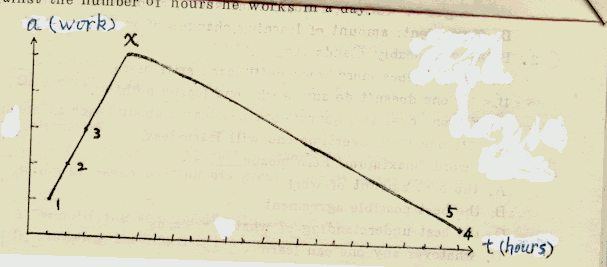
If one doesn’t do any work, one learns nothing. If one does an hour’s work, one learns a certain amount (point 1). If one does two hours’ work, one learns about twice as much. If one does more work , he’ll learn still more . Now if one tried to do 23 hours’ work in 24, one will be so tired that one will hardly remember anything;what one learns will be little (point 4). If one did less work, one would learn more . Point X is the very maximum anyone can learn in a day. It is the optimum. It is the best amount of work to do. It is the best possible agreement between the time spent and the overtiredness as a result.
Overtiredness is a 100% real thing, which no one can escape or try to pay no attention to or try not to see. If one does, if one forces oneself to work past the optimum (and any fool can keep his eyes open 14 hours a day without any sleep), one can only get on this downward slope in this graph and achieve less than the best and then get overtired and lose one’s power to fix any attention on anything one studies.
It is hard to say what the optimum is. When one reaches one’s optimum depends on many things such as one’s health and the kind of work one does. But when you find yourself repeatedly reading over the same paragraph and not taking it in, that shows you have reached the optimum. Most ordinary students find their optimum at about five hours a day.
1. Line A, Line T and the up-and-down slope stand for _____.
A. amount of learning, time spent, changes of working result
B. time spent, change of working result, amount of learning
C. changes of working result, time spent, amount of learning
D. time spent, amount of learning, changes of working result
2. Point 2 probably stands for _________ .
A. “ If one does more work he’ll learn still more.”
B. “ If one doesn’t do any work, one learns nothing.”
C. “ If one does two hours’ work, one learns about twice as much.”
D. “ If one works overtime one will learn less..”
3. The word “maximum” here means _____ .
A. the best amount of work
B. the best possible agreement
C. the best understanding of what one learns
D. whatever anyone can learn
4. Point 5 shows the result of ____ .
A. doing less work after getting past the optimum
B. doing 23 hours’ work in 24
C. forcing oneself to work past the optimum
D. not doing any work at all
5. After reaching one’s optimum, one will have to _____.
A. force one’s eyes open to work overtime
B. lose one’s power to fix one’s attention
C. repeat what one is reading
D. take a rest and do less work.
查看答案和解析>>
湖北省互联网违法和不良信息举报平台 | 网上有害信息举报专区 | 电信诈骗举报专区 | 涉历史虚无主义有害信息举报专区 | 涉企侵权举报专区
违法和不良信息举报电话:027-86699610 举报邮箱:58377363@163.com