
题目列表(包括答案和解析)
76、 ;77、 ;
78、 ;79、 ;
80、 ;81、 ;
82、 ;83、 ;
84、 ;85、 。
|
题目 |
36 |
37 |
38 |
39 |
40 |
41 |
42 |
43 |
44 |
45 |
|
答案 |
|
|
|
|
|
|
|
|
|
|
|
题目 |
46 |
47 |
48 |
49 |
50 |
51 |
52 |
53 |
54 |
55 |
|
答案 |
|
|
|
|
|
|
|
|
|
|
|
题目 |
21 |
22 |
23 |
24 |
25 |
26 |
27 |
28 |
29 |
30 |
|
答案 |
|
|
|
|
|
|
|
|
|
|
|
题目 |
31 |
32 |
33 |
34 |
35 |
|
|
|
|
|
|
答案 |
|
|
|
|
|
|
|
|
|
|
|
题目 |
1 |
2 |
3 |
4 |
5 |
6 |
7 |
8 |
9 |
10 |
|
答案 |
|
|
|
|
|
|
|
|
|
|
|
题目 |
11 |
12 |
13 |
14 |
15 |
16 |
17 |
18 |
19 |
20 |
|
答案 |
|
|
|
|
|
|
|
|
|
|
B
u Children start out as
natural scientists, eager to look into the world around them. Helping them
enjoy science can be easy; there’s no need for a lot of scientific terms
or expensive lab equipment. You only have to share your children’s
curiosity. Firstly, listen to their questions. I once visited a classroom of
seven-year-olds to talk about science as a job. The children asked me “textbook
questions” about schooling, salary and whether I liked my job. When I finished
answering, we sat facing one another in silence. Finally I said, “Now that we’ve
finished with your lists, do you have questions of your own about
science?”
Children start out as
natural scientists, eager to look into the world around them. Helping them
enjoy science can be easy; there’s no need for a lot of scientific terms
or expensive lab equipment. You only have to share your children’s
curiosity. Firstly, listen to their questions. I once visited a classroom of
seven-year-olds to talk about science as a job. The children asked me “textbook
questions” about schooling, salary and whether I liked my job. When I finished
answering, we sat facing one another in silence. Finally I said, “Now that we’ve
finished with your lists, do you have questions of your own about
science?”
After a long pause, a boy raised his hand,” Have
you ever seen a grasshopper(蚱蜢) eat? When I try eating leaves like that, I get a stomachache.
Why?”
This began a set of questions that lasted nearly
two hours.
Secondly, give them time to think. Studies over
the past 30 years have shown that, after asking a question, adults typically
wait only one second or less for an answer, no time for a child to think. When
adults increase their “wait time” to three seconds or more, children give more
logical(符合逻辑的),complete and
creative answers.
Thirdly, watch your language. Once you have a
child involved in a science discussion, don’t jump in with “That’s
right” or “Very good”. These words work well when it comes to encouraging good
behavior. But in talking about science, quick praise can signal that discussion
is over. Instead, keep things going by saying, “That’s interesting” or
“I’d never thought of it that way before”, or coming up with more
questions or ideas.
Never push a child to “Think”. It doesn’t
make sense, children are always thinking, without your telling them to. What’s
more, this can turn a conversation into a performance. The child will try to
find the answer you want, in as few words as possible, so that he will be a
smaller target for your disagreement.
Lastly, show doesn’t tell.
Real-life impressions of nature are far more impressive than any lesson
children can learn from a book or a television program. Let children look at
their fingertips through a magnifying glass(放大镜), and they’ll understand why you want
them to wash before dinner. Rather than saying that water evaporates (蒸发),set a pot of
water to boil and let them watch the water level drop.
60. According to the passage, children are
natural scientists, and to raise their interest, the most important thing for
adults to do is
.
A. to share the children’s curiosity
B. to let them see the world around
C. to explain difficult phrases about
science
D. to supply the children with lab equipment
61. In the last sentence of the first paragraph,
the word “lists” could best be replaced by .
A. any questions
B. textbook questions
C. questions about science D. questions seven-year-olds
are curious about
62. According to the passage, children can
answer questions in a more logical, complete and creative way if adults .
A. wait at least for three seconds after a question
B. tell them to answer the next day
C. ask them to answer quickly
D. wait for one or
two seconds after a question
63. In which of the following paragraph(s) does the author tell us what
to say to encourage children in a science discussion?
A. The second and third. B. The fourth and fifth.
C. The fifth and sixth. D. The seventh.
C
The twentieth century saw greater changes than any century before: changes for the better, changes for the worse; changes that brought a lot of benefits to human beings, changes that put man in danger. Many things caused the changes, but, in my opinion, the most important was the progress in science.
Scientific research in physics and biology has vastly broadened our views. It has given us a deeper knowledge of the structure of matter and of the universe; it has brought us a better understanding of the nature of life and of its continuous development. Technology-the application of science-has made big advances that have benefited us in nearly every part of life.
The continuation of such activities in the twenty-first century will result in even greater advantages to human beings: in pure science - a wider and deeper knowledge in all fields of learning; in applied science - a more reasonable sharing of material benefits, and better protection of the environment.
 Sadly, however,
there is another side to the picture. The creativity of science has been employed
in doing damage to mankind. The application of science and technology to the
development and production of weapons of mass destruction has created a real
danger to the continued existence of the human race on this planet. We have
seen this happen in the case of nuclear weapons, Although their actual use has
so far occurred only the Second World War, the number of nuclear weapons that
were produced and made ready for us was so large that if the weapons had
actually been used, the result could have been the ruin of the human race, as
well as of many kinds of animals.
Sadly, however,
there is another side to the picture. The creativity of science has been employed
in doing damage to mankind. The application of science and technology to the
development and production of weapons of mass destruction has created a real
danger to the continued existence of the human race on this planet. We have
seen this happen in the case of nuclear weapons, Although their actual use has
so far occurred only the Second World War, the number of nuclear weapons that
were produced and made ready for us was so large that if the weapons had
actually been used, the result could have been the ruin of the human race, as
well as of many kinds of animals.
William Shakespeare said, “The web of our life is of a mingled yarn(沙线), good and ill together.” The above brief review of the application of only one part of human activities - science seems to prove what Shakespeare said. But does it have to be so? Must the ill always go together with the good? Are we biologically programmed for war?
64.Which of the following best shows the structure of the passage?
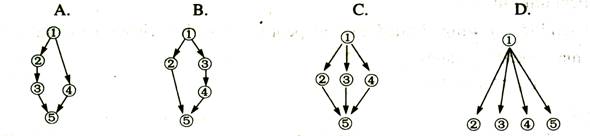
①=Paragraph 1, ②=Paragraph 2, ③=Paragraph 3, ④=Paragraph 4, ⑤=Paragraph 5
65.From the fourth paragraph, we can infer that ___________.
A.a great many nuclear weapons actually used for war
B.a large number of nuclear weapons should have been used for war
C.the author is doubtful about the ruin of human beings by nuclear weapons
D.the author is anxious about the huge number of nuclear weapons on the earth
66.The underlined word “mingled” in the last paragraph most probably means ___________.
A.simple B.mixed C.sad D.happy
67.What do you think the author is most likely to suggest if he continues to write?
A.Further application of science to war.
B.More reading of William Shakespeare.
C.Proper us of science in the new century.
D.Effective ways to separate the good from the ill.
D
I entered St Thoma’s Hospital as a medical student at the age of 18 and
spent five years there. I was an unsatisfactory student, for my heart, as you
might have guessed, was not in it. I wanted, I had always wanted to be a
writer, and in the evening, after my high tea, I wrote and read. Before long, I
wrote a novel, called “Liza of Lambeth”, which I sent
to a publisher and was accepted. It appeared during my last year at the
hospital and had something of a success. It was of course an accident, but
naturally I did not know that. I felt I could afford to give up medicine and
make writing my profession; so, three days after I graduated from the school of
medicine, I set out for Spain to write another book. Looking back now and
knowing as I do the terrible difficulties of making a living by writing, I
realize I was taking a fearful risk. It never even occurred to me.
The next ten years were very
hard, and I earned an average of £100 a year. Then I had a bit of luck. The
manager of the Court Theatre put on a play that failed ; the next play he
arranged to put on was not ready , and he was at his wits’ end. He read
a play of mine and, though he did not much like it, he thought it might just
run for the six weeks till the play he had in mind to follow it with could be
produced. It ran for fifteen months. Within a short while I had four plays
running in London at the same time. Nothing of the kind had ever happened
before. I was the talk of the town. One of the students at St Thomas’s Hospital
asked the famous surgeon with whom I had worked whether he remembered me. “Yes,
I remember him quite well, “he said. “ One of our failures, I’m afraid. “
68. Which of the following
statements is not true?
A. The author was very
pleased to have his book published but he didn’t realize it was something of an
accident.
B. The success of his first
book led the author to think he could afford to make writing his profession.
C. The author knew he was
running a terrible risk when he decided to become a writer.
D.
The author became a writer after graduation but was not a successful one.
69.
In the second paragraph, “… he was at his wits’ end “means ________.
A. he was having a nervous
breakdown B.
he was out of his wisdom
C. he did not know what to do
D.
he almost went mad
70. The manager of the Court
Theatre agreed to put the author’s play on the stage because _____________.
A. he thought it would run
for fifteen months
B. he knew it was one of the
author’s best plays shown in London
C. he had just put on a play
that failed
D. the play he had arranged
to put on was not ready
71. The author became the
talk of the town. The reason was that __________.
A. he talked with a great
many people in London about his plays
B. the plays he wrote were
excellently performed in London
C. his performances in the
Court Theatre were unexpectedly
D. he was criticized by an
eminent surgeon as one of their failures
A
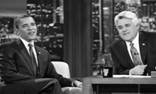 President Barack Obama has apologized for a gaffe (失言) in which he described his bowling
skills as akin to participants in the Special Olympics, a sports program
for people with intellectual disabilities.
President Barack Obama has apologized for a gaffe (失言) in which he described his bowling
skills as akin to participants in the Special Olympics, a sports program
for people with intellectual disabilities.
Obama made the mistake during an interview on Thursday night on “The Tonight Show” with host Jay Leno, the first time a sitting U.S. president had been on the show.
Talking about living in the White House, Obama said he had been practicing his bowling in the home’s bowling alley and had scored a 129 out of a possible 300.
It was an improvement on the embarrassing 37 he had rolled during a stop on the presidential campaign trail a year ago. “It’s like-it was like Special Olympics or something,” Obama said.
The Special Olympics is a global nonprofit organization serving some 200 million people with intellectual disabilities, with a presence in nearly 200 countries worldwide.
Soon after the Jay Leno interview, Obama telephoned Special Olympics chairman Tim Shriver to apologize.
Shriver told ABC’s “Good Morning America” television show that Obama had apologized “in a way that I think was very moving” and that he said “he did not intend to humiliate (羞辱) the population, didn’t want to embarrass or give anybody any more reason for pain or kind of suffering.”
Shriver said people should gain a lesson from the incident.
 “I think it’s important to
see that words hurt. Words do matter. And these words in some respect, can be
seen as humiliating or a put-down to people with special needs, do cause pain.
And they do result in stereotypes,” Shriver said.
“I think it’s important to
see that words hurt. Words do matter. And these words in some respect, can be
seen as humiliating or a put-down to people with special needs, do cause pain.
And they do result in stereotypes,” Shriver said.
White House spokesman Bill Burton said Obama “made an offhand remark making fun of his own bowling that was in no way intended to look down upon the Special Olympics.”
“He thinks that the Special Olympics are a wonderful program that gives an opportunity to shine to people with disabilities from around the world,” Burton said.
56. What does the underlined word “akin” in Paragraph 1 mean?
A. skillful B. similar C. appealing D. superior
57. Which of the following statements is true?
A. Obama loves sports and is especially gifted at bowling.
B. Obama apologized for his remarks via ABC’s TV show.
C. The Special Olympics are for various disabled people.
D. The Special Olympics don’t intend to make any money.
58. What does Shriver mean by saying people should gain a lesson from the incident?
A. Disabled people cannot be humiliated. B. One should be careful with his words.
C. An apology for wrong words is wanted. D. Words matter even more than actions.
59. The passage is mainly about ________.
A. Obama receiving a TV interview B. Obama looking down on the disabled
C. Obama apologizing for his gaffe D. Obama being attacked for his words
湖北省互联网违法和不良信息举报平台 | 网上有害信息举报专区 | 电信诈骗举报专区 | 涉历史虚无主义有害信息举报专区 | 涉企侵权举报专区
违法和不良信息举报电话:027-86699610 举报邮箱:58377363@163.com