
题目列表(包括答案和解析)
B) 完成对话 通读下面的对话,根据上下文补全对话内容。
A: Hi, Bill! You’re reading the novel again.
B: Yes, Tom. I’ll never be tired of it.
A: 1.______________________________ ?
B: Three times. Every time I read it, I can always learn something new.
A: Really? 2. ____________________?
B: Charles Dickens. I think he is a great English writer. What about you?
A: 3.___________________ . He is also my favorite foreign writer. Please let me have a look at it.
B: OK, here you are! What do you think of this novel?
A: 4. ________________. I haven’t seen such a novel for long. Where did you buy it?
B: In the Rose Bookshop.
A: I don’t know where it is. 5. ________________?
B: No. Only 10 minutes’ walk from here, next to the People’s Cinema.
A: Oh, I see. I’m going there to get one, too. Thank you!
B: You’re welcome!
In China, the National Holiday is a big festival and it is to celebrate the founding of the People's Republic of China by Mao Zedong in 1949.Besides from the Spring Festival, the National Holiday is the only other week-long public break from school and work.
As one of the only opportunities for workers to go home, visit their families or to travel around the country, all hotels, tourist attractions, trains, buses and airplanes around the country are completely packed with holidaying Chinese people.
Are you sorry for not traveling during the National Day ? If you stay at home at that time, I think you are very lucky. Why? Because there are too many people everywhere. In many places of interest in China, it’s too crowded to do anything.
Look at the picture. It was too crowded on the Great Wall on October 1st, 2012. You even couldn’t take photos for you or your friends. All that we could see were people. It was reported that there were about twenty people per meter on the Great Wall. My friends told me they could see nothing but many people on the Great Wall. “We couldn’t walk if the people in front of us didn’t walk,” he said. He showed us a photo on the Great Wall. In the photo, we hardly found him out, there were too many people.
So some people give the advice that we should not have the gold week any more. But other people say no about this advice. What’s your idea of it? Are you sorry now for not traveling during the gold week? I love staying at home more than traveling next National Day.
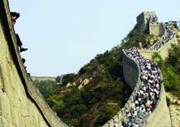
1. How did the writer feel about staying at home on National Day?
A. He believed it was interesting to stay at home on National Day.
B. He believed it was boring to stay at home on National Day.
C. He felt lucky to stay at home on National Day.
D. He felt sorry to stay at home on National Day.
2.How many days can people have a break on the Spring Festival.
A. 5 days B.7 days C.10 days D 15 days
3.Which of the following is TRUE about the Great Wall on National Day?
A. You could find yourself easily on the photos you took that day
B. You could walk as you like on the Great Wall
C. There were about 30 people per meter.
D. All that could you see on the Great Wall were people.
4.Where do you think is the article from?
A. www.chinabus.com B. www.movies123.com
C. www.chinatourist.com D. www.storyhouse.com
根据对话内容,在空白处填写适当的话语(话语可能是一个句子,也可能是一个短语或一个词),使对话完整。(5分)
A: Hi. Bill! You’re reading the novel again.
B: Yes, Tom. I’ll never be tired of it.
A: (1) ______________ have you read it?
B: Three times. Every time I read it, I can always learn something new.
A: Really? (2) _________________________
B: Charles Dickens. I think he is a great English writer.
A: He is also my (3)________ foreign writer. Please let me have a look at it.
B: OK, here you are! … What do you think of it?
A: I think(4)__________________. I haven’t seen such a good novel for long. Where did you buy it?
B: In the Rose Bookshop.
A: I don't know where it is. (5) _________________
B: No. Only ten minutes’ walk from here, next to the People’s Cinema.
Recently, CCTV reporters asked many people a simple question, “Are you happy?”
1._________ Even Mo Yan, who recently won a Nobel Prize, responded by saying, “I don’t know.”
While the question has become a popular phrase and the Internet plays host to heated discussions, we ask, 2.__________________
Last year, China’s Premier Wen Jiabao told the nation, “We do everything to let people live more happily.” At last year’s Nation’s People’s Congress(人代会), officials agreed that increasing happiness would be a top goal for the 12th five-year- plan.
Many think that happiness is difficult to describe and that it is from many ways. 3.___________ For some, happiness can be as simple as having enough money to buy a new bicycle; for others, it’s about having wealth, keeping healthy or finding the perfect marriage.
Chen Shanguyan is a college student. 4._____________ “At present it relates to how well I study in a day, “ he said. “It might be linked to a good job after I graduate.”
5.______________ Does it depend on how many friends we have, or whether we own the latest smartphone? Is it even quantifiable(量化)?
Economists(经济学家) are trying to measure happiness in people’s lives. Since 1972, Bhutan’s GDP measurement has been taken the place of g Gross National Happiness index国民幸福指数), according to the people’s sense of being well-governed(管理), their relationship with the environment, their satisfaction with economic(经济的) development, and their sense of national belonging. But is well-being more easily measured?
A.What exactly is happiness and how do you measure it?
B.The question is really too difficult for us to answer.
C.Then there is the question of measuring happiness.
D.He said his idea of happiness always developed.
E.It also means different things to different people.
You may know the English letters A, B and C. But do you know there are people called ABC? You may like eating bananas. But do you know there is such a thing a "banana person"? How strange! Are these people from “another earth”? No, they are just Chinese people like you and me.
ABC means American–born Chinese. An ABC is a Chinese, but was born in the United States. Sometimes, people call an ABC a “banana person”. A banana is yellow outside and white inside — looking like a Westerner and yellow outside — looking like a Chinese.
Do you know why? Usually, ABCs know little about China or the Chinese language. Some of them don’t speak Chinese. Also, they are not interested in Chinese politics.
But if ABCs can not speak Chinese, can we still call them Chinese people? Yes, of course. They are Chinese. They are overseas Chinese. These people may be citizens (公民)of another country like the US, Canada or Singapore. But they have Chinese blood.Their parents, grandparents or even great-grandparents were from China. They all have black eyes and black hair. But they are not Chinese citizens. They are not people of the People’s Republic of China. For example, we all know the famous scientist C .N.Yang (杨振宁). H e got the Nobel Prize for Physics in 1957. Chinese people love him. But he is an American citizen.
1.“ABC” in this passage means “____________”.
A.three English letters
B.a kind of banana
C.Chinese born in America
D.Americans born in China
2.Chinese in Western countries are called “banana persons” because _______.
A.their bodies are white inside but yellow outside
B.they think like Westerners but look like Chinese
C.they were born in China but got to study in America
D.they like to eat bananas
3.He underlined word “blood” may probably mean__________.
A.国籍 B.血统 C.爱心 D.皮肤
4.N.Yang is mentioned (提到) here to show that ____________
A.American Chinese are great.
B.We love American Chinese.
C.Chinese people can win Nobel Prizes.
D.American-Chinese are not Chinese citizens.
5.This passage mainly talks about _____.
A. different kinds of bananas
B. overseas Chinese
C. the Nobel Prize
D. the life story of C.N. Yang
湖北省互联网违法和不良信息举报平台 | 网上有害信息举报专区 | 电信诈骗举报专区 | 涉历史虚无主义有害信息举报专区 | 涉企侵权举报专区
违法和不良信息举报电话:027-86699610 举报邮箱:58377363@163.com