
题目列表(包括答案和解析)
听力部分(共30分)
一.听力理解(本大题共25小题,其中1-20小题,每小题1分,21-25小题,每小题2分。)
A.听句子,选出与其意思相符的图画。(本大题有5小题,每小题1分,共5分,每小题听一遍)
1.What’s the boy talking about(谈论)?
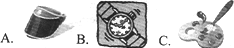
2.Which is David Brown?

3.What does the boy like?

4.Where is the basketball?

5.What does the boy eat every morning?
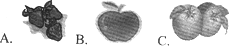
B.听对话(根据所听对话内容回答每段对话后面的问题,在各题所给的三个选项中选出一个最佳答案,每段对话听两遍。)
听第一段对话,完成第6小题
6.What’s the girl’s sister’s name?
A.Mary
B.Ann
C.Gina
听第二段对话,完成第7小题
7.What’s Jack’s telephone number?
A.290-2381
B.290-2831
C.223-9081
听第三段对话,完成第8小题
8.What does Linda eat for breakfast?
A.Carrots
B.Broccoli
C.Bananas
听第四段对话,完成第9小题
9.Does the boy like tennis?
A.Yes, he does.
B.No, he doesn’t.
C.I don’t know.
听第五段对话,完成第10小题
10.Where’s Alice’s hat?
A.It’s in the lost and found case.
B.It’s on the bed.
C.We don’t know.
听第六段对话,完成第11-12小题
11.What color is the ruler?
A.Black.
B.Red.
C.Black and red.
12.Whose ruler is it?
A.Lucy’s.
B.Lucy’s cousin’s.
C.The boy’s.
听第七段对话,完成第13-15小题
13.What does the girl want Tom to bring to her?
A.Some apples.
B.A pear.
C.Two bananas
14.What does the girl like to eat for lunch?
A.Only bananas.
B.A hamburger and some salad.
C.A hamburger, some salad and bananas.
15.What does Tom like to eat for lunch?
A.Chicken and apples
B.Chicken and pears
C.French fries and pears
C.听短文(根据所听的内容,在每小题给出的三个选项中,选出一个能完成句子的最佳答案,短文听两遍。)
16.What’s Holly’s family name?
A.Hand.
B.Brown.
C.Miller.
17.What’s Holly’s school ID card number?
A.1034.
B.1125.
C.1056.
18.How many ping-pong bats does Holly have?
A.Six.
B.Five.
C.Four.
19.Where are Holly’s ping-pong balls?
A.Under the bed.
B.In the drawer.
C.On the bookcase.
20.What does Holly play in the afternoon?
A.Ping-pong.
B.Basketball.
C.Soccer.
D.听填信息(你将听到一段对话或独白,根据所听内容,完成下面的信息采集表。录音听两遍。)
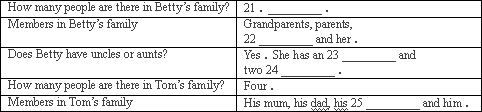
听力(25分)
(一).听句子(5分)
在每小题内,你将听到一个句子,并看到供你选择的3个单词或短语。每个句子读一遍。请在每小题A、B、C三个选项中选出你所听到的单词或短语。
1.A.lamb
B.name
C.time
2.A.luck
B.leg
C.neck
3.A.sounds
B.sons
C.salad
4.A.word
B.walk
C.work
5.A.how about
B.think about
C.ask about
(二)情景反应:根据你听到的句子选择适当答语。(5分)
6.A.I’m glad.
B.I have a stomachache.
C.I don’t know.
7.A.Once.
B.Once a week.
C.A week.
8.A.Yes, I do.
B.Yes, I can.
C.Yes, I have.
9.A.I’m tired.
B.No, you are tired.
C.Yes, very much.
10.She can’t sleep.
B.He can’t sleep.
C.I can’t sleep.
(三)听句子。
在每小题内,你将听到一个句子,请在每小题A、B、C三个选项中选出1个与你所听到的句子意义最接近的句子。(5分)
11.A.They often go to the movies every day.
B.they often go to the movies once a week.
C.They often go to the movies on Saturdays.
12.A.What’s wrong with you?
B.What’s your name?
C.What meat is in your Pizza?
13.A.Mary and Jim are in the same class.
B.Mary and Jim are not in different grades.
C.Mary and Jim are not in the same grade.
14.A.I am going to Paris.
B.Tom and I are going to Paris.
C.Tom is going to Paris.
15.A.We had a good time in the park last Sunday.
B.We loved the park very much.
C.Last Sunday we were in the park.
(四)对话理解。(5分)
根据你听到的对话内容选择正确答案。
16.A.He has a backache.
B.He has a stomachache.
C.He has an ache in his head.
17.A.Maybe she has a cold.
B.Maybe she has toothache.
C.Maybe she has a fever.
18.A.Coffee and milk.
B.Milk with honey.
C.Tea with honey.
19.A.Once a week.
B.Twice a week.
C.Three times a week.
20.A.Because she is stressed out.
B.Because she is very tired.
C.Because she isn’t feeling very well.
(五)短文理解。
听短文,回答下面问题。(5分)
21.What’s the young man doing by the road?
A.He is drinking something.
B.He is eating something.
C.He is reading something.
22.What does the young man do when he sees the policeman?
A.He says “Hello” to him.
B.He gets up and runs away.
C.He is waiting for him.
23.Why does the policeman run after the young man?
A.Because he thinks the young man is a thief.
B.Because he knows the young man.
C.Because he wants to know who runs faster.
24.Why does the young man run?
A.Because he is afraid of the policeman.
B.Because he likes running.
C.Because the doctor tells him to run after eating.
25.What does the young man look like?
A.He is a thief.
B.He is fat.
C.He is twenty.
| 幼时 | | |
| 初中 | “我”认为父亲是想白吃人家养的鱼儿去敲蔡婆家的门 | “我”不理解父亲 |
| 大学毕业 | | |
| A.文中有两条线索,明线是人与人之间真挚温暖的情谊,暗线是“敲门”“送鱼”。一明一暗两条线索串连起前后两个故事。 |
| B.文中共写了父亲两次“笑”。第一次,面对“我”的误解与责问,父亲的“笑”表明了他的宽厚大度。第二次,面对“我”的赞美,老实的父亲表现出了纯朴、实在、厚道。 |
| C.文中插叙了爷爷的故事,交代了父亲之所以常去敲蔡婆的门的原因,回应了上文“我”的一连串疑问与不解,使文章更吸引人。 |
| D.结尾用了议论和抒情的表达方式,点明了主旨,给读者以启迪。 |
湖北省互联网违法和不良信息举报平台 | 网上有害信息举报专区 | 电信诈骗举报专区 | 涉历史虚无主义有害信息举报专区 | 涉企侵权举报专区
违法和不良信息举报电话:027-86699610 举报邮箱:58377363@163.com