题目列表(包括答案和解析)
( A )
Cut the Carbon Footprint
 Everything you do leaves a “ carbon footprint”(碳足迹). For example, When you travel in a taxi, the car gives off (排放) CO2 into the air. CO2 is a greenhouse gas. Greenhouse gases make the earth become warm. To protect our environment, we need to leave less of a “carbon footprint”. How big is your carbon footprint? To get an idea, take a look at the following numbers.
Living areas
l TV sets and DVD players produce 723kg of CO2 a year.
l If you turn them off when you’re not using them, you can cut that number by 108kg.
Laundry room (洗衣房)
Drying clothes in a dryer produces a lot of CO2
l If you use your dryer five times per week, you produce 185kg of CO2 per year.
l Dry your clothes in the sun instead.
Bathroom
l If you take an eight-minute shower every day, you produce 616kg of CO2 a year.
l If you only use six minutes to take a shower, you can cut that number by 154kg a year.
根据短文内容,判断下列句子的正误,正确的用“T”,错误的用“F”。 1 CO2 is a greenhouse gas that can make the earth warm.
2 Watching TV and traveling in a taxi can produce little CO2.
3 If we use a dryer five times per week, we produce 154kg of CO2 per year.
4 If we spend less time taking a shower, we can cut the number of CO2.
5 The less of a “ carbon footprint” we leave, the better our environment will become.
( B )
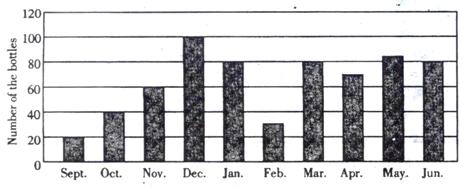
The students of Grade 9 at the Clean City School collect empty bottles. In June, they are going to take them to a recycling centre. They’re going to sell the bottles and buy some books for the school library.
Jimmy has started a graph (图表) to show the number of the bottles they have collected. This is the graph.
|
请根据短文内容,选择最佳答案。
6 How many bottles did the students collect in October?
A. 40 B. 60 C. 75 D. 85
7 The students collected more bottles in December than in February.
A. 60 B. 30 C. 20 D. 70
8 The students collected the same number of bottles in March and .
A. January and November B. January and June
C. May and June D. April and May
9 In which month did the students collect the fewest bottles?
A. September B. October C. February D. December
10 Why do the students collect the empty bottles?
A. Because they are in the Clean City School.
B. Because they are in Grade 9.
C. Because they wanted to start a graph.
D. Because they want to do something good for the school library.
( C )
The world is becoming smaller by using modern traffic, TV, telephone and so on. Life today is easier than it was hundreds of years ago, but it has also brought new problems. One of the biggest is pollution. Pollution comes in many ways. We see it, smell it, drink it and even hear it.
The more people, the more pollution. Many years ago, the problem was not so serious because there were not so many people. Man is now slowly polluting the whole world.
Air pollution is still the most serious. It’s bad to all living things in the world. Water pollution kills our fish and pollutes our drinking water, noise pollution makes us become angry more easily. The pollution of SO2 is now the most dangerous problem of air pollution. It is caused by heavy traffic. It is true that if there are fewer people driving, there will be less air pollution.
Many countries are making rules to fight pollution. They stop people from burning coal in houses and factories in the city. So the less pollution there is, the better life people will have.
请根据短文内容,选择最佳答案。
11Our world is becoming much smaller__________.
A. because of science development B. because there are fewer people
C. because there are more people D. Because the earth is being polluted day and night
12 Hundreds of years ago, life was _________ it is today.
A. easier than B. as easy as C. harder than D. as hard as
13 Pollution comes in many ways . We can even hear it. Here “it” means_______.
A. air pollution B. noise pollution C. water pollution D. soil pollution
14 Air pollution is the most serious kind of pollution because________.
A. it makes much noise B. it’s bad to all living things in the world
C. it has made our rivers and lakes dirty D. it causes unhealthy food
15 Which of the following is NOT true?
A. Many countries are making rules to fight pollution.
B. The pollution of the earth grows as fast as the world’s population does.
C. There will be less air pollution if fewer people drive cars.
D. The problem of pollution is not so serious because there are so many people.
English words do not stay the same. People need new words for new ideas and new inventions. Different words come into use, or older words are used in a new way.
English can change by borrowing words from other languages. The word "tomato" was borrowed from Mexico, and "tea" came from China and so on. Now new space and science words are being borrowed from other countries, too. New words are formed by adding two words together. "weekend" and "cookbook" are made up of two parts. Sometimes new words are shorter forms of older words. The word "photo" was made from "photograph" by cutting off the end of the longer word. "Plane" was made by cutting off the front part of "airplane". The names of people and products can become new words. Our "sandwich" was named after a man. "Sandwich" and "Sello" was a name given by the company that first made the product.
l. New English words are needed because________.
A. people use old words in a new way
B. people need a new way to explain things
C. the world is changing and developing quickly
D. new ideas and new inventions appear constantly
2. Which of the following words was taken to England from another country?
A. Plane. B. Sandwich. C. Tomato. D. Weekend.
3. We know from the passage that
A. new science words are shorter than the old ones
B. the best way to make a new word is adding words together
C. some new English words come from company names
D. most new English words are borrowed from other languages
4. How many ways of developing English words does the passage tell us?
A. Three. B. Four. C. Five. D. Six.
5. The main idea of this passage is
A. that the English language is always changing
B. that there are new ideas in English today
C. how people name new products and inventions
D. how the change of languages goes on in the word
All over the world, the global diet includes fast food—prepared items from inexpensive restaurants, snack bars, or food stands. Some examples of American fast food are hamburgers, hot dogs, sandwiches, fried chicken, and so on. Some types of international fast foods might be German sausage and Schnitzel, Italian pizza, Japanese sushi and tempura, Chinese eggrolls and noodles and the like. The variety of fast foods all over the world is growing. Even so, this kind of style is becoming worldwide. Fast-food places usually prepare and serve the items quickly. Many are part of fast-food chains (eating places with the same name and company owner). For example, the biggest and most famous American fast-food chain serves hamburgers in nearly every part of the world.
For several reasons, many people choose fast food. First, it is quick and convenient. Second, it is cheaper than special home-cooked meals or formal restaurant dinners. And third, it is easy to find every eating place with the same company name. The atmosphere and style of most fast-food places is casual, comfortable, and familiar.
Why do other eaters stay away from this fast, easy kind of nourishment? The main reason is its low nutritional value. Fast food doesn’t have large amounts of fiber, vitamins, minerals, and the like-elements necessary for good nutrition and health. In contrast (相反), most types of fast food have a lot of fat, sugar, or salt in them. Possibly, these things can cause or increase health disorders, like heart disease, and some kinds of cancer. Recently, these quick and easy kinds of world wide nourishment are generally getting better and more healthful. For example, many fast-food restaurants now have put vegetable items on their menus.
Of course, human beings around the world don’t always eat in fast-food places.The variety of food choices is large now and is probably going to increase. The number of food preparation methods is growing too. Cooking customs, eating habits, and food preferences all over the world are becoming more healthful. In these and other ways, the global diet is changing.
1. From Paragragh 1,we can know that __________________.
A. America serves four kinds of fast food
B. we used to have more types of fast food
C. different countries have different types of fast food
D. America serves fewer fast food than other countries
2. The underlined phrase “stay away from” means __________.
A. move away from B. disorder C. get out of D. dislike
3.The passage is mainly about ___________.
A. the changing global diet
B. the increasing types of diet
C. the reason why people choose fast food
D. the reason why people dislike fast food
There are differences between western culture and Chinese culture. We can see differences when we pay attention to the way words are used. Let’s look at the words about animals and plants. Most expressions in Chinese is about the dog, for example, “a homeless dog”, “a mad dog”, “a running dog” and “a dog catching a mouse”, have negative(消极) meanings. But in western countries, dogs are thought to be honest and good friends of humans. In English, people use the dog to describe positive(积极的) actions. For example, “you are a lucky dog” means you are a lucky person. And “every dog has its day” means each person has good luck sometimes. To describe a person’s serious illness, they say “sick as a dog”. The word “dog—tired” means very tired. However, Chinese love cats very much. But in western culture, “cat” is often used to describe a woman who is cruel(冷酷的). There are many other examples of how “cat” is used differently as well.
The rose is regarded as a symbol of love in both China and some western countries. People think the rose stands for love, peace, courage and friendship. And the rose is the national flower of England, America and many other countries.
The words about plants and animals are used in positive or negative ways in different cultures. We can learn about many differences in cultures by comparing how some words are used.
1.The word “dog” in Chinese usually ______.
A. stands for friendship B. has a negative meaning C. has a positive meaning
2.“Every dog has its day.” means “______”
A. Everybody in the world is lucky. B. Each person lives his own way of life.
C. Everybody has a time in life to be lucky.
3. Western people usually use “cat” to refer to “______”.
A. a tired person B. a brave man C. an unkind woman
4. Which of the following is TRUE according to the passage?
A. Words show differences in cultures.
B. Western people think cats to be good friends.
C. Rose is the national flower of all western countries.
5. This passage mainly tells us ______.
A. negative or positive things B. different countries have different cultures
C. what dog and cat mean in English and Chinese
湖北省互联网违法和不良信息举报平台 | 网上有害信息举报专区 | 电信诈骗举报专区 | 涉历史虚无主义有害信息举报专区 | 涉企侵权举报专区
违法和不良信息举报电话:027-86699610 举报邮箱:58377363@163.com