
题目列表(包括答案和解析)
阅读短文,根据短文内容回答问题。(共10分,每小题2分)
We need to be responsible for our environment. Being a frugal consumer(节俭的消费者) is one way to help. But, what exactly does that mean?
Use It Up
You can use things up instead of wasting them. Squeeze that last bit of toothpaste out of the tube. Use the last little piece of soap. Don't throw away any bits of the biscuit at the bottom of the box.
Wear It Out
You do not always need to have new things. Suppose your sneakers have broken laces, but they still fit you. Repair them and wear them longer. You don't have the latest iPhone until the old one doesn't work anymore. Then you can get a new one. Think twice before replacing something that still works.
Make It Do
When something you want is not on hand, look for something else that you already have to take its place. Suppose you are packing your lunch for tomorrow and want a butter sandwich. You are out of butter. Have a cheese sandwich instead so that you can use all of the cheese. Learn to fix broken toys instead of just throwing them away. With a little thought, you can make something do, instead of buying something new.
Do Without
Think about all those things that you would like to have. Do you really need them? How long will you really play with that new toy you saw on TV? Making the things that we want uses up your world's resources(资源). And, getting rid of the things we don't want any more takes up even more resources and space.
1.Do we need to be responsible for our environment?
2. How do we deal with the last little piece of soap?
3.When do we need to get a new iPhone?
4. What should we do when something we want is not on hand?
5.What does the writer want to tell us?
Suppose you are a football fan and have to work from 9:00a.m. to 5:00 p.m. on weekdays. Now you are reading the TV guide online of Sunshine Town TV(STTV) and looking through the TV programmes of Wednesday, November 21,2012.
|
TV Channel |
TV Programmes Wednesday, November 21,2012 |
|
STTV-1 |
14:05 TV Play: Come Back Home 16:05 A Glimpse(一瞥) of London 18:10 35-part Series: Love for the Pearl River 19:50 Approaches to Science 20:10 News STTV English Service 20:40 The World Football Cup (France vs. England) |
|
STTV-2 |
14:30 The World Football Cup (America vs. Italy) 16:30 TV Play: True Feeling 19:00 Children’s Programmes 19:30 Animal World 20:00 Countryside Life 21:00 American Professional Basketball Matches |
|
STTV-3 |
14:15 Sports Programmes (Cycling) 16:20 Science Age 19:00 Music Bridge 19:35 Film: Gone with the Wind 21:00 Chinese Programmes for Foreigners 22:03 TV Theaters |
1.Which programme would you prefer when you are free?
A.STTV-1 The World Football Cup (France vs. England)
B.STTV-2 The World Football Cup (America vs. Italy)
C.STTV-3 Sports Programmes (Cycling)
D.STTV-2 American Professional Basketball Matches
2.If your friend Tom likes countryside and animals, which channel will he choose?
A.STTV-1 B.STTV-2 C.STTV-3 D.None of the above
3.Which of the following programmes takes the least time?
A.Approaches to Science B.Film: Gone with the Wind
C.Countryside Life D.35-part Series: Love for the Pearl River
Winter is dangerous because it’s so difficult to know what is going to happen and accidents take place so easily. Fog can be waiting to meet you over the top of a hill. Ice might be hiding under the melting(融化)snow, waiting ahead to send you off the road. The car coming to you may suddenly slip across the road.
Rule Number One for driving on icy roads is to drive smoothly(平稳地). Sudden movements can make a car very difficult to control. So every time you either start or stop your car, increase or reduce your speed, you must be as gentle and slow as possible. Suppose you are driving with a full cup of hot coffee on the seat next to you. Drive so that you wouldn’t spill(溅) it.
Rule Number Two is to pay attention to what might happen. The more ice there is, the further down the road you have to look. Test how long it takes to gently stop your car. Remember that you may be driving more quickly than you think. Generally, allow twice of your usual stopping distance when the road is wet, three times this distance on snow, and even more on ice. Try to stay in control of your car at all times and you will not get into trouble.
【小题1】The writer tries to in this passage.
| A.show his dislikes about bad winter weather |
| B.give information about winter weather |
| C.ask people not to drive in winter |
| D.advise people about safe driving in winter |
| A.people should not drive in the snow |
| B.drivers should think more about problems in winter driving |
| C.people drive too fast in winter |
| D.winter drivers should stop their cars less |
| A.to show how important smooth movements are |
| B.to ask the drivers to bring some soft drinks with them |
| C.to tell the drivers to be more relaxed |
| D.to show how it can be spilled |
| A.Traffic accidents take place easily in winter. |
| B.Fog and melting snow often cause car accidents. |
| C.The stopping distance on ice is as long as the usual one. |
| D.In winter you should drive your car with great care. |


Salesman: $73.07,please.
Peter: What? Show me the receipt.
Salesman: Here it is.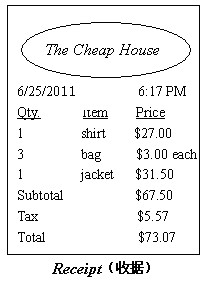
Peter:Look. The price on this shirt is $17. But the receipt says $27.
Salesman: You are right. The receipt is wrong.
Peter: And what is the $5.57 for?
Salesman: That’s for tax(税).
【小题1】The $5.57 is for the ___________.
| A.tax | B.bags | C.jacket | D.shirt |
| A.On June 17. | B.At noon. |
| C.On June 25. | D.In the morning |
湖北省互联网违法和不良信息举报平台 | 网上有害信息举报专区 | 电信诈骗举报专区 | 涉历史虚无主义有害信息举报专区 | 涉企侵权举报专区
违法和不良信息举报电话:027-86699610 举报邮箱:58377363@163.com