
题目列表(包括答案和解析)
阅读理解.
I have a rule for travel: Never carry a map. I prefer to ask for directions.
Foreign visitors are often puzzled in Japan because most streets there don't have names. In Japan, people use landmarks in their directions instead of street names. For example, the Japanese will say to travelers, “Go straight dawn to the corner. Turn left at the big hotel and go past a fruit market. The post office is across from the bus stop.”
In the countryside of the American Midwest, usually there are not many landmarks. There are no mountains, so the land is very flat. In many places there are no towns or buildings within miles. Instead of landmarks, people will tell you directions and distances. In Kansas or Iowa, for example, people will say, “Go north two miles. Turn east, and then go another mile.”
People in Los Angeles, California, have no idea of distance on the map. They measure distance by means of time, not miles. “How far away is the post office?” you ask. “Oh,” they answer, “It's about five minutes from here.” You say, “Yes, but how many miles away is it?” They don't know.
People in Greece sometimes do not even try to give directions because visitors seldom understand the Greek language. Instead of giving you the direction, a Greek will often say, “Follow me.” Then he'll lead you through the streets of the city to the post office.
Sometimes a person doesn't know the answer to our question. What happens in this situation? A New Yorker might say, “Sorry, I have no idea.” But in Yucatan, Mexico, no one answers, “I don't know.” People in Yucatan think “I don't know” is impolite. They usually give an answer, often a wrong one. A visitor can get lost in Yucatan!
One thing will help you everywhere-in Japan, in the United States, in Greece, in Mexico, or in any other place. You might not understand a person's words, but maybe you can understand his body language. He or she will usually turn and then point in the correct direction. Go in that direction, and you may find the post office.
1.The passage mainly tells us that ________.
[ ]
A.there are not many landmarks in the American Midwest
B.never carry a map for travel
C.there are different ways to give directions in different parts of the world
D.New Yorkers often say, “I have no idea,” but people in Yucatan, Mexico never say this
2.The passage says, “In Japan, people use landmarks in their directions.” The word “landmark” mean ________.
[ ]
A.streets names
B.building names
C.hotels, markets and bus stops
D.buildings or places are easily recognized
3.In which place do people tell distance by means of time?
[ ]
A.Japan.
B.American Midwest.
C.Los Angeles, California.
D.Greece.
4.In the passage, ________ countries are mentioned by the writer.
[ ]
5.Which of the following is wrong?
[ ]
A.Travelers can learn about people's customs by asking questions about directions.
B.People in some places give directions in miles, but people in other places give directions by means of time.
C.A person's body language can help you understand directions.
D.People in different places always give directions in the same way:They use street names.
口语运用
A、根据对话及方框中的选项补全对话。
| A. We can watch a video. B. Our house is across from the supermarket. C. What are you doing? D. It’s on Bridge Street . E. There’s a new hotel on the corner. |
Michael: Hey, John.
John: Hi, Michael.
Michael: 1
John: Reading a book.
Michael: Do you want to come over to my house? 2
John: OK. Where is your house?
Michael: 3 It’s a quiet street off Fifth Avenue.
John: Oh, OK. I know where that is. 4
Michael: Yes. There’s a small supermarket on the street. 5
John: OK, I’ll see you at two-thirty.
1-5 ___________________
B、对话排序 (5分)
你在这个城市,但对此城市不太熟悉,一天你一个人想去公园玩,但你又必须先到旅馆去看一位你的好朋友,然后出来后再去银行取一些钱,最后才去公园。对话中的A表示你,B是警察,请根据下列图示及句子,把下列句子排列成一段通顺的对话。
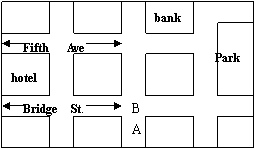
1. A: Excuse me. Can you tell me the way to the park?
2. B: Oh, I see. You can go straight and turn right on the first crossing, you’ll find a white building(建筑物). That’s the hotel.
3. A: How can I get to the bank after I go out of the hotel?
4. B: Oh, it is in the east(东面)of the city. You can go …
5. A: I’m sorry, I may tell you that before(在…..以前)I get to the park, I’ll have to go to the hotel to see my good friend, and then I’ll go to the bank to get some money.
6. B: That’s not difficult. After walking out of the hotel, please turn left and walk about 100 m. You will get to Fifth Avenue. Then turn right and the bank is on the right.
7: A: OK. Thanks a lot.
8. B: No, very near. Going out of the bank, you go back to the Fifth Avenue. Turn left and go straight, there is a park on the left.
9. A: Is the bank far(远) from the park?
正确顺序:___ 4___ ___ ___ ___ ___ ___ ___
湖北省互联网违法和不良信息举报平台 | 网上有害信息举报专区 | 电信诈骗举报专区 | 涉历史虚无主义有害信息举报专区 | 涉企侵权举报专区
违法和不良信息举报电话:027-86699610 举报邮箱:58377363@163.com