
题目列表(包括答案和解析)
Do you speak English? Do you speak e-mail English? Maybe you don’t. E-mail English is a new kind of English that many people use to save time. A lot of e-mail English words come from a computer program called QQ, which means I seek(寻找)you. Ian Lancashire, a Canadian teacher, likes QQ, “People can use QQ to talk with each other using computer. But, you have to be able to type quickly or the other person will be bored. So e-mail English can give some help.”
A message in e-mail English mostly uses two kinds of new words. The first kind is made up of the first letters of the words. These are called acronyms. The second kind is homophones,letter combination(合并), symbols that sound like other words.
Acronyms in an e-mail save space and time. It takes a long time to write by the way. BTW is much faster. Other acronyms are F2F which stands for face to face, CSL for can’t stop laughing and DBEYR for don’t believe everything you read! Some of the acronyms look like strange words, such as SWAK. But this one means sealed(封口) with a kiss.
Homophones often use letters and numbers that sound like words or parts of words. For example, 8 sound like—eat in great, to save time, people write gr8. Another example is CU for see you or sometimes CU l8r (see you later)
The number 2 is used for to or too and the number 4 is used instead of for.
Another part of e-mail is emotive symbols(表情符号) which make faces when you look at them sideways. The most common emotive, is the happy face :). A comma (逗号) is often used to help add other parts of the face and show different expressions.
E-mail English is fun. An e-mail message with lots of e-mail English starts to look like secret code(密码). Your best friend will probably understand it, but your parents and teachers may not. In fact, many teachers don’t like e-mail English. It’s not just because they can’t comprehend what it means. It’s because students start to use e-mail English in their everyday writing. E-mail English is great for writing quickly. But most teachers say that e-mail English should only be used in e-mails to one’s friends.
【小题1】What does the writer talk about in the first paragraph?
| A.How to read new e-mail words. |
| B.How new e-mail words are made. |
| C.Why people use e-mail English. |
| D.Canadian teachers and their e-mails. |
| A.accept | B.understand | C.guess | D.prefer |
| A.Parents will have to learn some e-mail English. |
| B.E-mail English will develop our everyday writing. |
| C.E-mail English can’t be used among schoolmates. |
| D.E-mail English shouldn’t be used in school writing. |
| A.E-mail English on Computer. | B.American E-mail English. |
| C.The Forms of E-mail English. | D.The Changing of English. |
Do you speak English? Do you speak e-mail English? Maybe you don’t. E-mail English is a new kind of English that many people use to save time. A lot of e-mail English words come from a computer program called QQ, which means I seek(寻找)you. Ian Lancashire, a Canadian teacher, likes QQ, “People can use QQ to talk with each other using computer. But, you have to be able to type quickly or the other person will be bored. So e-mail English can give some help.”
A message in e-mail English mostly uses two kinds of new words. The first kind is made up of the first letters of the words. These are called acronyms. The second kind is homophones,letter combination(合并), symbols that sound like other words.
Acronyms in an e-mail save space and time. It takes a long time to write by the way. BTW is much faster. Other acronyms are F2F which stands for face to face, CSL for can’t stop laughing and DBEYR for don’t believe everything you read! Some of the acronyms look like strange words, such as SWAK. But this one means sealed(封口) with a kiss.
Homophones often use letters and numbers that sound like words or parts of words. For example, 8 sound like—eat in great, to save time, people write gr8. Another example is CU for see you or sometimes CU l8r (see you later)
The number 2 is used for to or too and the number 4 is used instead of for.
Another part of e-mail is emotive symbols(表情符号) which make faces when you look at them sideways. The most common emotive, is the happy face :). A comma (逗号) is often used to help add other parts of the face and show different expressions.
E-mail English is fun. An e-mail message with lots of e-mail English starts to look like secret code(密码). Your best friend will probably understand it, but your parents and teachers may not. In fact, many teachers don’t like e-mail English. It’s not just because they can’t comprehend what it means. It’s because students start to use e-mail English in their everyday writing. E-mail English is great for writing quickly. But most teachers say that e-mail English should only be used in e-mails to one’s friends.
1.What does the writer talk about in the first paragraph?
A. How to read new e-mail words.
B. How new e-mail words are made.
C. Why people use e-mail English.
D. Canadian teachers and their e-mails.
2.The underlined word “comprehend” in the last paragraph means “_______”.
A. accept B. understand C. guess D. prefer
3.What do teachers insist according to the passage?
A. Parents will have to learn some e-mail English.
B. E-mail English will develop our everyday writing.
C. E-mail English can’t be used among schoolmates.
D. E-mail English shouldn’t be used in school writing.
4.What’s the title for this passage?
A. E-mail English on Computer. B. American E-mail English.
C. The Forms of E-mail English. D. The Changing of English.
Complete the e-mail below with‘before’,‘after’and‘until’.
Hi Amy
I hope you are doing fine at school.
Today is my second day in Shanghai. (1)________ I had breakfast at the hotel coffee shop in the morning, I went to the office. I did not know they had so many problems (2)________ I spoke to the clerks there. They told me that they took some computer courses (3)________ they started to use computers in the office but they still could not use them well. You are really lucky, Amy. You have the chance to learn about computers (4)________ you start working in society.
(5)________ I had visited the Shanghai office, we went to the Oriental Pearl Radio and TV Tower, I did not know how tall it is (6)________ I saw it myself. I bought some souvenirs there (7)________ I left. I think you will like them. (8)________ I finish, I must remind you to record my TV programmes. When I come back, I will watch all of them (9)________ I go to bed.
Dad
听力部分
Ⅰ.听句子,选出句子中所包含的信息。(共5小题,每小题1分,计5分)
1.A.lesson
B.list
C.license
2.A.go to the station
B.ask a question
C.take a vacation
3.A.jks9645@126.com
4.A.I’m leaving by air.
B.Tom’s leaving by air.
C.They’re leaving together by air.
5.A.They will meet each other soon.
B.They met somewhere not long ago.
C.They haven’t seen each other for a long time.
Ⅱ.听句子,选出该句的最佳答语。(共5小题,每小题1分,计5分)
6.A.Noodles.
B.Coke.
C.Roses.
7.A.I’m working.
B.I’m very well.
C.I’m busy now.
8.A.That’s right.
B.I don’t know.
C.Sorry, you’d better not.
9.A.Be careful!
B.Never mind.
C.Not at all.
10.A.Good idea!
B.Enjoy yourself!
C.Thank you!
Ⅲ.听对话和问题,选择正确的选项。(共5小题,每小题1分,计5分)
11.What are they talking about?
A.A job.
B.A test.
C.A text.
12.Where do you think the woman will be tonight?
A.At a cinema.
B.At a friend’s.
C.At home.
13.What does the girl do before going to school?
A.Wash her face and eat breakfast.
B.Eat breakfast and help her mom.
C.Wash her face and cook breakfast.
14.Which season does Grandma like best?
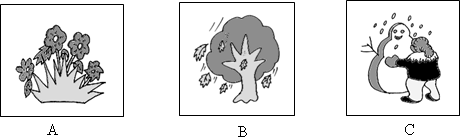
15.Why does the woman go to see the doctor?
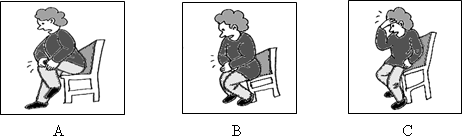
Ⅳ.听语段、对话和问题,选择正确答案。(共10小题,每小题1分,计10分)
16.Which lesson are they going to learn?
A.Lesson 8.
B.Lesson 16.
C.Lesson 18.
17.What will the students do first?
A.Have a free talk.
B.Choose the best answer.
C.Listen to a conversation.
18.How often does Chris use the Internet?
A.Once a week.
B.Twice a week.
C.Once every two weeks.
19.What does Chris do online?
A.Chatting, shopping and reading books.
B.Watching films, making friends and chatting.
C.Listening to music, playing games and reading.
20.Where is the e-mail from?
A.England.
B.China.
C.USA.
21.What’s Bill’s trouble?
A.He can’t go to college in the United States.
B.He gets a headache and wants to see a doctor.
C.He doesn’t know which university to choose.
22.Who is asking Linda questions?
A.A friend.
B.Her brother.
C.A reporter.
23.What does Linda do?
A.She’s a singer.
B.She’s a student.
C.She’s a salesgirl.
24.Where did Linda buy the blouse?
A.At a small store.
B.At a big store.
C.In a supermarket.
25.How much is the hat?
A.$120.
B.$55.
C.$65.
湖北省互联网违法和不良信息举报平台 | 网上有害信息举报专区 | 电信诈骗举报专区 | 涉历史虚无主义有害信息举报专区 | 涉企侵权举报专区
违法和不良信息举报电话:027-86699610 举报邮箱:58377363@163.com