Although most people believe that laughter is one of the nature’s great treatments for a whole range of mental and physical diseases, it is still a serious scientific subject that researchers are trying to figure out.
“Laughter above all else is a social thing,” says Baltimore neuroscientist(神经科学家), Robert Provine, who has studied laughter for many years. “All laughter groups laugh ‘ha-ha-ha’ basically the same way. Whether you speak Mandarin, French or English, everyone will understand laughter. There is a pattern generator(发生器) in our brain that produces this sound.”
Laughing is our first way of communicating. Babies laugh long before they speak. No one teaches them how to laugh. They just do. People may laugh at a prank(恶作剧) on April Fools’ Day. But surprisingly, only 10 to 15 percent of laughter is the result of someone making a joke. Laughter is mostly about social responses rather to a joke. Deaf people laugh without hearing and people on cell phones laugh without seeing, showing that laughter isn’t dependent on single sense but on social interactions.
And laughter is not just a people thing. Chimps tickle(挠痒) each other and even laugh when another chimp pretends to tickle them.
Jaak Panksepp, a Bowling Green University Psychology professor, studies rats that laugh when he tickles them. It turns out rats love to be tickled — they return again and again to the hands of researchers tickling them.
By studying rats, scientists can figure out what’s going on in the brain during laughter. Northwestern University biomedical engineering professor, Jeffrey Burgdorf has found that laughter in rats produces a chemical that acts as an antidepressant(抗抑郁药). He thinks the same thing probably happens in humans, too. This would give doctors a new chemical target to develop drugs that can fight depression.
Even so, laughter itself has not been proved to be the best medicine, experts said. Margaret Stuber, a professor at University of California, studied whether laugher helped patients. She found that distraction(分心) and mood improvement helped, but she could not find a benefit of laughter alone.
“No study has shown that laughter produces a direct health benefit,” Provine said, mainly because it’s hard to separate laughter from just feeling good. But he thinks it doesn’t really matter: “Isn’t the fact that laughter feels good when you do it enough?”
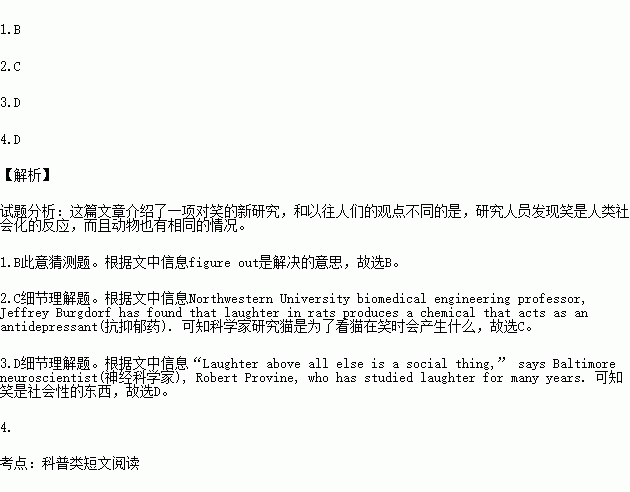
1.The underlined word “figure out” in Paragraph 6 means “________”.
A. deal with B. work out
C. look out of D. come up with
2.According to the passage, scientists studied rats in order to find ______.
A. how they laugh
B. if they like laughing
C. what laughter in rats produces
D. how rats react while being tickled
3.What can we know from Robert Provine’s research?
A.Laughter makes a person feel good.
B.Laughter produces a direct health benefit.
C.Laughter depends on all kinds of senses.
D.Laughter is a way of communicating.
4.What is probably the best title for this passage?
A. Why Rats Laugh
B. When Laughter Happens
C. How Laughter Works
D. Why Laughter Matters
 天天向上一本好卷系列答案
 小学生10分钟应用题系列答案
科目:初中英语 来源:2014-2015学年广东省汕头市金平区中考模拟英语试卷(解析版) 题型:单项填空
--- Time for bed, Dear. --- Not yet, Mum. I _____ until I _____ going over my lessons.
A. will stay up; finish B. stays up; will finish
C. won’t stay up; finish D. don’t stay up; will finish
查看答案和解析>>
科目:初中英语 来源:2014-2015学年广东汕头市毕业生学业考试英语试卷(解析版) 题型:单项填空
This is empty glass. Would you please give me full one.
A. a; an B. an; a C. the; a D. an; the
查看答案和解析>>
科目:初中英语 来源:2014-2015学年福建龙岩市九年级学业升学质量检查英语试卷(解析版) 题型:单项填空
—Tommy, don’t make a mess in your room.
— OK, mum. I will ______ my toys at once.
A. connect to B. play with C. put away
查看答案和解析>>
科目:初中英语 来源:2014-2015学年福建龙岩市九年级学业升学质量检查英语试卷(解析版) 题型:单项填空
—Tim, where is your sister?
—She ______ sports on the playground.
A. is doing B. does C. was doing
查看答案和解析>>
科目:初中英语 来源:2014-2015学年北京市顺义区中考一模英语试卷(解析版) 题型:单项填空
— Could you tell me your grandparents?
— Every week.
A.how often you visit
B.how often do you visit
C.how often will you visit
D.how often you will visit
查看答案和解析>>
科目:初中英语 来源:2014-2015学年北京市顺义区中考一模英语试卷(解析版) 题型:单项填空
— How do you like math?
— I think it’s than English.
A. difficult B. more difficult
C. most difficult D. the most difficult
查看答案和解析>>
科目:初中英语 来源:2014-2015学年北京市房山区燕山中考一模英语试卷(解析版) 题型:单项填空
— May I watch TV for a while?
— No, you __________. You have to finish your homework first.
A.shouldn't B.needn't C.mustn't D.won't
查看答案和解析>>
科目:初中英语 来源:2015年初中毕业升学考试(湖北荆州卷)英语(解析版) 题型:阅读理解
If you need glasses to read this, you are among most of Chinese students. About four-fifths of high school students in China have poor eyesight(视力). And now more and more children in primary school need glasses, too.
Two main reasons can cause poor eyesight: too much time spent indoors studying and too little time spent outdoors playing. Reading and writing for hours and hours, sometimes in poorly lighted rooms, causes eyesight to weaken. But students have to do this because there is so much pressure on them to succeed in school. They have less time to enjoy the sun.
The sun, it turns out, is important in developing good eyesight. According to a study by Australian National University, Australian children and Chinese children have the same level of eyesight before they start school, but once they enter primary school, Chinese children only spend about an hour a day outside, while Australian children spend three to four hours each day in the sunshine. The result is that while about forty percent of Chinese primary school students need glasses, only three percent of Australian children do.
And poor eyesight at a young age can have serious long term influence. As you get older, your eyesight can worsen.
With all that in mind, don’t you think it’s time to give your eyes a break?
1.How many high school students have poor eyesight in China according to the reading?
A. A half of them. B. Three percent of them.
C. Forty percent of them. D. Four-fifths of them.
2.Which can cause poor eyesight according to the reading?
A. Like reading and writing very much.
B. Spend too much time enjoying the sun.
C. Spend too much time indoors studying.
D. Start primary school at a young age.
3.What can we learn from the third paragraph?
A. Primary school studying can be very harmful to young students.
B. Australian children spend more time outdoors than Chinese children.
C. After primary school, children in China and Australia have the same eyesight.
D. Fewer Chinese primary school students have poor eyesight than Australian ones.
4.What does the writer want to tell us?
A. Remember to give our eyes a break.
B. Develop good eyesight in Australia.
C. Avoid poor eyesight at an old age.
D. Spend little time outdoors playing.
查看答案和解析>>
湖北省互联网违法和不良信息举报平台 | 网上有害信息举报专区 | 电信诈骗举报专区 | 涉历史虚无主义有害信息举报专区 | 涉企侵权举报专区
违法和不良信息举报电话:027-86699610 举报邮箱:58377363@163.com