At school, besides cheating on a test, a kid might cheat in other ways. They might steal someone else’s idea for a science project, or copy a book report from the Internet and hand it in as if it’s his or her work.
Cheating can happen in a lot of different ways. When people cheat, it’s not fair to other people, like the kids who study for the test or who are the true winners of a game.
Some kids cheat because they’re busy or lazy and they want to get good grades without spending the time studying. Other kids might feel like they can’t pass the test without cheating. Even though there seems to be a “good reason” for cheating, cheating isn’t a good idea.
A kid who thinks cheating is the only way to pass a test need to talk with the teacher or another grown-up. They can find some ways to help solve this problem. Talking about the problem and working it out will make him or her feel better than cheating.
Kids who cheat may feel worried about getting caught. Whether they are caught or not, these kids may feel guilty or embarrassed. Even if they feel fine or don’t get caught, that doesn’t mean it’s OK.
There’s an old saying that cheaters never win and winners never cheat. This may sound difficult to understand, because sometimes it seems like cheaters do win--- at least for the moment. However, sooner or later, they’ll pay the price. It’s just a matter of time only. And kids who don’t cheat are true winners because, when they win, they do it honestly.
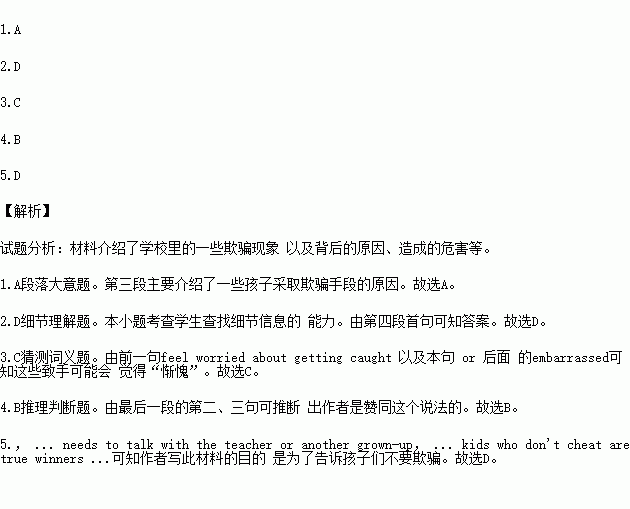
1.What does Paragraph3 mainly talk about?
A.Why kids cheat. B.How kids cheat.
C.What cheating is. D.How harmful cheating is.
2.What’s the writer’s advice to kids who want to cheat in a test?
A.To keep it a secret.
B.To try not to be caught.
C.To study hard for the test.
D.To turn to grown-ups for help.
3.What does the underlined word “guilty” in Paragraph5 mean?
A. Lucky. B. Proud. C. Sorry. D. unfair
4.What’s the writer’s attitude towards the old saying mentioned in the last paragraph?
A. He is against it.
B. He agrees with it.
C. He doubts whether it is true.
D. He thinks it is only partly true.
5.The writer wrote the passage to _______
A. introduce the different types of cheating.
B. show how popular cheating is at school.
C. tell several cheaters’ stories.
D. tell kids not to cheat.
科目:初中英语 来源:2016届广东深圳宝安区九年级第二次调研测试英语试卷(解析版) 题型:单项填空
Lily bought a new pen. And it ______ her twenty yuan.
A. spent B. paid C. cost
查看答案和解析>>
科目:初中英语 来源:2015-2016学年江苏张家港八年级下期末考试英语试卷(解析版) 题型:单项填空
一Excuse me, I'm looking for my English book.
一Oh,sorry. I took by mistake.
A. yours B. mine C. hers D. his
查看答案和解析>>
科目:初中英语 来源:2015-2016学年湖北北大附中武汉为明实验校初二下第三次月考英语卷(解析版) 题型:单项填空
The mountain I visited last Sunday isn’t very famous. Few _____ go sightseeing there.
A. tourists B. adults
C. researchers D. Passengers
查看答案和解析>>
科目:初中英语 来源:2016届山东济南商河县九年级第二次中考模拟考试英语试卷(解析版) 题型:书面表达
书面表达
假如你是李芳,某报社记者来你校采访,想了解一下学生们的读书习惯。请你根据下列提示,写一篇短文谈谈你的阅读习惯。
1.我喜欢阅读,每周花差不多三小时阅读;
2.对历史书感兴趣,最喜欢读的是......;
3.我的大多数书都是图书馆借的和书店买的;
4.关于读什么书,老师们常常给我意见;
书是好朋友,读书帮助......,也给我.......。
查看答案和解析>>
科目:初中英语 来源:2016届山东济南商河县九年级第二次中考模拟考试英语试卷(解析版) 题型:单项填空
---Katie, can you tell me _____ to the new library?
---Of course, last Sunday
A. when did you go B. when you went
C. when will you go D. when you will go
查看答案和解析>>
科目:初中英语 来源:2016届山东济南商河县九年级第二次中考模拟考试英语试卷(解析版) 题型:单项填空
--- Do your parents mind you ______ out?
--- No. But I have to return home before 9 o’clock.
A. to go B. to going C. going D. Go
查看答案和解析>>
科目:初中英语 来源:2016届山东济南商河县九年级第二次中考模拟考试英语试卷(解析版) 题型:单项填空
--- Mary, may I borrow your camera?
--- Sorry, you ______. My brother took it to Qingdao yesterday.
A. mustn’t B. needn’t C. can’t D. may not
查看答案和解析>>
科目:初中英语 来源:2016届江苏泰州沿江区域九年级第二次模拟考试英语试卷(解析版) 题型:口语应用
— Never give up. If you keep practising speaking English every day, you’ll make great progress.
—Thanks for encouraging me. I know _______.
A. practice makes perfect
B. it never rains but it pours
C. many hands make light work
D. every dog has its day
查看答案和解析>>
湖北省互联网违法和不良信息举报平台 | 网上有害信息举报专区 | 电信诈骗举报专区 | 涉历史虚无主义有害信息举报专区 | 涉企侵权举报专区
违法和不良信息举报电话:027-86699610 举报邮箱:58377363@163.com