
----It’s Father’s Day,_____?
----Yes. Let’s buy a gift for Dad.
A. isn’t it B. doesn’t it
C. isn’t he D. doesn’t he
A
【解析】
试题分析:句意:---今天是父亲节,是不是?---是的,让我们为我的父亲买个礼物,根据在反意一般疑问句,如果陈述部分是肯定形式那么问句部分用简短的否定一般疑问句;根据前面句子的谓语动词是is。结合句意,故选A
考点:考查反意一般疑问句的用法。
考点分析: 考点1:一般疑问句 一般疑问句通常用来询问一件事情是否属实。答句通常是"yes或no"。知识点拓展
1、特殊疑问句以疑问词开头,对句中某一成分提问的句子叫特殊疑问句。常用的疑问词有:what 、who 、whose 、which、 when、 where、 how 、why等。例如:
who is singing in the room?
what class are you in﹖
2、选择疑问句提出两个或两个以上可能的答案供对方选择。选择疑问句的两种或两种以上的情况用or 连接,不能用yes或no回答,而是就其选择内容直接回答。这类疑问句有两种形式:
一种是:一般疑问句+or+被选择部分?, 这一类选择疑问句通常都是在前一个供选择的答案用低升调,后一个用降调;如果有两个以上供选择的答案,则在最后一个用降调,其余都用低升调。例如: Would you like a gin,or a whisky,or a `beer? 你是要喝杜松子酒,还是威士忌酒,还是啤酒?
另一种是:特殊疑问句+被选择部分(A)+or+被选择部分(B)?,也是在语调上有所区别。例如: Which vase shall I use, the short one or the tall one ?
4、反意疑问句又叫附加疑问句,是指当提问的人对前面所叙述的事实不敢肯定,而需要向对方加以证实时所提出的问句。其结构为:前一部分是一个陈述句,后一部分是一个简单的问句。完成后一部分简单问句时,要根据前面陈述句的动词时态和人称来选择适当的助动词进行提问,前后两部分的人称和动词时态要保持一致。如果前一部分用肯定式,后一部分一般用否定式;反之,前一部分为否定式,后一部分要用肯定式,即“前肯定后否定,前否定后肯定”。 例如:They work hard, don’t they?
She was ill yesterday, wasn’t she?
They haven't been in beijing for three years,have they?
.反义疑问句的回答用yes, no, 但是,当陈述部分是否定形式时,回答要按事实。如:
They don’t work hard, do they? 他们不太努力工作,是吗?
Yes, they do. 不,他们工作努力。/No, they don’t. 对, 他们工作不努力。
注意:
1)当陈述句的主语是everyone, everybody, someone, somebody时,简短问句中的主语通常用they。如果陈述句的主语是非人称的复合词,如everything, something, anything, 则简短问句中相应的人称代词是单数的中性词it。后面的疑问句应表示为:
I am a student, aren’t I
Everyone is in the classroom, aren’t they?
Everything begins to grow in spring, doesn’t it?
Nobody will go, will they?
2)当陈述部分是I think/believe/ expect/ suppose/imagine 加从句时,疑问句应和从句的人称时态保持一致。 I think chickens can swim, can’t they?
3)当陈述部分是祈使句时,一般情况下用will you 或 won't you。
Give me a hand,will you?
4)以Let's开头的祈使句,疑问句必须用shall we;只有以Let usLet me开头的祈使句,问句才用will you。
5)There be 句型中,反义疑问部分必须为be 动词 + there.
6)当陈述部分有never,seldom, hardly,few,little,barely, nothing 等否定词时,后面的疑问句则必须用肯定式。
常见考法
对于陈述句和疑问句的考查,常会以单选,完形填空或句子填空的形式出现。考查知识点往往集中在反意疑问句的构成与回答、选择疑问句或陈述句与疑问句的转换方面。
典型例题:I don't think he is bright, ?
A is he B isn't he C do I D don't I
解析:本题考查反意疑问句的构成。当陈述部分是I think 加从句时,疑问句应和从句的人称时态保持一致。所以排除C和D;主句部分don't表明是否定句,所以后面应用肯定形式。
答案:A
误区提醒
对于反意疑问句的回答,一定要根据事实来回答,尤其是“前否定,后肯定”的反意疑问句的回答,更是我们容易出错的地方,一定要注意哦!
典型例题:——You've never seen dinosaur eggs, have you?
——_________. How I wish to visit the Dinosaur World.
A Yes, I have B No, I haven't C No, I have D Yes, I haven't
解析:本题考查反意疑问句的回答。根据答语“我多么希望去参观恐龙世界”可知他没去过恐龙世界,没见过恐龙蛋,根据“Yes+肯定事实”和“No+否定事实”的原则,可以得出答案。
答案:B

 阅读快车系列答案
科目:初中英语 来源:2014-2015学年江苏东台实验初中九年级下第一次月考英语试卷(解析版) 题型:单词拼写
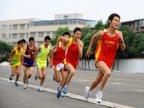
PE classes have become a nightmare (噩梦) for Liu Fei, a 15-year-old student. He has to run at l___1.___4 laps (圈) of the playround in every PE class. That’s nearly 1,500 m___2.___!
Liu is p___3.___for the PE test now. Many Junior 3 students have started doing so. The test is very i___4.__. It is worth 40 points in the senior high school entrance examination (中考). It usually i___5.___ long-distance running, long jump, rope skipping and sit-ups.
“Now I can run 1000 meters in only 3 minutes 40 seconds, about 30 seconds f___6._than before.” Liu said.
A PE teacher from Zhenjiang with teaching e__7.___ of 10 years, said, “Long-distance running n__8.__ lots of energy and endurance (耐力), which cannot be gained in a short time.
Taking up other activities early is also necessary. Teachers will t_9.___ you some skills and you need time to practice.
Training is important, but don’t forget to protect y_10.___. He suggested that students should warm up before training. Start slowly and build up the activity a little at a time.
查看答案和解析>>
科目:初中英语 来源:2014-2015学年河北承德市九年级第一次月考英语试卷(解析版) 题型:单项填空
Reading English newspapers can help you learn English _______.
A. a lot B. a lot of C.lots of D. lot
查看答案和解析>>
科目:初中英语 来源:2014-2015学年甘肃定西安定区公园路中学九年级下第一次月考英语试卷(解析版) 题型:单项填空
Her father in 1990 and her husband for more than five years.
A. died; has been dead B. has died; died
C. died; has been died D. has died; has died
查看答案和解析>>
科目:初中英语 来源:2014-2015学年甘肃定西安定区公园路中学九年级下第一次月考英语试卷(解析版) 题型:单项填空
He likes reading very much. He has_____ lots of money ____ books.
A. spent; on B. paid; on
C. taken; on D. cost; for
查看答案和解析>>
科目:初中英语 来源:2014-2015学年甘肃定西安定区公园路中学九年级下第一次月考英语试卷(解析版) 题型:单项填空
His composition is very good _____ some spelling mistakes.
A. except B. besides
C. except for D. Except
查看答案和解析>>
科目:初中英语 来源:2014-2015学年甘肃定西安定区公园路中学九年级下第一次月考英语试卷(解析版) 题型:单项填空
I want to know _____.
A. who will you go there with B. who will you go there
C. who you will to there D. who you will go there with
查看答案和解析>>
科目:初中英语 来源:2014-2015学年重庆云阳盛堡初级中学八年级下第一次月考英语试卷(解析版) 题型:单项填空
We'll go on a field trip if it _______ this weekend.
A. won't rain B. isn't raining
C. doesn't rain D. will rain
查看答案和解析>>
科目:初中英语 来源:2014-2015学年江苏无锡南长实验中学七年级4月学业调研英语试卷(解析版) 题型:单项填空
— Are you going to the cinema _______ underground?
— No. I am going there _______ a car.
A. take; in B. by; take
C. by; in D. by; by
查看答案和解析>>
湖北省互联网违法和不良信息举报平台 | 网上有害信息举报专区 | 电信诈骗举报专区 | 涉历史虚无主义有害信息举报专区 | 涉企侵权举报专区
违法和不良信息举报电话:027-86699610 举报邮箱:58377363@163.com