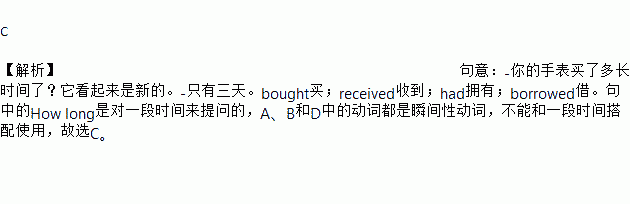
--How long have you your watch? It looks new.
--Only three days.
A. bought B. received C. had D. borrowed
C 【解析】句意:-你的手表买了多长时间了?它看起来是新的。-只有三天。bought买;received收到;had拥有;borrowed借。句中的How long是对一段时间来提问的,A、B和D中的动词都是瞬间性动词,不能和一段时间搭配使用,故选C。 全能测控期末小状元系列答案
科目:初中英语 来源:牛津译林版7b unit 4 单元测试 题型:填空
任务型阅读。
Babysitter (临时照顾幼儿者) Wanted
Do you like children? Do you have free time in the afternoon? We need a babysitter for our son. He is five years old. Hours are 3 p.m. to 6 p.m. from Monday to Friday. Sometimes you have to work on the weekend. Pay (薪水) is $10 each hour.
For the job, you will: watch our son, read to him, play with him. You will work at our house. We live on Fourth Road, near Huaxing Clothes Store.
Please call Mr Wang at 010-58899333.
阅读上面的招聘信息,填写正确答案。
1.The babysitter can work in his/her ___________time in the afternoon.
2.On Friday, the babysitter will work for_________hours.
3.The babysitter will watch the boy, __________ to the boy and play with the boy.
4.The babysitter must___________ at the house to look after the boy.
5.The boy’s house is on Fourth Road ___________Huaxing Clothes Store.
1.free 2.3 3.read 4.work 5.near 【解析】短文是一篇招聘短时婴儿保姆的广告,包括了上班时间、服务内容和联系电话。 1.考查细节理解题。根据Do you have free time in the afternoon?,可知要有空闲时间,故填free。 2.考查细节理解题。根据Hours are 3 p.m. to 6 p.m....查看答案和解析>>
科目:初中英语 来源:人教版八年级英语下册:Unit 3~5 过关测试卷 题型:单选题
Mike’s mother often tells him too much time playing computer games.
A. to not spend B. not to spend
C. doesn’t spend D. not spend
B 【解析】 试题分析:句意:麦克的妈妈经常告诉他不要花费太多的时间用在玩电子游戏上。此题考查固定短语tell sb not to do sth告诉某人不要做某事。根据句意,应选B。查看答案和解析>>
科目:初中英语 来源:2018年沈阳市中考英语题型复习训练:回答问题型 题型:回答问题
More Americans prefer to get food at their local food markets. According to a new study of the University of Iowa (UI), it’s not just because these people believe the food is fresher and tastes better, but because they think they are following a kind of social duty — sharing a healthy lifestyle, helping save environment and so on.
These so-called “locavores (土食者)” are shopping at farmers markets and joining food coops (食品合作社), because they enjoy knowing who grows the food. They are also driven to eat locally grown produce and meat because their promise to do so makes them feel a part of something greater than themselves.
Vasi, an associate professor at the UI, said the local food market is a “moralized (道德化的) market”, and that is a market in which people combine economic activities with their values. Among the findings, the UI researchers discovered local food markets were more likely to develop in areas where local people had a strong promise to social duty, health and the environment. “It’s about valuing the relationship with the farmers and people who produce the food and believing that how they produce the food agrees with your personal values.” Vasi said.
Vasi shared the results of the study at the American Sociology Association annual meeting in Chicago on Aug. 22, 2015. Researchers also did 40 interviews with consumers and producers in different local food markets in Iowa and New York.
1.Where do people like to get food better in America?
________________________________
2.Why do the locavores join food coops?
________________________________
3.How do people feel when eating locally grown produce and meat?
________________________________
4.Who found that local food markets were possible to develop in areas?
______________________________________
5.When did Vasi share the results of the study at the American Sociology Association annual meeting?
_______________________________
1.At their local food markets. / They like to get food at their local food markets. 2.Because they enjoy knowing who grows the food. 3.They feel a part of something greater than themselves 4....查看答案和解析>>
科目:初中英语 来源:2018年沈阳市中考英语题型复习训练:回答问题型 题型:回答问题
Once upon a time, in the forest there lived a baby elephant who had no friends. None of the animals wanted to be his friend because he was too large.
One day, a wild fire happened in the forest. The animals ran to safer places. The dry trees caught fire and the fire was sure to go all around the forest. The baby elephant ran to the nearest river, collected much water in his trunk(象鼻) and rushed to the burning trees. He sprayed(喷) the water on the fire. Finally, he put out the fire.
Later, while he was resting after the hard job, all the animals came to him and expressed their thanks for his kind help in time. They were now ready to regard him as their good friend and their hero. They said, “A friend in need is a friend indeed.”
The baby elephant was happy to get so many friends and played games with them. He walked through the forest, carrying several small animals on his back.
1.Why did the baby elephant have no friends at first?
________________________________________
2.Where did the wild fire happen?
________________________________________
3.Who put out the fire in the end?
________________________________________
4.What was the baby elephant doing after the hard work?
________________________________________
5.Was the baby elephant happy to get so many friends?
________________________________________
1.Because he was too large. 2.In the forest. 3.The baby elephant 4.He was resting. 5.Yes, he was. 【解析】试题分析:本文是一篇记叙文,主要讲述了一头小象因为个头太大而没有朋友。一天森林着火了,小象用它的长鼻子吸水扑灭了火,拯救了森林和动物。所有的动物都视小象为好朋友和英雄...查看答案和解析>>
科目:初中英语 来源:牛津译林版8下Unit 2 Travelling Integrated skills & Study skills 课堂评价 题型:单选题
Mr Liu is away on holiday. He to Beijing.
A. has gone B. has been C. goes D. will go
A 【解析】句意:刘老师外出度假了,他去了北京。has gone去了某地,还没回来;has been去过某地,已经回来了;goes去,是一般现在时态第三人称单数形式;will go将会去,一般将来时。根据句意Mr Liu is away on holiday可知,刘老师去度假没有回来,故应选A。查看答案和解析>>
科目:初中英语 来源:人教新目标七年级下Unit5单元检测试卷 题型:语法填空
阅读下面短文,按照句子结构的语法性和上下文连贯的要求,在空格处填入一个适当的词或使用括号中词语的正确形式填空(每空不多于3个单词)。
Animals are 1.(we) friends. We can find different 2.(kind) of animals. Some animals are living 3. big woods(森林). And some animals 4.(live) with man.
Animals are very 5.(use) to man. People can teach the elephant 6.(do) some heavy work. And they can 7. teach the dog to look after the house. A watch dog is very clever. It can help people in danger(危险). 8.(child) like dogs very much. Most of children like to go to the zoo. 9. there are many animals in zoos. Zoo is a good place 10. children to get to know animals.
1.our 2.kinds 3.in 4.are living 5.useful 6.to do 7.also 8.Children 9.Because 10.for 【解析】本文主要讲述动物和人的关系。动物是我们的朋友。我们可以找到不同种类的动物。有些动物住在大树林里。有些动物和人类住在一起。动物对人类很有用。人们可以教大象做一些重活。...查看答案和解析>>
科目:初中英语 来源:人教版七年级下册英语 unit2 第3课时 测试 题型:单选题
(N)We usually________school at seven thirty in the morning and ________ home after school at half past four in the afternoon.
A. go;go B. go to;go to
C. go to;go D. go;go to
C 【解析】句意:我们通常在早晨7点半去上学,在下午4:30放学回家。根据usually句子应该用一般现在时,句子的主语是第一人称,所以第一空用动词原形;短语go to school去上学,故排除AD;第二空短语go home回家。故排除D;故选C。查看答案和解析>>
科目:初中英语 来源:人教版八年级下册英语 unit3 第4课时 练习2 题型:单选题
—Could you please ___ some information for us about the students’ healthy?
—O f course, it’s my pleasure.
A. show B. give C. pass D. provide
D 【解析】句意:——针对学生的健康你能提供一些信息?——当然,这是我的荣幸。考查动词辨析题。A. show展示;B. give给;C. pass路过;D. provide提供(+for),赡养(+for)。provide sth. for sb. 为某人提供某物,固定短语;。根据句意语境,可知选D。查看答案和解析>>
湖北省互联网违法和不良信息举报平台 | 网上有害信息举报专区 | 电信诈骗举报专区 | 涉历史虚无主义有害信息举报专区 | 涉企侵权举报专区
违法和不良信息举报电话:027-86699610 举报邮箱:58377363@163.com