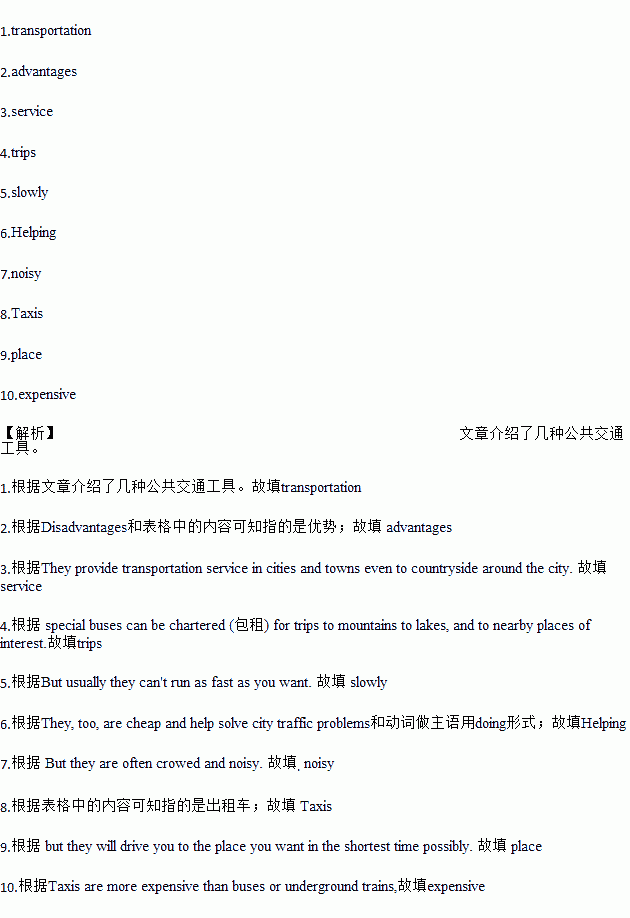
The most common form of public transportation is the bus. They provide transportation service in cities and towns even to countryside around the city. Also, special buses can be chartered (包租) for trips to mountains to lakes, and to nearby places of interest. But usually they can't run as fast as you want.
Undergrounds are mostly found in larger cities, such as New York, London, Beijing and so on. The underground is a underground system of high-speed trains. The world's first system was built in London. Underground trains move more quickly than buses. They, too, are cheap and help solve city traffic problems. But they are often crowed and noisy.
Taxis are more expensive than buses or underground trains, but they will drive you to the place you want in the shortest time possibly. Taxis are suitable if you are in a hurry or if you are taking a number of handbags or packages.
If you ever visit a big city in another country, you will probably have no trouble getting around. Like many people, of course, transportation will be your own two legs!
Public 1.
Forms | 2. | Disadvantages |
Buses | Providing transportation 3. in cities and towns; special buses can be chartered for 4. to different places. | Running 5. |
Undergrounds | Moving more quickly than buses. 6. solve city traffic problems. | Crowded and 7. |
8. | Going to the 9. you want in shortest time. Suitable if you are in a hurry or if you are taking lots of handbags or packages. | More 10. than buses and undergrounds |
科目:初中英语 来源:牛津译林版2018届9BU1-2 限时训练 题型:单选题
When was __________ umbrella __________ ?
A. /; invented B. a ; discovered C. an, discovered D. the, invented
D 【解析】句意:雨伞是什么时候发明的?discover发现,invent发明;伞被发明应用动词invented;故排除B和C;a/an表示“一个……”,表示数量或泛指某类事物,a用于辅音因素开头的可数名词单数前,an用于元音因素开头的可数名词单数前; [?m'brel?]的发音是以元音为开头的,排除B;可数名词单数不能单独使用,排除A; the表示特指某事物,the umbrella指这种...查看答案和解析>>
科目:初中英语 来源:牛津译林版8b 第一单元测试卷(有答案) 题型:单选题
— How do you like your English teacher?
— He is great. We friends since three years ago.
A. were B. have made
C. have been D. have become
C 【解析】现在完成时态的用法。由答句中的since three years ago知,主语用现在完成时态,且动词用延续性动词,因此选C。查看答案和解析>>
科目:初中英语 来源:牛津译林版8B Unit 2 单元检测 题型:完型填空
Each of us makes mistakes from time to time. In fact, we can____a lot from our mistakes.
Donnie was a____student and never answered questions in class. He was____to make mistakes. He never finished his homework____he didn’t want to make any mistakes. Nothing changed____Marry Anne, a teacher, came to our____One morning, Marry Anne asked Donnie to____some questions. After a while Donnie was in tears because he made a mistake.____Marry Anne got a box full of erasers from the desk.
“Look, Donnie,” she said standing____him. “I’ve got something to show you.” She____the erasers, one at a time, and put them on the desk. “See these erasers, Donnie?” she continued. “Do you know____the erasers become smaller and smaller? That’s because we make mistakes. But we erase the mistakes and try____That’s what you must learn.”
“Here,” she said, “I’ll____one eraser on your desk, so you will remember that____may make mistakes.” Donnie looked at Marry Anne and smiled.
Donnie____a lot from then on. He knew that everyone had the permission(允许) to make mistakes as long as you learned them and tried again.
1.A. take B. make C. get D. bring
2.A. good B. shy C. clever D. small
3.A. glad B. excited C. surprised D. afraid
4.A. because B. so C. if D. but
5.A. after B. while C. until D. when
6.A. row B. class C. team D. classroom
7.A. answer B. ask C. give D. have
8.A. Suddenly B. Unluckily C. Luckily D. Carefully
9.A. on B. with C. beside D. to
10.A. put out B. took away C. took out D. took off
11.A. when B. how C. what D. why
12.A. more B. again C. another D. one
13.A. forget B. carry C. leave D. take
14.A. nobody B. somebody C. no one D. everybody
15.A. change B. got C. learned D. thought
1.C 2.B 3.D 4.A 5.C 6.B 7.A 8.A 9.C 10.C 11.D 12.B 13.C 14.D 15.A 【解析】试题分析:短文大意:本文讲述一个非常害羞的小男孩Donnie因为害怕犯错误,从来不敢回答问题。这种现状却在来了一位新老师Marry Anne后而改变了,这位老师以一块橡皮...查看答案和解析>>
科目:初中英语 来源:牛津译林版8B Unit 2 单元检测 题型:单选题
– She _________. Please be quiet! – What? It’s seven a.m. I ______ for an hour.
A. has just fallen asleep; have got up B. has just slept; have got up
C. has just fallen asleep; have been up D. has just been asleep; have been up.
C 【解析】句意:——她刚刚睡着了,请安静!——什么?现在是上午7点,我刚起床一个小时。get up起床,短暂性动词不能和时间段连用,所以排除A/B;fall asleep睡着,强调入睡的动作;be asleep睡着,强调睡着的状态,根据just可知是指动作;故选C查看答案和解析>>
科目:初中英语 来源:牛津译林版8B Unit 1 单元检测 题型:单选题
—Haven’t you seen that film? That’s the funniest one I’v ever seen.
—Really? When ________ you _________ it?
A. have; seen B. did see C. will see D. were seeing
B 【解析】句意:——你没看过那个电影吗?那是我看过的最有趣的一个。——真的吗?你什么时候看的?根据问什么时候看的可知用过去时态;故选B查看答案和解析>>
科目:初中英语 来源:牛津译林版8B Unit 1 单元检测 题型:单选题
— Does your father drive to work?
— He . But now he rides a bike because riding bikes is greener.
A. had to B. used to C. has been D. would like be
B 【解析】句意:——你爸爸开车去上班吗?——他过去常常开,但是现在他骑自行车,因为骑车更环保。A. had to不得不; B. used to 过去常常; C. has been已经是; D. would like be想是;根据句意故选B查看答案和解析>>
科目:初中英语 来源:七年级人教新目标英语下册Unit 2 单元测试卷 题型:单选题
—______ do you usually play the violin?
—On weekends.
A. What time B. Why
C. Where D. When
D 【解析】试题分析:句意:----你通常什么时候拉小提琴?----周末。由答语On weekends.可知是对时间进行提问的。A.What time什么时间,对时间点提问;B.Why为什么;C.Where在哪儿;D.When什么时候。故选D。查看答案和解析>>
科目:初中英语 来源:牛津译林版八下Unit3Comic strip-Reading2测试卷(含答案) 题型:单选题
We can type words with a _________.
A. screen B. keyboard C. mouse D. printer
B 【解析】句意:我们可以用键盘打字。A是屏幕,B是键盘,C是鼠标,D是打印机。故选B。查看答案和解析>>
湖北省互联网违法和不良信息举报平台 | 网上有害信息举报专区 | 电信诈骗举报专区 | 涉历史虚无主义有害信息举报专区 | 涉企侵权举报专区
违法和不良信息举报电话:027-86699610 举报邮箱:58377363@163.com