
根据文章内容完成表格
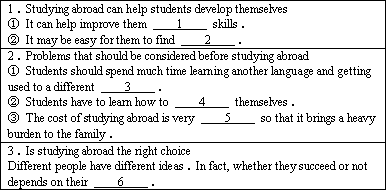
“USA? Britain? Which country is better to study in? ” We often hear such discussion.As China opens its door, studying abroad has become a dream for many Chinese students.They want to learn about the world.It's true that studying abroad can help students develop themselves.Language skills will improve and it may be easier to find a job.
But there are problems that should be considered.Language is the first.Students must spend a lot of time learning another language and getting used to a different culture.
Students must also learn to live without parents’ care and deal with all kinds of things they haven't had to do before, like looking after themselves.There are reports about Chinese students abroad sinking in an ocean of difficulties and giving up easily.When they have to take care of themselves, it is hard for the students to study well.
Finally, studying abroad brings a heavy burden(负担)to the family.For most Chinese parents, the cost of studying abroad is very high.But is it worth it?
We know that there are many famous people who succeed in great things through their hard work in China.Liu Xiang is a good example.Once an American teacher invited him there but he refused.He kept training hard with his Chinese teacher.He surprised the world when he won a gold medal at Athens Olympics.So when you wonder which country is better to study in, consider whether studying abroad is the right choice.
任务型阅读:根据短文内容,填写下列表格。
科目:初中英语 来源:2008年江苏省常州市初中毕业升学统一考试、英语试卷 题型:053
阅读文章,根据文章内容完成表格
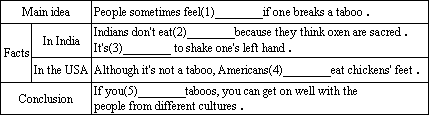
A taboo is a social action that is not allowed.Every culture in the world has its own taboos.The breaking of a taboo sometimes makes people feel uncomfortable.I learned this through my own experience.
Last weekend, Wang Lin and I showed two foreigners around our city.Mr.Singh was from India and Mr.White from the USA.When I held out my left hand to shake hands with him, Mr.Singh seemed to be unhappy.Mr.White, however, was quite casual(随意的).He said hello to me with a big smile and a wave of his hand.
In the evening, we stopped at a restaurant for dinner.I noticed that Mr.Singh didn't touch the beef and Mr.White seemed not to like chickens' claws(爪子).During the meal, Wang Lin said sorry to Mr.Singh and continued to explain that we didn't know it was a taboo in India to shake one's left hand.Mr.Singh explained that since oxen(牛-)are sacred(神圣的)in India, people don't eat beef there.Mr.White joined in and said that it was not usual in the States for people to eat chickens' claws.He went on to say that Americans don't usually get into each other's personal space.Isn't it a good lesson to remember?
查看答案和解析>>
科目:初中英语 来源:三点一测丛书 九年级英语 题型:053
阅读理解
For most people, the word “fashion” means “clothes”. But people may ask the question, “What clothes are in fashion?” And they use the adjective “fashionable” in the same way:“She was wearing a fashionable coat.” “His shirt was really a fashionable color.”
But of course there are fashions in many things, not only in clothes. There are fashions in holidays, in restaurants, in films and books. There are even fashions in school subjects, jobs…and in languages.
Fashions change as time goes. If you look at pictures of people or things from the past, you will see that fashions have always changed. An English house of 1750 was different from one of 1650. A fashionable man in 1780 looked very different from his grandson in 1860. Mobile is a fashion, but perhaps it will be out of fashion later on.
Today fashions change very quickly. Some of this is natural. We hear about things much more quickly than in the past. Newspapers, radios, telephones and television send information from one country to another in a few hours.
New fashions mean that people will buy new things, so you see there is money in fashion.
根据文章内容完成表格

查看答案和解析>>
科目:初中英语 来源:2013年初中毕业升学考试(山东烟台卷)英语(解析版) 题型:阅读理解
According to a new survey, students’ safety has become a big problem. Now in some cities of China, many schools start a new lesson: self-protection. Students like this lesson because there are no exams or boring classes. And they can learn how to save lives and know how to stop danger before it really happens.
Lin Li, a teacher from Yantai, gives young students some advice on how to deal with danger.
If you are in a traffic accident
If a car hits you, you should remember the car number. If it is a bicycle, try to call your parents before you let the rider go. This is because you don’t know how seriously you are hurt.
If it is raining hard and there is lightning
Don’t stay in high places and stay away from trees.
When there is a fire
Get away as fast as you can. Put wet things on your body and try to find an exit. Don’t take the lift.
If someone is drowning
If you can’t swim, don’t get into water. Cry out for help.
Remember that danger is never as far away as you think. Take care or yourself at all times!
If you are robbed (抢劫)
Keep calm. If you can not cry for help or run away, give the robber your money. Try to remember what the robber looks like and tell the police later.
根据文章内容,完成下列表格。
|
Best title: _____1.________ |
|
|
Danger |
What to do |
|
____2.____ |
◆If hit by a car, you’re supposed to 3.___ ◆If hit by a bike, call your parents. |
|
Raining with lightning |
Stay at low places and keep away from trees. |
|
Fire |
Don’t take the lift and find an ___4.___ as fast as you can. |
|
Drowning |
If you can’t swim, just shout “Help!” |
|
Robbery |
◆Keep calm. ◆Remember the robber’s ____5.____ and tell the police later. |
查看答案和解析>>
科目:初中英语 来源:江苏中考真题 题型:阅读理解

查看答案和解析>>
湖北省互联网违法和不良信息举报平台 | 网上有害信息举报专区 | 电信诈骗举报专区 | 涉历史虚无主义有害信息举报专区 | 涉企侵权举报专区
违法和不良信息举报电话:027-86699610 举报邮箱:58377363@163.com
