
D
Men usually want to have their own way. They want to think and act as they like. No one, however, can have his own way all the time. A man cannot live in society without considering the interests(利益) of others as well as his own interests. “Society” means a group of people with the same laws and the same way of life. People in society may make their own decisions, but these decisions ought not to be unjust(不公平) or harmful to others. One man’s decisions may so easily harm another person. For example, a motorist may be in a hurry to get to a friend’s house. He sets out, driving at full speed like a competitor in a motor race. There are other vehicles and also pedestrians (行人) on the road. Suddenly there is a crash. There are screams and confusion. One careless motorist has struck another car. The collision(碰撞) has injured two of the passengers and killed the third. Too many road accidents happen through the thoughtlessness of selfish drivers.
We have governments, the police and the law courts to prevent or to punish such criminal acts. But in addition, all men ought to observe certain rules of conduct. Every man ought to behave with consideration for other men. He ought not to steal, cheat, or destroy the property(财产) of others. There is no place of this sort of behavior in a civilized society.
1. A man cannot have his own way all the time because________.
A. he may have no interest in other people
B. he has to share the same interest with the people in the same society
C. his decisions are always unjust D. his decisions always harm other people
2. According to the passage, people in a civilized society should usually______.
A. be honest to each other B. be cautions in doing everything
C. behave in a responsible way D. punish criminal acts
3. The purpose of this passage is to_________.
A. tell people how to behave in society
B. illustrate the importance of laws
C. teach people how to prevent criminal acts
D. persuade people not to make their own decisions
4. It is implied that there will be fewer road accidents if_______.
A. the drivers are more considerate(体贴的) of other people
B. there are fewer cars or walkers in the street
C. the motorists are not always in a hurry
D. the passengers are calm but not confused before the accidents
5. We can draw a conclusion that_______.
A. the government should contribute more efforts
B. the criminals should be more severely punished
C. man should be more strict with himself
D. man should have more and more similar interests
 名校课堂系列答案
科目:高中英语 来源: 题型:阅读理解
In England three foreign gentlemen came to a bus stop. They studied the information on the post sign and decided which bus to take. About five minutes later the bus they wanted came along. They prepared to get on. Suddenly people rushed onto the bus and tried to push them out of the way. Someone shouted insulting remarks about the foreigners. The bus conductor came rushing down the stairs to see what all the trouble was about. The three foreign gentlemen looked puzzled and ashamed. No one had told them about the British custom of lining up for a bus so that the first person who arrived at a bus-stop is the first person to get on the bus.
Learning the language of a country isn’t enough. If you want to ensure a pleasant visit, find out as much as possible about the manners and customs of your hosts. You will probably be surprised just how different they can be from your own. A visitor to India would do well to remember that people there consider it impolite to use the left hand for passing food at table. The left hand is supposed to be used for washing yourself. Also in India, you might see a man apparently(显然地)shaking his head at another and assume (认为) that he is disagreeing. But in many parts of India a rotating (旋转) movement of the head is a gesture that express agreement or acceptance. Nodding your head when offered a drink in Bulgaria is likely to leave you thirsty. In that country you shake your head to express “yes” — a nod means “no”.
In Europe it is quite usual to cross your legs when sitting talking to someone, even at an important meeting. Doing this when meeting an important person in Thailand, however, could cause offence (冒犯). It is considered too informal an attitude for such an occasion. Also when in Thailand avoid touching the head of an adult — it’s just not done.
Attitudes to women vary considerably(相当地)around the world. In Japan, for example, it is quite usual for men to plan evening entertainments for themselves and leave their wives at home.
Knowing about customs and attitudes is useful when you are travelling, but you also need to know the language used to express different degrees of formality (礼节).
The three foreign gentlemen looked puzzled and ashamed because __________________.
A. they didn’t know the English language B. someone called their names
C. they didn’t know the custom of lining up for a bus
D. they knocked someone down while getting on the bus
According to the passage, which attitude to women is usual in Japan?
A. Men always go to parties with women.
B. Men plan evening entertainments for their wives.
C. Men and women have equal rights to go to parties.
D. Men plan evening entertainments for themselves, while their wives stay home.
What’s the meaning of the underlined word “insulting” in Para. 1 ?
A. 善意的 B. 咨询的 C. 商量的 D. 无礼的
查看答案和解析>>
科目:高中英语 来源: 题型:阅读理解
In England three foreign gentlemen came to a bus stop. They studied the information on the post sign and decided which bus to take. About five minutes later the bus they wanted came along. They prepared to get on. Suddenly people rushed onto the bus and tried to push them out of the way. Someone shouted insulting remarks about the foreigners. The bus conductor came rushing down the stairs to see what all the trouble was about. The three foreign gentlemen looked puzzled and ashamed. No one had told them about the British custom of lining up for a bus so that the first person who arrived at a bus-stop is the first person to get on the bus.
Learning the language of a country isn’t enough. If you want to ensure a pleasant visit, find out as much as possible about the manners and customs of your hosts. You will probably be surprised just how different they can be from your own. A visitor to India would do well to remember that people there consider it impolite to use the left hand for passing food at table. The left hand is supposed to be used for washing yourself. Also in India, you might see a man apparently(显然地)shaking his head at another and assume (认为) that he is disagreeing. But in many parts of India a rotating (旋转) movement of the head is a gesture that express agreement or acceptance. Nodding your head when offered a drink in Bulgaria is likely to leave you thirsty. In that country you shake your head to express “yes” — a nod means “no”.
In Europe it is quite usual to cross your legs when sitting talking to someone, even at an important meeting. Doing this when meeting an important person in Thailand, however, could cause offence (冒犯). It is considered too informal an attitude for such an occasion. Also when in Thailand avoid touching the head of an adult — it’s just not done.
Attitudes to women vary considerably(相当地)around the world. In Japan, for example, it is quite usual for men to plan evening entertainments for themselves and leave their wives at home.
Knowing about customs and attitudes is useful when you are travelling, but you also need to know the language used to express different degrees of formality (礼节).
The three foreign gentlemen looked puzzled and ashamed because __________________.
A. they didn’t know the English language
B. someone called their names
C. they didn’t know the custom of lining up for a bus
D. they knocked someone down while getting on the bus
According to the passage, which attitude to women is usual in Japan?
A. Men always go to parties with women.
B. Men plan evening entertainments for their wives.
C. Men and women have equal rights to go to parties.
D. Men plan evening entertainments for themselves, while their wives stay home.
What’s the meaning of the underlined word “insulting” in Para. 1 ?
A. 善意的 B. 咨询的 C. 商量的 D. 无礼的
From the passage, we know that shaking head means Yes in ______________.
A. India and Thailand B. India and Bulgaria
C. Bulgaria and Thailand D. Thailand and Japan
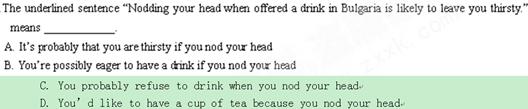
The underlined sentence “Nodding your head when offered a drink in Bulgaria is likely to leave you thirsty.” means ____________.
A. It’s probably that you are thirsty if you nod your head
B. You’re possibly eager to have a drink if you nod your head
C. You probably refuse to drink when you nod your head
D. You’d like to have a cup of tea because you nod your head
查看答案和解析>>
科目:高中英语 来源:2013-2014学年陕西省高三上学期第四次适应性训练英语试卷(解析版) 题型:阅读理解
Shopping for clothes is not the same experience for a man as it is for a woman. A man goes shopping because he needs something. His purpose is settled and decided in advance. He knows what he wants, and his objective is to find it and buy it; the price is a secondary consideration. All men simply walk into a shop and ask the assistant for what they want. If the shop has it in stock(有现货的), the salesman promptly produces it, and the business of trying it on follows at once. All being well, the deal can be and often is completed in less than five minutes, with hardly any chat and to everyone's satisfaction.
For a man, slight problems may begin when the shop does not have what he wants, or does not have exactly what he wants. In that case the salesman, as the name implies, tries to sell the customer something else, he offers the nearest to the article required. No good salesman brings out such a substitute impolitely; he does so with skill: “I know this jacket is not the style you want, sir, but would you like to try it for size? It happens to be the color you mentioned.” Few men have patience with this treatment, and the usual response is: “This is the right color and may be the right size, but I should be wasting my time and yours by trying it on.”
Now how does a woman go about buying clothes? In almost every respect she does so in the opposite way. Her shopping is not often based on need. She has never fully made up her mind what she wants, and she is only “having a look round”. She is always open to persuasion; indeed she sets great store by what the saleswoman tells her, even by what companions tell her. She will try on any number of things. Uppermost in her mind is the thought of finding something that everyone thinks suits her. Contrary to a lot of jokes, most women have an excellent sense of value when they buy clothes. They are always on the lookout for the unexpected bargain. Faced with a roomful of dresses, a woman may easily spend an hour going from one rail to another, to and fro, often retracing her steps, before selecting the dresses she wants to try on. It is a laborious process, but apparently an enjoyable one. Most dress shops provide chairs for the waiting husbands.
1.The underlined sentence “the price is a secondary consideration” in the first paragraph means when a man is shopping ______.
A. he buys good quality things, so long as they are not too dear
B. he buys whatever he likes without considering its value
C. he does not mind how much he has to pay for the right things
D. he often buys things without giving the matter proper thought.
2.What does a man do when he can not get exactly what he wants?
A. He buys a similar thing because of the color he wants.
B. He usually does not buy anything.
C. At least two of his requirements must be met before he buys.
D. So long as the style is right, he buys the thing.
3.What is the most obvious difference between men and women shoppers?
A. Men do not try clothes on in a shop while women do.
B. Women bargain for their clothes, but men do not.
C. The time they take over buying clothes.
D. Men go shopping based on need, but women never.
查看答案和解析>>
科目:高中英语 来源:2015届甘肃省高二上学期期中考试英语试卷(解析版) 题型:阅读理解
Shopping for clothes is not the same experience for a man as it is for a woman. A man goes shopping because he needs something. His purpose is settled and decided in advance. He knows what he wants, and his objective is to find it and buy it; the price is a secondary consideration. All men simply walk into a shop and ask the assistant for what they want. If the shop has it in stock, the salesman promptly produces it, and the business of trying it on follows at once. All being well, the deal can be and often is completed in less than five minutes, with hardly any chat and to everyone's satisfaction.
For a man, slight problems may begin when the shop does not have what he wants, or does not have exactly what he wants. In that case the salesman, as the name implies, tries to sell the customer something else, he offers the nearest he can to the article required. No good salesman brings out such a substitute impolitely; he does so with skill: “I know this jacket is not the style you want, sir, but would you like to try it for size? It happens to be the color you mentioned.” Few men have patience with this treatment, and the usual response is: “This is the right color and may be the right size, but I should be wasting my time and yours by trying it on.”
Now how does a woman go about buying clothes? In almost every respect she does so in the opposite way. Her shopping is not often based on need. She has never fully made up her mind what she wants, and she is only “having a look round”. She is always open to persuasion; indeed she sets great store by what the saleswoman tells her, even by what companions tell her. She will try on any number of things. Uppermost in her mind is the thought of finding something that everyone thinks suits her. Contrary to a lot of jokes, most women have an excellent sense of value when they buy clothes. They are always on the lockout for the unexpected bargain. Faced with a roomful of dresses, a woman may easily spend an hour going from one rail to another, to and fro, often retracing her steps, before selecting the dresses she wants to try on. It is a laborious process, but apparently an enjoyable one. Most dress shops provide chairs for the waiting husbands.
1.The passage mainly talks about ________.
A. differences between men and women shoppers
B. A man goes shopping because he needs something
C. How women go about buying clothes.
D. Women are better at shopping than men
2.The underlined sentence “the price is a secondary consideration” in the first paragraph means when a man is shopping ________.
A. he buys good quality things, so long as they are not too dear
B. he buys whatever he likes without considering its value
C. he does not mind how much he has to pay for the right things
D. he often buy things without giving the matter proper thought.
3.What does a man do when he can not get exactly what he wants?
A. He buys a similar thing because of the color he wants.
B. He usually does not buy anything.
C. At least two of his requirements must be met before he buys.
D. So long as the style is right, he buys the thing.
4.What is the most obvious difference between men and women shoppers?
A. Men do not try clothes on in a shop while women do.
B. Women bargain for their clothes, but men do not.
C. The time they take over buying clothes.
D. Men go shopping based on need, but women never.
查看答案和解析>>
科目:高中英语 来源: 题型:阅读理解
Bill Trew worked on the night shift in an old mine called Park Deep. Day and night 180 miners 1 underground there, more than 6,000 feet down. They all took their 2 of night work, but Bill always worked at night. He said he 3 it.
One day he came home as 4 at half past seven in the morning. He had his “supper”, as he 5 it, and went to bed. An unusual dream troubled his sleep. Afterwards, the 6 thing he remembered about was – a throbbing (跳动) blue light.
Bill got up in the afternoon as usual. It was as 7 getting up – because he could 8 see the blue light in front of his eyes. As the evening grew 9 , the light grew stronger. Bill got 10 for the night shift. But by eight o’clock the blue light was so bright that he could 11 see anything else. He and his wife were very 12 . Bill had never been sick before.
“Don’t go to work,” Mrs. Trew said. “If it isn’t 13 by tomorrow, I’ll have to sent for the doctor.”
Bill didn’t go to work. He sat in an armchair, 14 but with closed eyes. Even then the blueness was like a living thing. It 15 him, silent, throbbing. The family went to bed but Bill wasn’t tired: he stayed in his armchair.
At eleven o’clock a long, loud explosion 16 the ground. Bill opened his eyes and jumped to his 17 . The blue light was gone! He rushed outside. Someone shouted, “Gas! Gas in Park Deep! Oh, 18 the night shift!”
The gas explosion killed 179 men in Park Deep. The mine was destroyed for 19 .The bodies remain to this day in their grave. And Bill has never stopped 20 .That blue light: why did it make him the only man unfit for work that night?
1.A.gathered B.stayed C.had to D.worked
|
3.A.loved B.disliked C.preferred D.hated
4.A.rule B.order C.ago D.usual
5.A.described B.said C.called D.liked
6.A.great B.funny C.big D.only
7.A.good B.strange C.late D.bad
8.A.still B.only C.hardly D.clearly
9.A.bigger B.later C.darker D.blacker
10.A.up B.well C.prepared D.ready
11.A.seldom B.merely C.hardly D.barely
12.A.confused B.puzzled C.wondered D.frightened
13.A.good B.normal C.better D.fine
14.A.awake B.sleeping C.surprising D.resting
15.A.feared B.surrounded C.wakened D.brightened
16.A.hit B.broke C.shook D.crashed
17.A.feet B.chair C.shoes D.door
18.A.bad B.misery C.pity D.die
19.A.that B.all C.everything D.good
20.A.thinking B.wondering C.working D.sympathizing
查看答案和解析>>
湖北省互联网违法和不良信息举报平台 | 网上有害信息举报专区 | 电信诈骗举报专区 | 涉历史虚无主义有害信息举报专区 | 涉企侵权举报专区
违法和不良信息举报电话:027-86699610 举报邮箱:58377363@163.com
