
人造的 190. 真实的.确实的 191.无用的 查看更多


题目列表(包括答案和解析)

阅读下文,完成下面题目。
人造太阳
何 平
①前不久,一条新闻引起全世界关注:中国科学院等离子体物理研究所研制的“人造太阳”调试成功,年内即可试发电。
②“人造太阳”?难道真要在地球上造一个太阳?当然不是!“人造太阳”是指科学家利用太阳核反应原理,为人类制造一种能提供能源的机器——人工可控核聚变装置,科学家称它为“全超导托克马克试验装置”。
③太阳的光和热,来源于氢的两个同胞兄弟——氘和氚(物理学叫氢的同位素)在聚变成一个氦原子的过程中释放出的能量。“人造太阳”就是模仿这一过程。
④氢弹是人们最早制造出的“人造太阳”。但氢弹的聚变过程是不可控的,它瞬间释放出的巨大能量足以毁灭一切。而“全超导托克马克试验装置”却能够稳定控制核聚变,使聚变产生的能量缓缓输出,转化为人们可持续使用的电能。
⑤核聚变反应,首要条件是高温高压。太阳中心的温度高达1500万摄氏度,压强达到3000多亿个大气压。在这样的高温高压下,太阳的聚变反应非常容易。但在地球上可不容易,因为用任何一种材料制作的容器都无法耐受这样的高温高压。
⑥怎么办?科学家们想到了用磁场做容器。从氢弹爆炸至今,科学界用了60年的努力,目前已成功地在磁场容器中将温度提高到4亿至5亿摄氏度,然后投入氘氚产生聚变反应。但由于很难把这种高温长时间维持下去,所以全世界30多个国家上百个实验装置的聚变放电时间都很短!少则几秒,长的也不过数百秒。我国从1965年研究“人造太阳”开始,如今已能使放电时间持续千秒以上。
⑦所以,科学家说,建设核聚变电站投入民用,至少要再等上50年时间。但等待是值得的!现在地球上的石油、煤炭等化石能源至多可用200年时间,其中石油不足50年。即使目前核裂变电站使用的铀燃料,全世界也只能再开采60年。用这些材料做能源还有个致命弱点——环境污染!
⑧相反,氘和氚却是清洁能源,如空气中平时就有氘和氚。所以不用担心聚变反应会产生废气、废渣和放射性污染等问题。有人担心电站爆炸,但科学家说,聚变在磁场中进行,维持温度已很不易,只要稍微马虎,温度就会降下来,聚变就停止了,因此爆炸的可能性是零。
⑨氘和氚是取之不尽用之不竭的能源。世界海洋中大概蕴藏了40万亿吨氘。如果全部用于聚变反应,释放的能量足够人类使用几百亿年,这比太阳的寿命还要长了。
【小题1】选文的说明对象是什么?它的总体特征是什么?(3分)
【小题2】选文第③段的目的在于说明什么?(2分)
【小题3】第⑥自然段与第⑦自然段能不能互换?为什么?(3分)
【小题4】氘和氚是清洁的能源,这样说的根据是什么?在自然界中,你认为还能开发哪些目前还未利用的清洁的能源?简要说说能开发的理由。(4分)

查看答案和解析>>

阅读理解

  Why don't birds get lost on their long flights from one place to another? Scientists have puzzled over this question for many years. Now they are beginning to fill in the blanks.

  Not long ago, experiments showed that birds rely(依赖) on the sun to guide them during daylight hours. But what about birds that fly at night? Tests with artificial(人造的) stars have proved that certain night-flying birds are able to follow the stars on their long-distance flights.

  A dove had spent its lifetime in a cage and had never flown under a natural sky. Yet it showed an inborn ability to use the stars for guidance. The birds's cage was placed under an artificial starfilled sky. The bird tried to fly in the same direction as that taken by his outdoor cousins. Any change in the position of the make-believe stars caused a change in the direction of his flight.

  Scientists think that doves, when flying in daylight, use the sun for guidance. But the stars are obviously their principal(主要的) means of navigation(or flying). What do they do when the stars are hidden by clouds? Obviously, they find their way by such landmarks as mountain ranges, coastlines, and river courses. But when it's too dark to see these, the doves circle helplessly, unable to get their bearings(方位).

1.The reason why birds don't get lost on long flights ________.

[  ]

A.is known by everybody

B.still remains a mystery

C.has been discovered recently

D.has been known to scientists for years

2.Experiments showed that ________.

[  ]

A.birds rely on the sun to guide them

B.birds rely on the stars to guide them

C.birds are likely to get lost if there aren't artificial stars

D.day-flying birds rely on the sun while night-flying birds rely on the stars

3.The experiment on the dove indicated(表明) that ________.

[  ]

A.a bird that has been caged will not fly long distances

B.some birds seem to follow the stars when they fly at night

C.a bird having spent its lifetime in a cage has to- be taught how to navigate

D.birds can fly in the same direction as that taken by their cousins

4.Under artificial stars, the bird in the cage ________.

[  ]

A.tried to fly in the same direction as birds not caged

B.changed direction when the position of the stars was changed

C.would not fly well

D.both A and B

5.In total darkness, doves ________.

[  ]

A.circle helplessly

B.use landmarks

C.find their way by clouds

D.fly back home

查看答案和解析>>

Run, Terry, Run

  Terry Fox had cancer(癌). It left him with only one leg. Yet he became famous for running. He ran with an artificial (人造的) leg to raise(集资) money to fight cancer. His plan was to run all the way across Canada, from St. John's to Vancouver. He would cross the water by boat. Terry started out in St. John's in April, 1981, and made it to the halfway point.

  Terry had to give up the run at Thunder Bay when doctors found cancer in his lungs. He died on June 28, when he was 22 years old. He raised more money for the Canadian Cancer Society than he dreamed possible-over $24 million.

  This map shows the route that Terry Fox planned to run and the part of the route he was able to cover.
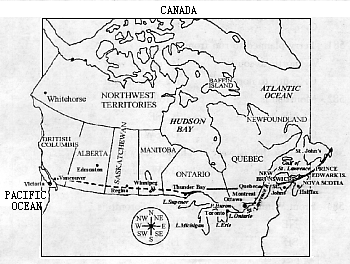
  To follow Terry's run on a map, you must be able to find directions (方向) . The four main directions on a map are north, south, east, and west. Between the four main directions are four “halfway” directions. They are northeast (NE), northwest (NW), southeast (SE) , southwest (SW) . These directions appear on the map's compass rose. Find the compass rose at the bottom of the map .

  Some maps use only an arrow pointing north. When you know which direction is north, you can figure out that south is below. West is to the left. East is to the right.

1.Terry started his run in St. John's on Canada's ________ coast.

[  ]

A.north
B.south
C.east
D.west

2.Terry planned to run from ________ .

[  ]

A.north to south
B.east to west
C.south to north
D.west to east

3.Montreal is ________ of St. John's.

[  ]

A.NE
B.SE
C.NW
D.SW

4.The city that is west of Thunder Bay is ________ .

[  ]

A.St. John's
B.Winnipeg
C.Ottawa
D.Montreal

5.From Winnipeg, the direction to Toronto is ________ .

[  ]

A.NE
B.NW
C.SE
D.SW

查看答案和解析>>

完形填空。

  Just   1   your special clothes in the morning and you could jump 3 metres into the air and even carry more than 60 kilograms without getting tired.The walk to school would be very, very   2  .Such clothing is one of the products   3  “wearable robotics(机械装置)”technology.

  Scientists are developing artificial(人造的)arms and legs that allow   4   people to go freely.The US Army is interested in using wearable robot legs to help soldiers run faster, carry more equipment(装备)and be stronger in wars.

  A robot is controlled by some commands(指令).You've probably played with simple robots, such as toy cars or airplanes that are controlled by a remote control.Wearable robotics goes   5    6   just receiving information through a remote control, the robotic can send information back to its controller.

  Suppose you wore a robotics   7  .Every time you move your arm, it senses your movements and sends the information to a robot, which then moves its arm just as you did.  8  , scientists are working to wrap(裹)the robot   9   the person.Their goal is   10   the sleeve, shoe or suit help you do what you want to do.

(1)

[  ]

A.

wear

B.

put on

C.

in

D.

dress

(2)

[  ]

A.

heavy

B.

hard

C.

easy

D.

amazed

(3)

[  ]

A.

used

B.

to use

C.

using

D.

used to

(4)

[  ]

A.

poor

B.

disabled

C.

young

D.

needy

(5)

[  ]

A.

further

B.

farther

C.

faster

D.

quicker

(6)

[  ]

A.

With

B.

Without

C.

Instead of

D.

Except

(7)

[  ]

A.

shoe

B.

glove

C.

sock

D.

sleeve(袖子)

(8)

[  ]

A.

In this way

B.

In some ways

C.

By the way

D.

In the way

(9)

[  ]

A.

through

B.

around

C.

up

D.

on

(10)

[  ]

A.

making

B.

to make

C.

to being making

D.

made

查看答案和解析>>

阅读理解

  For hundreds Of years, scientists have been trying to answer what things have an effect on people's emotions(情感).How you feel is controlled by many things.Your emotions can be affected by your personality, by the actions of others and by events around you.Perhaps you don't know your emotions can be influenced by the weather as well.

  People often say they feel good when the sun is shining and sad when it is cloudy.In fact, sunlight makes us feel good.When sunlight hits our skins, our bodies produce a vitamin.Vitamins are natural chemicals(化学物质)which we all need to stay healthy.Sunlight helps our bodies produce vitamin D.Vitamin D helps our bodies make a special chemical.This special chemical affects our brains(大脑)and makes us feel happy.For example, there are long, dark winters of little sunlight in Sweden and Norway, so many people in these countries often feel sad.Without much sunlight, their bodies produce less vitamin D.Without enough vitamin D, their bodies make less of this special chemical which makes them feel good.To help the people in these countries feel better, special“sunrooms”with artificial(人造的)lights have been built.People can go there and get“sunlight”for an hour or two!

  The weather can also affect people's emotions in other ways.Hot weather can make people angry because people feel uncomfortable when they are hot.In the same way, rain can make people angry because being wet can be unpleasant.As you can see, the weather can have an effect on the chemicals which control our brains.Through these ways, the weather can influence our emotions.Sadly, while the weather can change us, we can hardly change the weather.

(1)

Which of the following is NOT mentioned as a factor(因素)that can affect one's emotions?

[  ]

A.

Weather.

B.

Actions of others.

C.

Personality.

D.

Age.

(2)

Which of the following is true about vitamin D according to the passage?

[  ]

A.

It is a kind of artificial chemical.

B.

It makes us worried by affecting our brains.

C.

It is needed by us all to keep fit.

D.

It is in the sunlight.

(3)

What can we infer(推断)from the passage?

[  ]

A.

We feel good when we are in the bright cool weather.

B.

We will be happy when we are caught in the rain.

C.

All people in Norway and Sweden feel sad in winter.

D.

The more vitamin D you have, the happier you'll be.

(4)

What may be the best title for this passage?

[  ]

A.

Why Do We Feel Sad?

B.

The Weather Influences People's Emotions

C.

People Need More Vitamin D

D.

We Can Hardly Change the Weather

查看答案和解析>>


同步练习册答案