
题目列表(包括答案和解析)
2.( )The engineer will return from Hong Kong _____ a few days.
A.since B.in C.for D.after
Ⅰ.单项选择。(10分)
1.( )In Australia the meaning of “Good on ya, mate!” is _____
A.“Not good!” B.“It’s a pity!” C.“Well done!” D.“Sorry!”
Ⅰ.听句子,选择正确图片。每个句子读一遍。(5分)
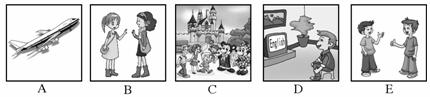
1._____ 2._____ 3._____ 4._____ 5._____
Ⅱ.听对话及问题,选择正确答案。每段对话和问题读两遍。(5分)
6.( )A.By working with his friends.
B.By taking notes.
C.By asking the teacher for help.
( )ging language. B.Increasing population. C.Developing country.
8.( )A.Because she can’t spell some English words.
B.Because she can’t understand spoken English.
C.Because she can’t pronounce some of the words.
9.( )A.She is good at English.
B.She joined an English language club one year ago.
C.She does badly in English.
10.( )A.He advises the girl to join a language club.
B.He advises the girl to listen to some tapes.
C.He advises the girl to make a pen pal.
Ⅲ.听对话,选择正确答案。对话读两遍。(5分)
11.( )When does Xiao Ming get up every morning?
A.At 5: 30 a.m. B.At 6: 00 a.m. C.At 6: 30 a.m.
12.( )Why does Xiao Ming get up so early every morning?
A.Because he wants to do some exercise.
B.Because he wants to memorize(记忆) some English words.
C.Because he wants to memorize and recite something.
13.( )Who gets up as early as Xiao Ming every morning?
A.His father. B.His mother. C.Nobody.
14.( )How does Xiao Ming spend his spare time?
A.By playing football. B.By reciting something.
C.He has no spare time at all.
15.( )What’s the possible relationship between the two speakers?
A.Teacher and student. B.Reporter and student. C.Mother and son.
Ⅳ.听短文,填空。短文读三遍。(5分)
Languages change with time and place, and so does English. In English many words are borrowed from other languages. About 900 years ago, many great changes 16 to English. A great many words were borrowed into English from French. About 500 years ago there was another great change. This time it was a change in 17 , but the 18 was not much changed. Sometimes one word has different 19 in different countries. You need to know some of these 20 to make yourself understood.
16._____ 17._____ 18._____ 19._____ 20._____
Ⅰ.词汇。(10分)
(A)根据句意及首字母提示补全单词。
1.I am very w_____ in English, so I’m going to work hard at it.
2.The plans have been under d_____.
3.My English teacher told us many good m_____ to study.
4.I’m sorry, I can’t follow you. Can you r_____ that?
5.What a nice story! Can you r_____ it in English?
(B)根据句意及汉语提示完成句子。
6.They ________ ________ ________(坚持弹奏) the music late yesterday night.
7.Please ________ ________ ________ ________(深呼吸) and relax yourself before you give a speech in class.
8.We can learn from ________ ________(犯错误).
9.He is so excited that he can’t say ________ ________(完整的话).
10.In order to ________ ________ (练习语法), I keep a diary.
Ⅱ.句型转换。(5分)
11.Every year the farmers plant many trees on those hills.(改为被动语态)
Many trees _______ _______ on those hills _______ the farmers every year.
12.I don’t know what I should do with the broken bike.(同义句转换)
I don’t know what _______ _______ _______ the broken bike.
13.Don’t give up learning English, it’s helpful to you.(同义句转换)
Don’t _______ _______ English, it’s helpful to you.
14.The children had a good time in Disneyland.(同义句转换)
The children _______ _______ in Disneyland.
15.Jane would like to eat some fish.(同义句转换)
Jane _______ _______ _______ some fish.
Ⅲ.书面表达。(10分)
你的英语非常优秀, 学校请你和七年级的同学做一次英语学习经验交流。请根据下列提示,写一份80词左右的发言稿。
提示:
1.When did you begin to learn English?
2.Why do you like English?
3.How do you study English well?
4.take part in/join, follow the tape, keep a diary in English, remember words ...
听 力 材 料
Unit 3 Topic 3
Ⅰ.听句子,选择正确图片。每个句子读一遍。
1.Kate has a lot of homework to do. She is wondering whether to go to Lucy’s birthday party.
2.There are many English movies. I can’t decide which to see tonight.
3.Kangkang insists that taking part in the English Corner help to improve speaking skills.
4.We are thinking about going to China to learn Chinese.
5.Listening to BBC may help you to improve your listening.
Ⅱ.听对话,选择正确答案。每段对话读两遍。
6.M: Kitty, can you make yourself understood in England?
W: Not really. Sometimes my pronunciation is not quite right.
7.M: Look at the old man. His clothes are old. How ugly he is!
W: Don’t say so. Clothes don’t make the man. He is a learned and kind teacher in my school.
8.M: Hey, Lucy. What’s up?
W: Well, I’m worried about my English. I can’t speak very well.
M: Why not go to the English Corner with me?
W: Good idea. Let’s go.
9.M: Hi, Linda, nice to see you.
W: Nice to see you, too.
M: Well, we haven’t seen each other since we graduated in 1998. How’s everything?
W: Pretty good. I’m an English teacher now. I’m happy to be with my students.
10.W: I wonder what methods are helpful in learning English.
M: There are many good methods. Choose the ones that suit you best.
Ⅲ.听短文,完成下面表格。短文读三遍。
Attention, please! I have something important to tell you. To help students learn more about foreign customs, we have invited Mr. Brown from Nanjing University to make a speech for us on Saturday, the twenty-first of October. Mr. Brown will talk about the differences between Chinese customs and Canadian customs. The speech begins at 3:30 p.m. in Room 408 of the Library Building. Everyone in our school is welcomed to come to the speech. After the speech, Mr. Brown will leave time for questions. Don’t forget to be there on time. That’s all. Thank you.
Ⅳ.听短文,回答问题。短文读三遍。
Tom asked John to help him with his English one evening. But John’s father was ill. John had to look after his father at home. He couldn’t help Tom that evening.
John called Tom at two fifteen the next afternoon. But Tom wasn’t in. He went out to the park.
John called again later. Tom said,“Thanks very much. Tomorrow I’ll go to see my granny and you should take care of your father. Don’t worry about my English.”
(C)
When you are learning English, you find it stupid to translate an English sentence, word for word, into your native(本国的) language. Take the sentence “How do you do?” as an example. If you look up each word in the dictionary, what is your translation? It must be a wrong sentence in your own language.
Languages do not just have different sounds, they are different in many ways. It’s important to master the rules for word order in the study of English, too. If the speaker puts words in a very unusual order, the listener can’t understand the speaker’s sentence easily. Sometimes when the order of words in an English sentence is changed, the meaning of the sentence changes. Let’s see the differences between the following sentences.
I visited my old teacher only in the city.(我仅仅在城里看望了我以前的老师。)
(A)I visited only my old teacher in the city.
I have a light desk.(我有一张很轻的书桌。)
(B)I have a desk light.
So, when you are learning English, you must try your best to grasp(领会) the spirit of the language and use it as a native speaker does.
根据短文内容,完成下面两个任务。
任务一: 翻译。
36.将画线部分(A)译成汉语: _______________________________________________
37.将画线部分(B)译成汉语: _______________________________________________
任务二: 回答下列问题。
38.When you are learning English, is it clever to translate an English sentence word for word into your native language?
____________________________________________________________________________
39.If the speaker puts words in a very unusual order, what will happen?
____________________________________________________________________________
40.When you are learning English, what can you do?
____________________________________________________________________________
(B)
In order to know a foreign language thoroughly(完全地), four things are necessary. Firstly, we must be able to understand the language when we hear it. Secondly, we must be able to speak it correctly with confidence and without hesitation(犹豫). Thirdly, we must be able to compose(创作) sentences that are grammatically(语法地) correct. Fourthly, we must know how to put sentences into paragraphs, so as to write a good letter or composition.
There is no easy way to success in language learning. A good memory(记忆力) is of great help but it is not simply enough to memorize rules from a grammar book. It is not much use learning long lists of words and their meanings by heart. We must learn words not by themselves but in sentences. We must learn by using the language. “Learn through use.” is a good piece of advice for those who are studying a new language. Practice is very important. We must practice speaking and writing the language whenever we can.
根据短文内容,判断正(T)误(F)。
31.( )The passage is mainly about how to learn a foreign language.
32.( )When we try to speak a foreign language, we must believe ourselves.
33.( )The writer advises us to use a dictionary whenever we can.
34.( )The first step learning a language is reading.
35.( )“Learn through use.” is a good piece of advice for those who are studying a new language.
(A)
English words don’t stay the same. People need new words for new ideas and new inventions. Different words come into use, or old words are used in a new way.
English can be changed by borrowing words from other languages. The word “tomato” was borrowed from Mexico and“tea”came from China and so on. Now new space and science words are being borrowed from other countries, too. New words are formed by adding two words together. “Countryside” and “earthquake” are made up of two parts. Sometimes new words are shorter forms of old words. The word “photo” was made from “photograph” by cutting off the end of the longer word. “Plane” was made by cutting off the front part of “airplane”. The names of people and products can become new words, too. Our “sandwich” was named after a man called Sandwich and “sello tape”(透明胶带) was a name given by the company that first made the product.
26.( )New English words are needed because _____.
A.people use old words in a new way
B.the population is bigger now
C.the old words are not enough
D.new ideas and new inventions appear all the time
27.( )Which of the following words was taken to English from another country?
A.Plane. B.Sandwich. C.Tomato. tryside.
28.( )Which of the following words came from China?
A.Tea. B.Earthquake. C.Airplane. D.Sello tape.
29.( )How many ways of developing English words does the passage tell us?
A.Three. B.Four. C.Five. D.Six.
30.( )The main idea of this passage is _____.
A.that the English language is always changing
B.that there are new ideas in England today
C.how people name new products and inventions
D.how people use old words in a new way
Ⅱ.情景交际。(5分)
A: How are you getting on with your English, Li Kai?
B: 11 especially in speaking. When I speak in public, I become nervous and make a lot of mistakes. 12
A: Don’t give up. But do you often speak English?
B: No.
A: That’s the problem. Just as you can’t learn to swim if you don’t jump into water, 13
B: You’re right. But I’m afraid of making mistakes.
A: Don’t think like that. 14 especially in the beginning. It’s part of the learning.
B: Mmm... I see.
A: Very good. I hope you’ll take every chance to practice. 15
B: OK, I will. Thank you very much.
|
A.you can’t speak English well if you
don’t speak it. B.Everyone makes mistakes, C.I have some difficulties in spelling, pronunciation, D.You know, “Practice makes perfect”. E.I don’t know how to remember new words. F.Sometimes I wonder if I can learn English well. G.I hate to speak English in public. |
10.( )Listening, speaking and reading are all important _____ writing.
A.beside B.besides C.except D.expect
湖北省互联网违法和不良信息举报平台 | 网上有害信息举报专区 | 电信诈骗举报专区 | 涉历史虚无主义有害信息举报专区 | 涉企侵权举报专区
违法和不良信息举报电话:027-86699610 举报邮箱:58377363@163.com