
题目列表(包括答案和解析)
6.( )If you have a chance _____ in a university,you shouldn’t give it up.
A.study B.studying C.to study D.studied
5.( )Maria has _____ trouble _____ math, so she often asks her math teacher for help.
A.much; understanding B.no; with
C.many; understanding D.not; to understand
4.( )Teachers should _____ their students to practice _____ English as much as possible.
A.encourage; speaking B.let; speak C.make; speak D.keep;speaking
2.( )I spend much money on books _____ I am not rich.
A.but B.so C.even though D.as if
( )a takes the leading position _____ space industry.
A.in B.at C.of D.up
Ⅰ.单项选择。(10分)
1.( )-What a nice classroom!
-It _____ every day.
A.is cleaning B.has cleaned C.must clean D.is cleaned
Ⅰ.听句子,选择正确图片。每个句子读一遍。(5分)
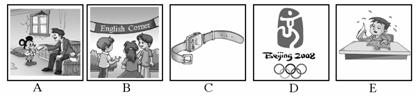
1._____ 2._____ 3._____ 4._____ 5._____
Ⅱ.听句子,选择正确答语。每个句子读一遍。(5分)
6.( )A.I prefer English. B.I agree with you.
C.I think they’re both quite difficult for me.
7.( )A.Yes, it is. B.Yes, they do. C.Yes, they are.
8.( )A.Listen to me carefully. B.Please be quick. C.Oh, sorry.
9.( )A.No, my English is poor. B.Not at all.
C.Thank you for your praise.
10.( )A.Certainly. I’ll be glad to. B.No, I won’t. C.I’m sorry to hear that.
Ⅲ.听对话及问题,选择正确答语。每段对话和问题读两遍。(5分)
11.( )A.France. B.The U.S.A. C.England.
12.( )A.English. B.Both English and French.
C.French.
13.( )A.Adults. B.Women. C.Children.
14.( )A.Japanese food. B.French food. ese food.
15.( )A.To Hunan. B.To Hainan. C.To Yunnan.
Ⅳ.听短文,回答问题。短文读三遍。(5分)
16.Where did the man go one day?
___________________________________________________________
17.Where did he saw a box of good apples?
___________________________________________________________
18.How did he do with the apples at first?
___________________________________________________________
19.Why did the river become very big?
___________________________________________________________
20.What did he have to do when he could not get over the river?
___________________________________________________________
Ⅰ.词汇。(10分)
(A)根据句意及首字母提示补全单词。
1.If you want to learn English well, you should pay attention to its spelling and p_____.
2.What are the d_____ between the two pictures?
3.Fall is another saying of a _____.
4.People in the city held a great party to celebrate their v_____.
5.He spoke English with a little Dutch(荷兰语的) a_____.
(B)根据句意,用所给单词的适当形式填空。
6.She ________ (force) herself to be polite to them.
7.The two ________(German) are from Germany.
8.English is spoken ________(different) in different English-speaking countries.
9.In the word “knew”, the letter“k”is not ________(pronounce).
10.In ________ (Australian), people call their friends “mates”.
Ⅱ.英汉互译。(5分)
11.我父亲叫我把旅行箱放在汽车尾部的行李箱里。
My father _____ me _____ put the suitcase in the boot.
12.澳大利亚英语和英式英语一样吗?
Is Australian English _____ _____ _____ British English?
13.迈克尔将去机场为王军峰送行。
Michael is going to the airport _____ _____ Wang Junfeng _____.
14.昨天下午4:00林涛看到他的同学在操场上打篮球。
Lin Tao _____ his classmates _____ basketball on the playground at 4:00 p.m. yesterday.
15.陈真学英语没有困难。
Chen Zhen has no _____ in _____ English.
Ⅲ.书面表达。(10分)
假如你是王群,正在澳大利亚度暑假。在那儿你遇到了一些语言障碍。请给你的英语老师Mr. Zhou发一封电子邮件,把你所遇到的困难告诉他。(80词左右)
听 力 材 料
Unit 3 Topic 2
Ⅰ.听句子,选择正确图片。每个句子读一遍。
1.Wang Qiang learns English by watching English-language videos.
2.In Australia, people say “G’day” instead of “Hello”.
3.People say “Good on ya, mate!” instead of “Well done!” in Australia.
4.The flight is from Beijing to Shanghai.
5.My family are enjoying spending our holiday in Disneyland.
Ⅱ.听对话及问题,选择正确答案。每段对话和问题读两遍。
6.W: Jack, do you usually study for a test by taking notes?
M: No, I don’t do that. I study for a test by asking the teacher for help.
Q: How does Jack study for a test?
7.M: Has the English language taken in many new words from other languages?
W: Yes. For example, Americans borrowed“cent”from old French and“tofu”from Chinese.
Q: What are they talking about?
8.M: Do you think it’s easy to learn English?
W: No, I can’t pronounce some of the words. So it’s a little hard for me.
Q: Why does the woman think English is a little hard for her?
9.M: Is that girl Mary? Her English is perfect.
W: Yes, she has been a member of an English club for two years.
Q: What do we know about Mary?
10.W: I am short of writing. What should I do?
M: I think you should make a pen pal. It helps a lot.
Q: What does the man advise the girl to do?
Ⅲ.听对话,选择正确答案。对话读两遍。
W: Excuse me, Xiao Ming. It must be hard work to be a middle school student now.
M: It certainly is. I’m going to take the most important examination and I must prepare every subject very well.
W: I guess you can’t have enough sleep.
M: Yes. I have to get up at six o’clock every morning and go to bed very late.
W: Why do you get up so early then?
M: Because I want to remember and recite something at that time.
W: Does your mother get up as early as you?
M: Yes. She cooks breakfast for me. She wants me to stay healthy.
W: Your mother is so kind. Well, how do you spend your spare time?
M: Spare time? I have no spare time. I have lessons all the time.
W: I really hope it goes well after your hard work.
M: Thank you.
Ⅳ.听短文,填空。短文读三遍。
Languages change with time and place, and so does English. In English many words are borrowed from other languages. About 900 years ago, many great changes happened to English. A great many words were borrowed into English from French. About 500 years ago there was another great change. This time it was a change in pronunciation, but the spelling was not much changed. Sometimes one word has different meanings in different countries. You need to know some of these differences to make yourself understood.
(C)
English is spoken as the first language by most people in the U.S.A., Britain, Australia, New Zealand, Ireland and Canada. However, English is spoken all over the world. It is the main language in over 60 countries, including India, Singapore and many of the Caribbean and Pacific islands. In these places English is often the second language.
English is also an international language in many other countries, like China and Japan. People in these countries use it for business, and travelers to these countries use English when they want to communicate. Other people may learn English because they enjoy reading books in English, listening to British or American music or watching American films.
English has changed a lot over the years and still goes on changing. It is no longer right to talk about British English or American English if the speakers come or don’t come from those countries. People in Japan and Korea, for example, may use the American spelling but may not sound like American.
English will probably be the most widely used language in the world by the end of the 21st century. This language no longer belongs to British, American or Australian speakers. It belongs to anyone in the world. So, as a middle school student today, think about how you can use this language. After you leave school, you will almost certainly need it.
根据短文内容填空,每空一词。
36.In the U.S.A., Britain and Australia, English is _____ as their _____ language.
37.English is spoken as an _____ _____ by the people all over the world now.
38.English doesn’t stay _____ _____, it has changed a lot over the years.
39._____ the most widely used language will be _____ by the end of the 21st century.
40.In the future, English will be more _____ and _____.
(B)
When I was 16 years old, I made my first visit to the United States. It wasn’t the first time I had been abroad. Like most English children, I learnt French at school and I had often been to France, so I was used to speaking a foreign language to people who didn’t understand English. But when I went to America I was really looking forward to having a nice easy holiday without any language problems.
How wrong I was! The misunderstanding began at the airport. I was looking for a public telephone to give my American friend Danny a ring and tell her that I had arrived. A friendly old man saw me looking like being lost and asked if he could help me.
“Yes,”I said.“I want to give my friend a ring.”
“Well, that’s nice,”he exclaimed (惊呼).“Are you getting married? But aren’t you a bit young?”
“Who is talking about marriage?” I replied. “I just want to give my friend a ring to tell her I’ve arrived. Can you tell me where there’s a phone box?”
“Oh!”he said.“There’s a phone downstairs.”
When at last we did meet up, Danny explained the misunderstanding to me.“Don’t worry,” she said to me.“I had many difficulties at first. There are lots of words which the Americans use differently in meaning from us British. You’ll soon get used to all the funny things they say. But most of the time British and American people can understand each other!”
31.( )Which sentence is right according to the passage?
A.This was the first time for the writer to go abroad.
B.The writer could speak French and English.
C.He thought he would have some difficulties in understanding the Americans.
D.The writer had been to the U.S.A. many times.
32.( )When the writer arrived at the airport, he wanted to _____.
A.buy a ring for his friend B.ask the way to his friend’s
C.telephone his friend D.call a taxi
33.( )The old man thought _____.
A.the writer wanted to find a phone box
B.the writer was old enough to get married
C.the writer didn’t know the way
D.the writer wanted to find his girlfriend
34.( )At last, the old man _____.
A.understood what the writer wanted to do
B.couldn’t understand the writer
C.bought a ring for the writer
D.took the writer to the phone box by himself
35.( )Which sentence is wrong according to the passage?
A.The writer’s friend, Danny had a lot of difficulties in the U.S.A. at first.
B.There are some differences between American and British English.
C.British people can’t understand the Americans most of the time.
D.British and American people can understand each other most of the time.
(A)
Every person uses his own special words to show his ideas and feelings. Some of these expressions are commonly used for many years. Others are popular for just a short time. One such American expression is “Where’s the beef ?”. It is used when something is not as good as it is said to be. In the early 1980s, “Where’s the beef ?” was one of the most popular expressions in the United States. It seemed as if everyone was using it at that time.
Beef, of course, is the meat from a cow, and no food is more popular in America than a hamburger made from beef. In the 1960s, a businessman named Ray Kroch began building small restaurants that sold hamburgers at a low price. Kroch called his restaurant “McDonald’s”. Ray Kroch became one of the richest businessmen in America.
Other business people saw his success. Some of them opened their own hamburger restaurants. One company called “Wendy’s” said its hamburgers were bigger than those sold by McDonald’s or anyone else. The Wendy’s company began to use the expression “Where’s the beef ?” to make people know that Wendy’s hamburgers were the biggest. The Wendy’s television advertisement showed three old women eating hamburgers. The bread that covered the meat was very big, but inside there was only a bit of meat. One of the women said she would not eat a hamburger with such a little piece of beef.“Where’s the beef?”she shouted in a funny way. The advertisement for Wendy’s hamburger restaurants was a success. As we said, it seemed everyone began using the expression “Where’s the beef ?”.
根据短文内容,判断正(T)误(F)。
( )26.The expression “Where’s the beef ?” is used when something is not as good as it is said to be.
27.( )Wendy started McDonald’s restaurant.
28.( )Other people wanted to open hamburger restaurants because they thought they could make a lot of money.
29.( )Wendy’s made the expression known to everybody by a television advertisement.
30.( )The Wendy’s company wanted to tell others their hamburgers were the most delicious.
湖北省互联网违法和不良信息举报平台 | 网上有害信息举报专区 | 电信诈骗举报专区 | 涉历史虚无主义有害信息举报专区 | 涉企侵权举报专区
违法和不良信息举报电话:027-86699610 举报邮箱:58377363@163.com