
题目列表(包括答案和解析)
6.( )I’m afraid I have to _____ the doctor’s advice.
A.follow B.receive C.carry D.listen
5.( )You must try your best because you can’t depend _____ your parents all the life.
A.of B.for C.on D.upon
4.( )Not only my parents but also I _____ a doctor.
A.are B.is C.am D.were
3.( )How does the fight between them come _____?
A.to B.on C.about D.in
2.( )The engineer will return from Hong Kong _____ a few days.
A.since B.in C.for D.after
Ⅰ.单项选择。(10分)
1.( )In Australia the meaning of “Good on ya, mate!” is _____
A.“Not good!” B.“It’s a pity!” C.“Well done!” D.“Sorry!”
Ⅰ.听句子,选择正确图片。每个句子读一遍。(5分)
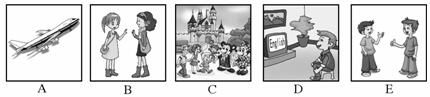
1._____ 2._____ 3._____ 4._____ 5._____
Ⅱ.听对话及问题,选择正确答案。每段对话读两遍。(5分)
6.( )A.By working with his friends.
B.By taking notes.
C.By asking the teacher for help.
( )ging language. B.Increasing population. C.Developing country.
8.( )A.Because she can’t spell some English words.
B.Because she can’t understand spoken English.
C.Because she can’t pronounce some of the words.
9.( )A.She is good at English.
B.She joined an English language club one year ago.
C.She does badly in English.
10.( )A.He advises the girl to join a language club.
B.He advises the girl to listen to some tapes.
C.He advises the girl to make a pen pal.
Ⅲ.听对话,选择正确答案。对话读两遍。(5分)
11.( )When does Xiao Ming get up every morning?
A.At 5: 30 a.m. B.At 6: 00 a.m. C.At 6: 30 a.m.
12.( )Why does Xiao Ming get up so early every morning?
A.Because he wants to do some exercise.
B.Because he wants to memorize(记忆) some English words.
C.Because he wants to memorize and recite something.
13.( )Who gets up as early as Xiao Ming every morning?
A.His father. B.His mother. C.Nobody.
14.( )How does Xiao Ming spend his spare time?
A.By playing football. B.By reciting something.
C.He has no spare time at all.
15.( )What’s the possible relationship between the two speakers?
A.Teacher and student. B.Reporter and student. C.Mother and son.
Ⅳ.听短文,填空。短文读三遍。(5分)
Languages change with time and place, and so does English. In English many words are borrowed from other languages. About 900 years ago, many great changes 16 to English. A great many words were borrowed into English from French. About 500 years ago there was another great change. This time it was a change in 17 , but the 18 was not much changed. Sometimes one word has the different 19 in different countries. You need to know some of these 20 to make yourself understood.
16._____ 17._____ 18._____ 19._____ 20._____
Ⅰ.词汇。(10分)
(A)根据句意及汉语提示完成句子,每空一词。
1.I think it’s very important ______ ______ ______ (与……交流) foreigners at the moment.
2.English is spoken ______ ______ ______ ______(作为第二语言) in some countries.
3.The cake was ______ ______ (把……分成……) three pieces by her.
4. ______(不论何时) you need help, send me an e-mail or telephone me.
5.The official goes to New York to take part in an ______ ______ (国际会议) every year.
(B)根据句意及首字母提示补全单词。
6.Is Japanese s______ to English?
7.The story is t______ from Chinese into English.
8.In g______, we have made progress in learning English in recent months.
you find our p______ on the map?
10.How can he make polite c______ with someone he dislikes?
Ⅱ.综合填空。(5分)
根据句意,用所给单词的适当形式填空。
|
rapid, understand, hold, language, begin,
need, wide |
English is the most 11 used language in the world. It’s used as the mother tongue by most people in many countries. It’s also one of the working 12 in the U.N. China is developing 13 and Beijing hosted 2008 Olympic Games. If we want to communicate with foreigners and prevent them from having trouble 14 , more and more people who can speak English well are 15 .
11._____ 12._____ 13._____ 14._____ 15._____
Ⅲ.书面表达。(10分)
英语是世界上使用最广泛的语言,其地位和作用日益重要。中国已成功举办了2008年奥运会,并与世界各地的来宾共同交流、学习。请以Let’s Study English Well为题,谈谈学好英语的重要性。(80词左右)
Unit 3 Topic 2
(满分100分,时间90分钟)
(C)
Once there were five beggars(乞丐). One was English, one Turkish, one Greek, one was an Arab and one was Persian. One day they met and decided to stay together, sharing what they had and helping each other in trouble times.
Soon a man passed them in the street and gave them a coin. They talked about what to do with it. At last they decided to buy something to eat.
“Let’s buy some grapes!” said the Englishman. But the Turkish wanted “uzum”, the Arab “aneb”, the Greek “stafelea”, and the Persian insisted on(坚持) “angur”. They did not understand each other’s language very well. Soon they were quarrelling and even fighting.
While they were fighting about how to spend the money, a stranger came along. He knew all the five languages. He asked them why they were fighting. After they told him, he said, “Give me your coin. I will buy what you want.”
He was soon back with a bunch of grapes. Each beggar was happy, as each had what he had wanted. They all asked for the same thing, but the word for“grapes”is different in different languages.
If people could understand each other, there would be no need to fight.
根据短文内容,回答下列问题。
36.Did these beggars speak the same language?
______________________________________________________________
37.What did they decide to do when they met one day?
______________________________________________________________
38.What did a man give them in the street?
______________________________________________________________
39.Why did they quarrel?
______________________________________________________________
40.In fact, all of them wanted to buy grapes, didn’t they?
______________________________________________________________
(B)
One day, I happened to meet an Englishman in the street and soon we began to talk. As I was talking about how I was studying English, the foreigner seemed to be very surprised, gently shaking his head and saying,“You don’t say! You don’t say!” I was puzzled(困惑的), and I thought, “Perhaps this is not a right thing to talk about.” So I said to him, “Well, shall we talk about the Great Wall? Have you ever been there?”
“Certainly. When I’m back home, everyone will laugh at me if I leave here without seeing it. The Great Wall is wonderful!”“Yes, it is one of the wonders in the world. And people of many countries have come to visit it.” As I went on telling him more about it, he stopped me again, “You don’t say!”
I couldn’t help asking,“Why do you ask me not to talk about it?”
“Well, I didn’t ask you to do so.” he answered, greatly surprised.
“Didn’t you say ‘You don’t say!’?” I asked again.
Hearing this, the foreigner laughed loudly. He began to explain,“‘You don’t say!’means ‘Really?’ Perhaps you know little about English idioms(习惯用语).”
Wow! How foolish I was! Since then I have been careful with English idioms.
根据短文内容,判断正(T)误(F)。
31.( )The foreigner didn’t want to listen to the writer to talk about how he was studying English.
32.( )The writer was puzzled because the foreigner knew the Great Wall very well.
33.( )The foreigner thought the Great Wall was wonderful.
34.( )Perhaps the story happened in China.
35.( )When the foreigner used the idiom“You don’t say!”, he meant“Stop talking!”
湖北省互联网违法和不良信息举报平台 | 网上有害信息举报专区 | 电信诈骗举报专区 | 涉历史虚无主义有害信息举报专区 | 涉企侵权举报专区
违法和不良信息举报电话:027-86699610 举报邮箱:58377363@163.com