
题目列表(包括答案和解析)
Ⅰ.词汇。(10分)
(A) 根据句意及首字母提示补全单词。
1.The government p_____ homeless people with nice homes.
2.Do you know what the p_____ of this passage is?
3.Project Hope is a s_____ service program to help poor students.
4.Some i_____ have changed our life. They make the world become better.
5.As a m_____ of fact, she didn’t know the thing at all.
(B) 根据句意,用所给单词或词组的适当形式填空。
|
mention, homeless, at home and abroad, get used to, in need |
6.It’s reported that there is a wonderful program to help ________ people return to work.
7.He tried to find out the problems ________ in the article.
8.Project Hope has raised much money from people ________.
9.Sooner or later I think you will ________ working here.
10.A friend ________ is a friend in deed.
Ⅱ.英汉互译。(5分)
11.As a matter of fact, it is a program that helps homeless people.
___________________________________________________________
12.You shouldn’t leave. You’d better see it for yourself.
___________________________________________________________
13.她来北京3年了。(用for)
___________________________________________________________
14.他们力争让流浪儿童重新过上正常的生活。
___________________________________________________________
15.大多数人因气候寒冷而生病。
___________________________________________________________
Ⅲ.书面表达。(10分)
根据下面提示写一篇80词左右的日记。
1.5月1日,星期六,天气晴朗;
2.上午9点,我和同学们一起去农村参观,沿途看到许多稻田、树林、工厂、商店和学校;
3.10点到12点我们参观了10户农家,了解到不少农民因种菜和养蚕而致富,有的还买了彩电,生活比以前好多了。据说有几位美国朋友还要来参观呢!
4.祝愿他们的生活越来越好。
参考词汇: 养蚕raise silkworms
听 力 材 料
Unit 1 Topic 1
Ⅰ.听句子,选择正确图片。每个句子读一遍。
1.We have learnt a lot about the 2004 Olympic Games in Athens.
2.Today is Tree Planting Day.
3.Ann used to go to school on foot, but now she goes to school by bike.
4.Rita often searches the Internet for some information.
5.Jane has gone abroad.
Ⅱ.听句子,选择正确答语。每个句子读一遍。
6.Have you ever fed the disabled granny?
7.Could you please tell me something about China?
8.Why not go to Mount Tai for the summer holiday?
9.Would you like to help the disabled children?
10.Where have you been?
Ⅲ.听对话,选择正确答语。每段对话读两遍。
11.W: Maria helped her classmate study English last Sunday.
M: Wow, she is helpful.
Q: What did Maria do last Sunday?
12.W: By the way, where is Rita? Is she at home?
M: Oh, no. She has gone to Beijing with her father.
Q: Where is Rita now?
13.W: Though I wanted to travel to America, I helped the disabled granny the whole holiday.
M: What a wonderful experience!
Q: What did the girl want to do in the holiday?
14.M: Hurry up, Kate. The film will begin in ten minutes.
W: OK, I’m coming.
Q: What are they going to do?
15.W: Jiangxi’s roads were narrow and dirty fifteen years ago.
M: Yes, I know. But they’re wide and clean now.
Q: What were the roads like in Jiangxi fifteen years ago?
Ⅳ.听短文,完成下面表格。短文读三遍。
Sally has changed a lot. At school she used to be lazy, but now she works very hard. She is one of the top students in our class. She used to hate English, but now she is very good at it. She used to have long hair, but now her hair is short.
As for sport, she used to play ping-pong, but now she is on the soccer team.
As for her hobby, she used to like collecting stamps, but now she likes to collect coins.
Topic 2
Ⅰ.听句子,选择正确图片。每个句子读一遍。
1.It is difficult for so many people to find a job in China.
2.Why not go and spend your holiday climbing mountains with us?
3.It’s a photo of Jim’s family. He is the only child in the family.
a has the largest population with 1.3 billion.
5.There are many supermarkets and shopping centers in Guangzhou.
Ⅱ.听对话及问题,选择正确答语。每段对话读两遍。
6.M:Have you ever been to Beijing? I’m going there next week.
W:Yes, I went there and visited the Summer Palace last month.
Q:Who was in Beijing last month?
7.M:What about the population of India?
W:Its population is just smaller than that of China. And it has the second largest population in the world.
Q:Which country has the largest population in the world?
8.M:What is the population of your country?
W:There are about 1.3 billion people in China. It has one fifth of the world’s population.
Q:What percent of the world’s population does China have?
9.W:It’s said that the population of some developed countries is decreasing.
M:Yes. But only a few countries.
Q:What are they talking about?
10.M:I’m sorry. I’m late again because of the bad traffic.
W:It doesn’t matter, Kangkang. But you’d better come earlier next time.
Q:Why is Kangkang late again?
Ⅲ.听短文,填空。短文读三遍。
I live in Beijing, the capital of China. It has a long history and many beautiful buildings. The Chinese people are hard-working. We have many big shopping centers and supermarkets. Our public transportation is excellent. Both students and workers have to study and work very hard because of the serious challenge in society. And even though we have made a lot of progress, we still have big pollution problems in the city.
Ⅳ.听短文,选择正确答案。短文读两遍。
Now, in this part of the program, we try to put people in contact with their old school friends. So, if you remember any of these people and want to see them again, listen carefully. Right now the first person this morning is Elise Crum. That’s spelt as E-L-I-S-E C-R-U-M and I’ll give you her telephone number in a minute or so. Elise said she was in Read Park School in South London for six happy years, and she wanted to meet all her old friends again. She started at the school in 1985 and she was very sorry when she left to get a job in 1991. So, if you were at Read Park School between those years, please phone her. She is waiting to hear from you and her telephone number is 675-2894. I’m sure you’ll have a lot to talk about.
Topic 3
Ⅰ.听句子,选择正确图片。每个句子读一遍。
1.Mother is cooking while he is watching TV.
2.When I was a child, I often saw films with my friends.
3.The students in Class 4 will go to the city parks to do some cleaning tomorrow.
4.Every country has homeless people.
5.The Red Cross has helped many people in need.
Ⅱ.听对话,判断下面句子正(T)误(F)。每段对话读两遍。
6.W:Tom, do you like eating candy?
M:Yes, I do. But I didn’t like it in the past.
7.W:Mike used to be fat, didn’t he?
M:Yes, he did. But now he is thin and healthy.
8.M:Thompson is only four years old, but he can draw beautiful pictures.
W:Really?
9.M:Look! What’s Kelly doing over there?
W:He is helping spread the message about Project Hope.
10.W:What’s your biggest problem?
M:Well, I have too much homework to do every day.
Ⅲ.听短文,选择正确答案。短文读两遍。
Van is Jim’s new friend at school. Van comes from a country far away. He doesn’t talk like the other children in the school. But he can do well in numbers and drawing. The teacher asks Jim to help him. Van sits next to Jim and his friends. They are helping him now. Jim shows Van how to play football. Then Jim shows him something and says the words. Van tries to say them.
Van has learned many new words. He wants to learn how to read. Van is happy because Jim and his friends are helping him. Jim likes Van because Van studies very hard.
Ⅳ.听短文,完成下面表格。短文读三遍。
Victor was a manager of a famous company. He was going to Beijing for a meeting. The meeting would start on February 12th. But when he phoned the booking office for a ticket, he was told there were only flights to Beijing on 11th. One was at 11:20 in the morning and the other was at 3:30 in the afternoon. Victor couldn’t leave until 2:10, so he could only take the 3:30 flight. The flight number was CHN 270. He had to pay 750 yuan plus another 50 yuan for the airport construction fee.
(C)
In Europe many people died during World WarⅡ. As a result, at the end of the war there were many orphans (孤儿) there. A man called Hermann Gmeiner wanted to help these children. His idea was simple. He wanted the orphans to have a home, and to have the care and kindness of parents. Gmeiner asked people to raise some money. With the money he built the first SOS Children’s Village at Imst, in Australia. It opened in 1949. This is how the SOS Children’s Village started. The letters SOS stand for“Save Our Souls (灵魂)”. This means “please help us!” The SOS Children’s Village gives help to orphans.
Hermann Gmeiner’s idea of helping orphans soon spread all over the world. By 1983, there were 170 SOS Children’s Villages in the world. People in many countries give money to help the villages. Today the children from the first children’s village have grown up. Now some of them work in other SOS Children’s Villages. In SOS Villages orphans live in family groups. There are several houses in each village. The biggest villages have 40 or 50 houses! From seven to ten children live in a house. A woman lives with each group of children and looks after them. She gives the children a lot of love and kindness. She cooks for them and makes a comfortable and happy home for them.
Of course, the children don’t spend all their time in the village. They go to school, go out with their friends and also go to town. But the village gives them a home-for the first time in their lives.
根据短文内容,回答下列问题。
36.What do we call a child who has no parents?
________________________________________________
37.What do the letters “SOS” stand for?
________________________________________________
38.How many SOS Children’s Villages in the world were there by 1983?
________________________________________________
the woman who lives with the orphans do some cooking for the children?
________________________________________________
40.The children don’t spend all their time in the village, do they?
________________________________________________
(B)
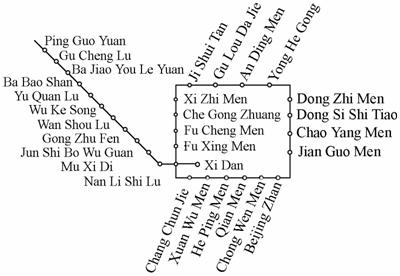
It is said that as the population of a city grows, so do its problems. Pollution, too many cars, and crowded streets are just a few of the problems. One way to deal with these problems is city trains. Traveling to different parts of a city by train means fewer cars and buses on our roads, cleaner air and more open streets. In recent years, cities such as Guangzhou, Shenzhen and Shanghai have all built city train lines.
The first city train line in China was built in Beijing. The oldest part of the train line, from Beijing Zhan to Ping Guo Yuan was opened in 1969. Its length was 23.6 kilometers. With the development of the city after 1980, more trains are needed. A new train line was built to help move people around the city center. The 16-kilometer-long “circle line” was finished in 1987. Since that time even more train stations have been built and today the train lines in the city are over 50 kilometers long.
For the 2008 Olympic Games, the trains of Beijing was very important. Most of the people who went to watch the different sports games during the Olympic Games traveled by train.
31.( )This passage tells us about _____.
A.the problems in big cities B.city trains
C.the history of Beijing D.2008 Olympic Games
32.( )How long was the first train line in Beijing?
A.About 16 kms. B.About 23 kms.
C.About 33 kms. D.About 50 kms.
33.( )In 1977, which of the following places in Beijing could you go to by train?
A.Chao Yang Men. B.An Ding Men.
C.Che Gong Zhuang. D.He Ping Men.
34.( )When was the 16-kilometer-long “circle line” finished in Beijing?
A.In 1969. B.In 1980. C.In 1987. D.In 2008.
35.( )Which of the following is true?
A.In 2008, the Beijing train line was nearly 40 years old.
B.The larger population a city has, the fewer problems it faces.
C.More and more cities are building underground train lines for the 2008 Olympic Games.
D.There are 30 stations on the “circle line” in Beijing.
(A)
Each nation has many people who help to take care of others. For example, some high school and college students in the U.S.A. often spend many hours as volunteers in the hospitals, orphanages (孤儿院) or rest homes. They read books to the people in these places, or they just visit them and play games with them or listen to their problems.
Other young volunteers go and work in the homes of people who are sick or old. They paint, clean up or repair their houses, do their shopping or mow (割,修剪) their lawns. For boys who no longer have fathers, there is an organization called Big Brothers. College students and some other men take these boys to baseball games or fishing trips and help them get to know things that boys usually learn from their fathers.
Each city has a number of clubs where boys and girls can go to play games. Some of these clubs show films or organize short trips to the mountains or some places of interest. Most of these clubs use a lot of high school and college students as volunteers because they are young enough to know the problems and needs of young boys and girls.
Volunteers believe that some of the happiest people in the world are those who help to bring happiness to others.
根据短文内容,判断正(T)误(F)。
26.( )In America, it takes most of high school and college students little time to be volunteers in hospitals, orphanages or rest homes.
27.( )Some young volunteers can go and play in the homes of people who are sick or old.
28.( )If a boy has no father, he can get to know things that boys usually learn from their fathers in an organization called Big Brothers.
29.( )Most of the clubs don’t like to use the high school and college students as volunteers because they’re too young to remember anything.
30.( )If you bring happiness to others, you will feel happy too.
Ⅱ.情景交际。(5分)
A: Do you like living in the city or the countryside?
B: 11
A: But I think the countryside is much better than the city for living.
B: 12
A: Because there is terrible traffic and too much noise in the city.
B: 13 I think the city is a wonderful place to live in, because we can go to parties, concerts and operas every day if we like. 14
A: 15 But I like living in a quiet and safe place.
|
A.I don’t think so. B.Maybe you are right. C.I like living in the city. D.Why do you think so? E.We can also have better education in the city than in the countryside. F.What about you? G.It’s very quiet in the village. |
10.( )She _____ great progress in the past 2 years.
A.made B.had mad C.has made D.make
9.( )Project Hope is _____ to help the poor children go to school.
A.aim B.aiming C.purpose D.wanting
8.( )His father has worked in this factory _____ he came here in 1980.
A.since B.for C.when D.how long
7.( )The traffic in the city _____ be terrible, but now it has improved a lot. I think you will _____ it soon.
A.use to; use to B.get used to; used to
C.used to; get used to D.get used to; use to
湖北省互联网违法和不良信息举报平台 | 网上有害信息举报专区 | 电信诈骗举报专区 | 涉历史虚无主义有害信息举报专区 | 涉企侵权举报专区
违法和不良信息举报电话:027-86699610 举报邮箱:58377363@163.com