
题目列表(包括答案和解析)
I watched as my little brother was caught in the act. He was sitting in the corner of the living room, a _____in one hand and my father’s hymnbook(赞美诗集)in the other.
As my father walked into the room, my brother cowered slightly(轻微地畏缩). He sensed that he had done something _____. Form a distance I could see that he had _____my father’s new hymnal and scribbled(乱涂)in it. Now looking at my father fearfully, we _____ waited for his punishment.
My father _____his book, looked at it, and then sat down without saying a word.He was a clergyman(神职人员) and for him, books were knowledge. And yet he _____ his children. What he did next was unbelievable. Instead of punishing my brother, he sat down, _____ the pen from my brother’s hand, and then wrote in the book himself, alongside the scribbles John had made:
“John’s work, 1959, _____ 2.” How many times have I looked into your beautiful face and into your warm eyes looking up at me and _____God for the one who has now scribbled in my new hymnal. You have made the book sacred(神圣的), as have your brother and sister.
“Wow,” I thought. “This is punishment?”
The years and the books came and went. Our family
_____ what all families go through and perhaps a little bit more. But we _____
knew our parents loved  us
and that one of the proofs(证明)of their love was the
hymnal by the piano.
us
and that one of the proofs(证明)of their love was the
hymnal by the piano.
Dad taught us about_____really matters in life: people, not objects; tolerance(宽容), not judgment; love, not anger. Now I, too, am a father. But unlike my father, I do not wait for daughters _____ to take books from my bookshelf and scribble in them. From time to time I take one down, and give it to one of my _____to scribble in. and as I look at their artwork, I think about my father and the_____he taught me.
1.A、book B、pen C、knife D、toy
2.A、wrong B、special C、dangerous D、different
3.A、dropped B、read C、borrowed D、opened
4.A、all B、both C、either D、each
5.A、picked up B、put up C、made up D、wrapped up
6.A、hated B、needed C、loved D、disliked
7.A、moved B、took C、brought D、borrowed
8.A、old B、birthday C、aged D、named
9.A、thanked B、asked C、respected D、pleased
10.A、spent B、experienced C、supported D、afforded
11.A、ever B、sometimes C、never D、always
12.A、what B、why C、which D、who
13.A、quickly B、secretly C、carefully D、suddenly
14.A、children B、sisters C、brothers D、parents
15.A、skills B、rules C、lessons D、subjects
In Britain, people have different attitudes(态度)to the police. Most people generally 1 them and the job they do, but some people said that the police shouldn’t have special 2 .
What does a policeman actually do? It is not a(n) 3 job to describe. After all,a policeman has a number of jobs to do. A policeman often has to 4 traffic, either on foot in the centre of a town, or in a police car on the roads. Indeed,in Britain, he might be in the Traffic Police and spend a lot of time 5 up and down main roads. A traffic policeman has to help keep the traffic moving,stop speeding cars and help when there is a(n) 6 .
A policeman has to help keep the 7 ,too. If there is a fight, we 8 the police to come immediately. And they often have to deal with situation at great risk of their own 9 .
We want the police to solve crimes,of course,so an ordinary(普通) policeman, 10 he is not a detective,he will often have to help 11 criminals. And 12 do we call when there is an emergency—an air crash,a fire or an earthquake?Of course the police. So a policeman has to 13 to face any terrible emergency that may happen in the modern world.
The police do a 14 job,they do it so well that I support them. But I do not envy policemen. I do not think that I could 15 do the job of a policeman.
1. A.dislike B.protect C.admire D.suspect
2. A.power B.thoughts C.knowledge D.abilities
3. A.funny B.difficult C.attractive D.easy
4. A.control B.stop C.remove D.break
5. A.walking B.driving C.marching D.searching
6. A.murder B.robbery C.accident D.theft
7. A.peace B.balance C.situation D.rule
8. A.order B.encourage C.allow D.expect
9. A.family B.safety C.future D.work
10. A.only if B.as C.since D.even if
11. A.interview B.notice C.arrest D.warn
12. A.how B.where C.what D.who
13. A.hope B.promise C.prepare D.decide
14. A.comfortable B.hopeless C.necessary D.meaningless
15. A.hardly B.ever C.forever D.never
Mr. Chen就英语杂志栏目的设置,在校园网上征求学生意见。请你根据下面表格内容的提示,用英语写篇短文回复,要求如下:
①介绍表中所提供的同学建议,可适当发挥,但不要逐字翻译;
②为杂志提供一个不同的栏目名称,并谈谈你的理由或做法;
③词数80~100。短文的开头已给出 (不计入总词数)。
|
同学建议 |
栏目名称 |
理由或做法 |
|
School News |
帮助师生了解校园内发生的事 |
|
|
Knowledge Window |
开阔眼界,学到更多知识 |
|
|
Free Talk |
让学生谈论自己的学习和生活 |
|
|
你的建议 |
... |
…… |
参考词汇:栏目column 开阔open up
As for the column names of our school English magazine,we have though of three:School News,Knowledge Window,and Free Talk.______________________________________ _______________________________________________
________________________________________________________________________
完形填空 (共15小题;每小题1分,满分15分)
阅读下面短文,从每题所给的A、B、C、D四个选项中,选出最佳选项
What will you do to make sure you reach your goals? There are 1 main steps .
First, sit down and 2 your dreams out. By writing them you will get a better idea of where you really want to go. Imagine yourself at the end of the year or maybe 3 five years. What do you see? 4 do people see you? What are you doing? Are you 5 ?
Well, a dream is just that. It’s a vision (远见) of how you 6 yourself in the future. As long as you know the direction in which you want to go, you can begin 7 some goals.
8 come the goals. Goals are ‘wants’. So are dreams, but goals are more specific (具体的). If you want to be rich, tell how much 9 you need to be rich. If you want 10 grades, tell what you mean by ‘good’. In fact, the more specific the goal is, the 11 it will be to get it. Give numbers and times. Don’t use words like ‘lots’ or ‘more’. 12, I want a ‘B’ in each of my subjects.
Third are the objectives (目标). They tell 13 what you will do and when you will do it. When you think about what you will do, don’t use words like ‘ 14 ’ or ‘maybe’. Be sure your objectives can be measured (估量). Every day or every week you can ask, ‘Did I 15 this?’ and you can answer with either a yes or a no. Don’t leave room for ‘maybes’.
|
1. |
|
|
2. |
|
|
3. |
|
|
4. |
|
|
5. |
|
|
6. |
|
|
7. |
|
|
8. |
|
|
9. |
|
|
10. |
|
|
11. |
|
|
12. |
|
|
13. |
|
|
14. |
|
|
15. |
|
In the summer of 1978 an English man named Steven was driving his tractor through a field of wheat when he discovered something strange. Some of his wheat was lying on the ground. The flattened wheat formed(形成)a circle about six meters across . Around this circle were four smaller circles of flattened wheat.
Three years later a farmer who lived nearby discovered almost the same circles in one of his fields. These circles were larger—nearly 15 meters across . That same year , another English farmer discovered three circles of flattened wheat on his land—one large circle between two small circles. During the following years, farmers in England found circles in their fields more and more often.
The circles are called “crop circles” because they usually appear in fields of wheat or corn. The wheat in the circles lies on the ground but is never broken; it keeps on growing, and the farmers can later harvest it. Farmers always discover the crop circles in the morning, so the circles probably form at night. They appear only in the months from May to September. What causes the crop circles?
At first, people thought that some kids were making them as a joke, or that farmers were making them to attract tourists.(In fact, in 1991, two men said they made the circles themselves, but many scientists don’t believe them.) People tried to copy them: They tried to make circles exactly like the ones the farmers had found. They couldn’t do it. They couldn’t enter a field of wheat without leaving tracks, and they couldn’t flatten the wheat without breaking it.
Several times people reported seeing stranger objects near the fields where crop circles later appeared. Many people believe that these crop circles are the messages sent by living things from outer space(外层空间)or the marks left by their spaceships.
Scientists who have studied the crop circles try to find out what causes them. In the summer of 1990 some scientists spent three weeks in the part of England where many circles have appeared. They had all the latest high-tech equipment(最新高科技设备). The equipment—worth 1.8 million dollars—got nothing. But one night, as the scientists were watching a field, crop circles formed in the field behind them, which were quite different from the others. The scientists had neither seen nor heard anything.
When Steven discovered the crop circles on his land in 1978, he said, “It was just like something that had landed in the field from the air and gone back up again. I don’t know what to make of these things.”
Crop circles have appeared in England, Japan, the United States and Russia. Experts from all over the world have studied them, and they say what Steven said: They don’t know what to make of these things.
【小题1】Which picture is probably the one formed in the field behind the scientists?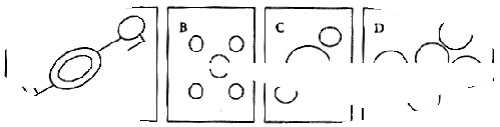
【小题2】“Flattened wheat” means ___________.
| A.broken wheat | B.lying wheat | C.harvested wheat | D.growing wheat |
| A.that is done by living things from outer space |
| B.that cannot be solved but found all around the world |
| C.that cannot be made clear or understood |
| D.that is discovered and copied by the farmers |
湖北省互联网违法和不良信息举报平台 | 网上有害信息举报专区 | 电信诈骗举报专区 | 涉历史虚无主义有害信息举报专区 | 涉企侵权举报专区
违法和不良信息举报电话:027-86699610 举报邮箱:58377363@163.com