
题目列表(包括答案和解析)
短文填空(本题共10小题;每小题1分,满分10分)
请认真阅读下面短文,并根据各题所给首字母的提示,写出一个合适的英语单词完整、正确的形式,使短文通顺。
Anger(生气) is a kind of feeling. Many things can make you angry. When your teacher gives you too much homework, when your team loses an important game, when your friend borrows your favourite thing and then 1.b it, you may get really angry.
Usually, your body will tell you when you are angry. For example, you breathe much faster, your2.f turns red and you may want to break something or hit someone, but sometimes, you try to hide your anger. For example, you may hide it in your head. The problem is that if you do this, you may get a 3.h or your stomach may hurt.
In fact, it's not 4.g to hide your anger, and it's normal for you to get angry sometimes. But anger must be let out in the right 5.w , without hurting others or yourself. Let me give you some advice.
When you get angry, you can talk about it with6.o people. It's 7.h to talk about your anger with other people, such as parents, teachers, good friends etc. When you talk about anger, those 8.b feelings can start to go away. On the other hand, when you start to feel angry, you can do some other9.t : count from 1 to 100, go for a bike ride, think about good things, and so on.
In a word, don't let your anger10.c you. Remember that how you act when you are angry can make everything better or worse.
In England recently three foreign gentlemen came to a bus stop and waited . About five minutes later, the bus they wanted came along. They were just going to get on when suddenly there was a loud noise behind them. People rushed onto the bus and tried to push them out of the way . Someone shouted at them. The bus conductor came rushing down the stairs to see what all the trouble was about. The three foreigners seem all at sea and looked embarrassed (窘迫的 . No one had told them about the British custom (习惯)of lining up for a bus that the first person who arrives at the bus stop is the first person to get on the bus .
Learning the language of a country isn't enough. If you want to have a pleasant visit, find out as much as possible about the manners and customs of your host country. You will probably be surprised just how different they can be from your own. A visitor to India would do well to remember that people there consider it impolite to use the left hand for passing food at table. The left hand is supposed to be used for washing yourself. Also in India, you might see a man shaking his head at another to show that he doesn't agree. But in many parts of India a shake of the head means agreement. Nodding (点头) your head when you are given a drink in Bulgaria will most probably leave you thirsty .
In that country, you shake your head to mean 'yes'— a nod means 'no' . At a meal in countries on the Arabic Peninsula, you will find that your glass is repeated refilled as soon as you drink up . If you think that you have had enough , you should take the cup or glasses in your hand and give it a little shake from side to side or place your hand over the top.
In Europe it quite usual to cross your legs when you are sitting talking to someone even at an important meeting. Doing this in Thailand, however, could bring about trouble . Also, you should try to avoid (避免)touching the head of an adult (成人) ——it's just not done in Thailand .
【小题1】The British people tried to push the three gentlemen out of the way, because the gentlemen______
| A.were foreigners | B.didn't have tickets |
| C.made a loud noise | D.didn't line up for the bus |
| A.learn the language of the country |
| B.understand the manners and customs of the country |
| C.have enough time and money |
| D.make friends with the people there |
| A.to use the right hand for passing food at table. |
| B.to pass food with the left hand. |
| C.to eat food with your hands. |
| D.to help yourself at table. |
| A.a common (平常的) habit | B.an important manner |
| C.a serious (严重的) trouble | D.a bad manner |
In England recently three foreign gentlemen came to a bus stop and waited . About five minutes later, the bus they wanted came along. They were just going to get on when suddenly there was a loud noise behind them. People rushed onto the bus and tried to push them out of the way . Someone shouted at them. The bus conductor came rushing down the stairs to see what all the trouble was about. The three foreigners seem all at sea and looked embarrassed (窘迫的 . No one had told them about the British custom (习惯)of lining up for a bus that the first person who arrives at the bus stop is the first person to get on the bus .
Learning the language of a country isn't enough. If you want to have a pleasant visit, find out as much as possible about the manners and customs of your host country. You will probably be surprised just how different they can be from your own. A visitor to India would do well to remember that people there consider it impolite to use the left hand for passing food at table. The left hand is supposed to be used for washing yourself. Also in India, you might see a man shaking his head at another to show that he doesn't agree. But in many parts of India a shake of the head means agreement. Nodding (点头) your head when you are given a drink in Bulgaria will most probably leave you thirsty .
In that country, you shake your head to mean 'yes'— a nod means 'no' . At a meal in countries on the Arabic Peninsula, you will find that your glass is repeated refilled as soon as you drink up . If you think that you have had enough , you should take the cup or glasses in your hand and give it a little shake from side to side or place your hand over the top.
In Europe it quite usual to cross your legs when you are sitting talking to someone even at an important meeting. Doing this in Thailand, however, could bring about trouble . Also, you should try to avoid (避免)touching the head of an adult (成人) ——it's just not done in Thailand .
1.The British people tried to push the three gentlemen out of the way, because the gentlemen______
A.were foreigners B.didn't have tickets
C.made a loud noise D.didn't line up for the bus
2. According to the article, if you want to have a pleasant journey in a foreign country, you should ____
A.learn the language of the country
B.understand the manners and customs of the country
C.have enough time and money
D.make friends with the people there
3.In India it is considered impolite ___________.
A.to use the right hand for passing food at table.
B.to pass food with the left hand.
C.to eat food with your hands.
D.to help yourself at table.
4.To cross one's legs at an important meeting in Europe is _______.
A.a common (平常的) habit B.an important manner
C.a serious (严重的) trouble D.a bad manner
匹配
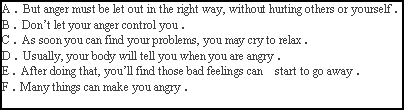
阅读下篇材料,从所给的A-F六个选项中,选出五个正确的选项填空,使短文通顺、内客完整。Anger is a kind of feeling 1 .When your teacher gives you too much homework, when your team loses an important game, when a friend borrows your favorite thing and then breaks it, you may get angry.
2 .For example, you breathe faster, your face turns red, and you may want to break something or hit someone, but sometimes you hide your anger.For example, you may hide it in your heart.The problem is that if you do this, you may get a headache or your stomach may hurt.
In fact, it's not good to hide your anger, and it's normal for you to get angry sometimes. 3 .When you get angry, you can talk about it with adults such as parents, teachers, etc. 4 .Here are some other things you can do when you start to feel angry:count from 1 to 100; give someone a hug; go for a bike ride; think about good things, etc.
Remember that when you are angry, how you act can make everything better or
worse. 5 .
| |||||||||||||||||||||||||||||||||||||||||||||||||||||||||||||||||||||||||
湖北省互联网违法和不良信息举报平台 | 网上有害信息举报专区 | 电信诈骗举报专区 | 涉历史虚无主义有害信息举报专区 | 涉企侵权举报专区
违法和不良信息举报电话:027-86699610 举报邮箱:58377363@163.com