
(四)听短文,判断句子正误,正确写A,错误写B
16.Mike never really washed his hands clean because he didn’t like water.
17.Ted lived very near to Mike.
18.Mike was a year older than Ted.
19.Ted’s hands were the cleanest of a11.
20.Mike’s hands were dirtier than Ted’s.
(三)听对话,选择正确答案
11.A.The Town Cinema. B.The Showtime Cinema. C.Both the two Cinemas.
12.A.The first one. B.The nearer one. C.The farther one.
13.A.The girl in blue. B.The girl in red. C.It’s hard to say.
14.A.Tom. B.Jim. C.Anna does.
15.A.Spring B.Summer. C.Autumn.
(二)听句子,选择与句子意思相符的图画
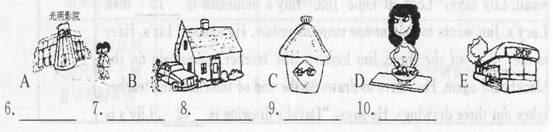
(一)听句子,选择你所听到的单词
1.A.theater B.cinema C.seat
2.A.cloth B.clothes C.clothing
3.A.comfortable B.important C.impossible
4.A.perform B.performer C.performance
5.A.put B.sit C.cut
5.I don’t like any subjects.我不喜欢任何功课。
注意:some和any的不同用法
some几个,少许,一些。通常用在肯定句中。如:
Give me some tea. 给我一些茶。
He has some video cassettes. 他有一些录象带。
any通常用在否定句和疑问中。如:
We don’t have any lessons on Saturday.我们星期六不上课。
Do you have any Japanese stamps? 你有一些日本邮票吗?
但是表示征求别人意见,表示婉转的 口气时,仍用some。如:
Would you like some ice-cream? 你想要吃冰激凌吗?
4.on,at ,in 在表示时间的区别
(1)at表示”在某一时刻”,如: at five 在五点钟 at 8:45 在八点四十五分
还用于固定的短语中 at noon 在中午 at night 在夜里 at tea time 在喝茶时间
(2) on指在具体的某一天,包括某年某月某日,星期几,某天的上午、下午、晚上等。
on Sunday on Monday morning on July 25th. on her birthday
(3)in表示在某年、某月、上午、下午、晚上。如:
in the morning in the afternoon in the evening in 2005 in September
3.I have math on Monday,Wednesday,and Friday.
have意思为上课,have除了表示拥有之外,在词组中有许多含义.
have a rest 休息 have a swim 游泳 have a shower 淋浴
have a look 看一下 have a cup of tea 喝茶 have some bread 吃面包
2.What’s your favourite subject?你最喜欢哪一门课?
(1) favourite 用作形容词,意为”最喜欢的......”如:
Her favourite color is blue.她最喜欢的颜色是蓝色.
(2)favourite 可以作名词,意为"最喜欢的人或物,宠儿"如:
Action movies are my favourite. 动作片是我最喜欢的电影.
1.你懂得what ,why ,who 引导的特殊疑问句及回答的运用吗?
What 是疑问代词,引导特殊疑问句,意为“什么”“干什么”,放在句首。如:
---What ‘s your father? --- He is a worker.
Why 是疑问副词,意为“为什么”,相当于“what…for?” 放在句首,用来询问原因理由。回答why的问句用because.如:
---Why do you learn English? ---Because I like it very much.
Who 是疑问代词,意为“谁”,位于句首。如:
Who is the man ? He is my uncle.
假如你叫林涛,你的笔友Tom从英国给你写了一封信, 信中谈了他在英国学校中的学习情况以及他本人的一些爱好。请你给他回信,信中谈谈你所在学校的学校情况,如:你在几年级、学习什么科目、你最喜欢哪门功课、最喜爱哪项体育运动等等。不少于60个单词。
Dear Tom,
______________________________________________________________________________________________________________________________________________________________________________________________________________________________________________________________________________________________________________________________
湖北省互联网违法和不良信息举报平台 | 网上有害信息举报专区 | 电信诈骗举报专区 | 涉历史虚无主义有害信息举报专区 | 涉企侵权举报专区
违法和不良信息举报电话:027-86699610 举报邮箱:58377363@163.com