
3. How does Steven go to school?
2. How does Kim go to school?
1. How does Jenny go to school?
2. Key sentences 重点句子
How do you / they go to …?
By bus / car.
How does she / he go to …?
She / He goes to work on foot.
Ability goals 能力目标
Enable students to express different means of transportation.
Learning ability goals 学能目标
Help students talk about their family members using the target language.
Teaching important points 教学重点
Learn to express different means of transportation.
Teaching difficult points 教学难点
The meanings and usage of different ways of transportation.
Teaching methods 教学方法
Listening and speaking.
Teaching aids 教具准备
Pictures, tape recorder and a projector.
Teaching procedures & ways 教学过程与方式
Step I Warming up
Ss sing a song: This is the way we brush our hair, on a Sunday morning.
Step II Lead-in
Show the pictures of a bus, a car, a bicycle and a picture of walking.
T: (Picture 1) How do I go to work?
S1: I go to work by bus. I take a bus to work.
T: (Picture 2) How do you go to school?
S2: I go to school by bicycle. I ride a bicycle to school.
T: (Picture 3) How does my friend go to work?
S3: My friend goes to work by car. My friend drives a car to work.
T: (Picture 4) How does my sister go to work?
S4: She goes to work on foot. She walks to work.
Teach the phrases: by bus / car / bicycle, on foot.
Introduce the phrases: in the / one’s car, on the / one’s bike, take a bus / car, ride a bicycle.
Language points:
How do you go to school? 你怎么去学校 ?
询问别人去做某事的交通方式,用how来提问,回答一般用“by +交通工具”或on foot 短语。要注意人称和动词形式的变化。
Step III Game
Tell Ss to find partners to play the game with the pictures used in Step II. Tell Ss to place the pictures face down in a pile. Player 1 picks up a picture and puts it on his or her forehead with the picture facing toward the other player. Player 1 tries to guess the picture according to Player 2’s action.
When Player 1 guesses the picture, the turn passes to the next player.
Step IV Presentation
(1) Free talk.
Ss have a free talk in pairs. Say something about their family members using the target language. A sample dialogue:
S1: How do you go to school?
S2: I walk to school.
S1: How does your father go to work?
S2: He goes to work by bus.
(2) Deal with Part 2 on Page 52: How does she / he go to work? Show the pictures on the screen. Ss ask and answer about them. (They stand in front of the whole class.)
A sample dialogue:
S1: Look at this picture. This is my uncle.
S2: What’s your uncle? / What does your uncle do?
S1: He is a clerk in a store.
S2: How does he go to work?
S1: He goes to work on foot. / He walks to work.
S3: Look at this picture. This is my aunt.
S4: …
Ask more Ss to practise it.
Step V Listening
T: Now you will hear a short dialogue with the target language. You’ll listen to it twice. Please listen carefully and then answer my Qs:
Period 1 Listening and speaking
Target language 目标语言
1. Words and phrases 生词和短语
walk, car, bicycle, doctor, by, far, near, drive, ride, businessman, store, by bus, by car
2. 课堂设计与课时分配
Period 1 lesson 41 Listening and speaking
Period 2 lesson 42 Listening and speaking
Period 3 lesson 43 Speaking
Period 4 lesson 44 Speaking and listening
Period 5 lesson 45 Speaking and playing
Period 6 lesson 46 Speaking and reading
Period 7 lesson 47 Speaking and singing
Period 8 lesson 48 Integrating skills
1.教材分析
本单元的主要内容是在学生熟悉的各种生活场景中,通过听力、对话练习等活动,学会用简单的英语进行购物及问路;掌握句子主语为第三人称单数的一般现在时是本单元的语法重点;通过交通方式的表达、动物生活习惯和环境的描述以及用英语表达加减法加深对一般现在时的理解。
Lesson 41 1通过对话介绍生活中常见的各种交通工具;2是口头训练,练习用目标语言看图说话、谈论家人常用的交通方式。
Lesson 42 1根据图片内容,引出本课目标语言;2与程度较好的学生进行对话,逐步引导学生用目标语言来做示范;3 是一个口头会话练习,结合目标语言,培养学生应用语言的能力。
Lesson 43 1让学生通过图片和游戏熟悉有关购物的词汇和句式,通过充分发挥想象回答问题、看卡通片、分组讨论等不同形式,进一步了解和掌握目标语言的用法;2是口头训练,指导学生如何用目标语言进行对话,给学生提供了一个应用所学语言的机会。
Lesson 44 1通过模仿在超市购物,让学生学习与超市相关的词汇和短语;2通过在商场购物,让学生学会用简单的英语进行购物。
Lesson 45 1引导学生用英语询问商品的价格并给予回答;2让学生学习30以上数字的英语说法,并学会用英语说出简单的数学加减法。
Lesson 46 1展示各种动物的图片,将同学们带入动物的世界;2看图对所示动物进行简单的描述。
Lesson 47 1通过图片展示不同的动物生活在不同的环境中;2了解更多的动物名称。
Lesson 48 通过整个单元的练习与小组活动,让学生更加全面的掌握所学知识。
|
Skill Focus |
听 |
Listen to people
talking about how to shop and ask the way in English. |
|
说 |
Do the
shopping and ask the way in English and describe some animals. |
|
|
读 |
Read and
understand brief stories about shopping and asking the way. |
|
|
写 |
Write about the language points in this unit and a short passage
that introduces persons or animals. |
|
|
Language Focus |
功能句式 |
Talking about shopping (I) - May I help you? - I want to buy … - How much is this? - Three yuan. I’ll take four, please. That’s expensive. Are these…on sale? Asking the way - Excuse me! Where is the school? - Go down this street and turn left. Expressions of means of transportation - How do you / they go to ……? - I ride my bicycle. / They walk . - How does she / he go to ……? - By car / bus. Expressing addition and subtraction in English Five plus four equals / is nine. Ten minus eight equals / is two. - What’s three plus four? - It’s seven. |
|
词 汇 |
1. 重点词汇 walk, car, bicycle, doctor, hotel, park, street, help, can, toy, sale, forty, fifty, sixty, seventy, eighty, ninety, hundred, zoo, lion, tiger, elephant, monkey, lonely, bird, panda, forest, goat, dog, sheep, rabbit, cow, pig, duck 2. 认读词汇 by, far, near, drive, ride, businessman, store, city, apartment, building, stop, wait, excuse, office, just, stair, show, follow, lost, man, map, turn, down, shop, why, because, buy, across, broken, need, chain, market, movie, way, expensive, equal, plus, minus, dream, river, tree, farm 3.短语 apartment building, traffic light, go shopping, clothes shop, bicycle shop, tea shop, grocery store, department store, movie theatre, on sale, excuse me, by bus / car, turn left / right |
|
|
语 法 |
The Simple Present Tense (II) My father drives me. She doesn’t go to work by bus. Where does a panda live? |
V. 书面表达: (20分)
假如今天是你喜欢的一个节日(如儿童节,国庆节,春节等),请简单介绍一下这个节日(包括日期,天气)以及你喜欢的理由--即在这个节日里你喜欢做些什么(like to do...)。50词左右。(可适当发挥)
(B)
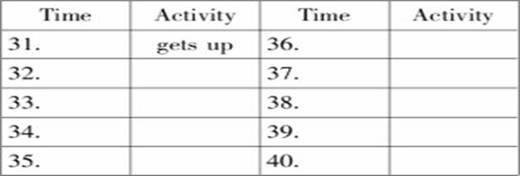
Janet Jin is a tennis(网球) star. She is thirteen years old. She usually gets up at seven o'clock. She has breakfast at seven thirty. Janet and her friend usually play tennis at eight thirty. They play for three hours. At twelve o'clock, Janet has a big lunch. She goes to school at one o'clock p.m. At four o'clock she usually plays tennis again. At six o'clock she has dinner. Janet usually does her homework at seven thirty. At nine o'clock, she watches tennis on TV. Janet usually goes to bed at ten thirty. Tennis is Janet's life!
根据上文填写下表。(20分)
湖北省互联网违法和不良信息举报平台 | 网上有害信息举报专区 | 电信诈骗举报专区 | 涉历史虚无主义有害信息举报专区 | 涉企侵权举报专区
违法和不良信息举报电话:027-86699610 举报邮箱:58377363@163.com