
5. My work _____(not finish) yet. I can’t go out to play with you.
Sample answers:
4. In our hometown there used to _____(be) many old trees.
3. Listen! Some children _____(sing) an English song over there.
2. The dinosaur eggs _____(discover) many years ago by scientists.
1. Every day my mother _____(get) up early.
2. Key sentences 重点句子 (P119)
We are trying to save the manatees.
Manatees eat about 100 pounds of food a day.
There used to be a lot of manatees.
In 1972, it was discovered that they were endangered.
Ability goals 能力目标
Enable the students to describe animals.
Emotion && attitude goals 情感和态度目标
Enable the students to protect animals and environment gladly.
Strategy goals 策略目标
To understand the target language by reading pictures.
Culture awareness goals文化意识目标
The importance of protecting animals and the environment.
Teaching important points教学重点
Talk about the animals and whether to build zoos.
Teaching procedures and ways教学过程与方式
Step I Revision and Lead- in
Ask the students to show their work.
T: In the last unit, we’ve learned to talk about the things that we have done. Now I’ll ask you a question: Have you ever been to a zoo? What kind of animals can you see in it?
S1: In the zoo of our city we can see tigers, lions, elephants, and monkeys.
S2: I can see deer and sheep.
S3: We can see some chickens, birds, camels and horses. ...
T: Have you ever seen cheetahs, pandas or manatees in our zoos?
Ss: No, we haven’t.
T: Do you know why we can’t see these animals in our zoos?
Ss: I think they are rare. / There aren’t any in our country ...
T: Some animals can’t be seen because they are endangered. So we should protect them.
Show the picture of a manatee.
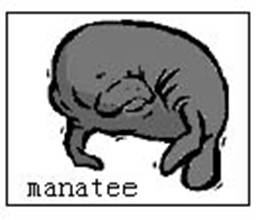
T: Now look at the picture. This animal is called manatee. It’s endangered, too. We can’t see it in the zoo, either. OK! Today we’ll learn Unit 15. We’re trying to save the manatees!
Write down the topic: We’re trying to save manatees!
Ask the students to look at the picture and answer the question.
T: We know animals are our best friends. Now look at the picture, please tell me which animal you like best and why you like it.
Show the following picture to the students.
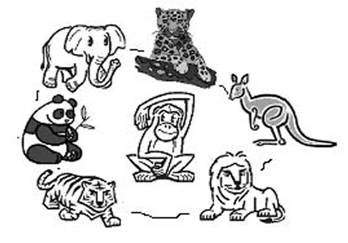
S1: I like pandas best because they are gentle.
Write the word “gentle” on the blackboard and ask for more ideas from other students.
S2: I like tigers best because they are the kings of the animals.
T: We know tigers are very aggressive.
Write the word “aggressive” down on the blackboard.
S3: I like monkeys best because they are clever and they can climb trees very quickly. They are playful.
Write down more useful words on the blackboard.
Step II Brainstorming (1a: P118)
T: Good. When we describe animals, we often use some adjectives, such as enormous, spotted, gray ... Now please find out the words that can describe the animals. You can use the adjectives from 1a.
Kangaroos: __________ _________ _________
Manatees: __________ _________ _________
Cheetahs: __________ _________ _________
Polar bears: __________ _________ _________
Elephants: __________ _________ _________
Chimpanzees: __________ _________ _________
Sample answers:
Kangaroos: playful, fast, big
Manatees: gentle, shy, enormous
Cheetahs: spotted, fast, aggressive
Polar bears: aggressive, furry, fat
Elephants: enormous, gray, strong
Chimpanzees: noisy, furry, ugly
Step III Listening and Oral Practice (1b, 1c: P118)
T: Next you will hear Ginny and Victor talking about the animals in the picture in 1a. Please listen. For the first time, get the main idea. Keep down the words used to describe the animals while listening. OK?
Play the recording. Then check the answers.
T: We just now heard that manatees are gentle and very shy. I think different people are like different animals to some extent. Different animals have different characters. For example, Jim is like a monkey because he is clever and he can climb trees very quickly. Please talk with your partners about what you are like. First, read the example from 1c in the box please.
Let the students work with their partners.
T: Which pairs would like to act out your dialogues?
Sample dialogue 1:
S1: I am like this animal because I am strong and live in the forest.
S2: You are like a lion.
S1: No.
S2: You are like a tiger.
S1: No. Because I don’t eat meat.
S2: You are like an elephant.
S1: Yes. You are right.
Sample dialogue 2:
S1: I’m like this animal because I’m spotted. I like to eat meat and I can run fast.
S2: You’re like a tiger.
S1: No.
S2: You are like a cheetah.
S1: Yes.
Sample dialogue 3:
S1: I am like this animal because I am gentle and very shy. I live in water.
S2: You’re like a manatee.
S1: Yes! You are great!
Step IV Listening Practice (2a, 2b: P119)
T: OK. We all know that manatees are gentle and very shy. They live in water and like eating vegetables. But do you want to know more about them? First let’s look at the picture on page 119. Can you say more about manatees?
Sample answers:
S1: I think they are living in the water.
S2: I believe that they eat aquatic food.
S3: I feel that there aren’t many of them.
S4: I know that they live in a place where trees grow in water.
S5: I think they are endangered.
Ask the students to listen to the recording.
T: Very well. I think your answers are all right. Manatees in the world are fewer and fewer. We should save them. We should take care of the environment that they are living in. Now let’s listen to the tape. First listen to the recording and match the words and definitions in 2a.
Play the recording for the first time.
T: Listen again and check your answers.
Play the recording for the second time. Check the answers.
T: You’ll hear the same conversation again. This time complete the chart in 2b. Put your answers on the line.
Play the recording again, then check the answers.
Step V Pairwork (2c: P119)
T: After listening, we know more about manatees. We know that they are fewer and fewer. The government has passed laws to protect them. They eat a lot of food every day. They are enormous. Can you make conversations about the animal in pairs? You can base on the model dialogue in 2c.
A sample dialogue:
S1: How many manatees are there in the US? S2: About 2,500.
S1: Where are they living?
S2: Their favorite habitat is in the water under the trees in mangrove swamps.
S1: Why are they endangered?
S2: Some of the swamps have been polluted.
S1: Do they eat a lot?
S2: Yes, they do.
...
Step VI Grammar (Grammar Focus: P119)
Help the students sum up the following patterns.
|
时 态 |
谓语动词的形式 (do) |
|
一般现在时 |
do / does |
|
一般过去时 |
did |
|
现在进行时 |
be (am / is / are) doing |
|
现在完成时 |
have / has done |
|
一般过去时被动语态 |
was / were done |
|
现在完成时被动语态 |
have / has been done |
T: Look at the Grammar Focus box on page 119. Now who’d like to read the sentences to the class?
Ask a student to read the sentences in the box.
T: Can you make some sentences with the different tenses and passive voice? Please write down your sentences in your exercise books.
Ask the students to do more practicing exercises, such as the following:
Fill in the blanks with the right forms of the given words.
分课时教案
Period 1 New function presenting
Language goals语言目标
1. Words && expressions 生词和短语
save, gentle, furry, enormous, playful, aggressive, gray, spotted, manatee, cheetah, chimpanzee, kangaroo, mangrove, swamp, habitat, aquatic, feed, underwater, vegetation
2. 教材重组和课时分配
Period 1 (Section A: 1a, 1b, 1c, 2a, 2b, 2c )
New function presenting
Period 2 (Section A: 3a, 3b, 4)
Practice
Period 3 (Section B) Integrating skills
Period 4 (Self check: 1, 2 )
Comprehensive review
|
Skill Focus |
▲Listen and talk about animals ▲Show disagreement and agreement ▲Learn to describe animals ▲Review the tenses and use them freely |
|
|
Language Focus |
功能句式 |
Show
disagreement and agreement (P120) I think that animals should not live in zoos. I disagree with you. / I agree with you. Talk about what we can do for the world (P121, P123) stop riding in cars don’t use paper towels or napkins recycle books and paper -How do you feel about ... -It makes me ... -What are three things you are supposed to do? |
|
词 汇 |
1. 重点词汇 pound, discover, expression, pull, planet, society, model, raise 2. 认读词汇 manatee, furry, enormous, playful, aggressive, gray, spotted, kangaroo, chimpanzee, cheetah, mangrove, swamp, habitat, aquatic, underwater, vegetation, weigh, polluted, present progressive, present simple, infinitive, passive voice, present perfect, suitable, tiny, cage, disgusted, educate, urge, recycle, built, stuff, glue, roof, discard, tile, fence, can, recently, inspiration, spare, Winterbourne 3. 词组 care for |
|
|
语法 |
Review
the tenses: Present Progressive, Present Simple, “used to”, Passive Voice and Present
perfect |
|
|
Strategy Focus |
1.
Classifying 2. Listening for specific information |
|
|
Culture Focus |
The
importance of protecting animals and the environment |
湖北省互联网违法和不良信息举报平台 | 网上有害信息举报专区 | 电信诈骗举报专区 | 涉历史虚无主义有害信息举报专区 | 涉企侵权举报专区
违法和不良信息举报电话:027-86699610 举报邮箱:58377363@163.com