
Period 1 Listening and speaking (Unit 1)
Period 2 Reading and writing (Unit 2)
Period 3 Language in use (Unit 3)
Ⅳ Teaching plans for each period分课时教案
Period 1 Listening and speaking
Target language 目标语言
1. Words & phrases生词和短语
study, teach, since, same, poor, project, get on (well) with, hear of
本模块以Education为话题,设计了三个单元的内容。旨在通过单元教学使学生学会谈论自己接受教育的情况;了解关于希望工程的情况;学会表述时间与事件;能用关联词and, or, but连接两个句子;能用所学的知识制作希望工程传单。
Unit 1 结合时间谈论某个事件,尤其是与学校教育有关的话题,重点学习since和for在现在完成时中的用法。
Unit 2 练习数字的读法;学习关于希望工程的课文,继续学习现在完成时所表达的含义;学习本单元重点词汇;用关联词but, and, or合并句子。
Unit 3 在练习中复现本单元重点词汇、句型和语法;读关于Oxfam的文章;制作一张希望工程传单为希望学校募捐。
|
技 能 目 标 |
听 |
Listen
for the times and events |
|
说 |
Talk about
questions about time |
|
|
读 |
Read a
passage about Project Hope for main ideas, matching words and meanings |
|
|
写 |
Write a
leaflet to raise money for the Hope
Schools Write joining sentences using words like and, or, but |
|
|
语 言 目 标 |
功 能 句 式 |
Talk about periods of time and numbers How long have you known her? For two years. How long have you lived there? Since 2004. How long have you been a student at your school? I’ve been a student at my school since 2004./for three years. How long has Sally studied Chinese? She has studied Chinese for a year. Since 1989 Project Hope has built schools all over China. |
|
词 汇 |
1. 重点词汇 study, teach, since, same, poor, project, still, raise, describe, drop, school, important, ill, pay, perhaps, nearly, luckily, point, health, care 2. 认读词汇 countryside, train, electricity, organization, leaflet 3.短语 head teacher, get on (well) with, hear about, take part, look after, drop out of, hear of |
|
|
语 法 |
Present perfect with
for and since |
III. Chinese etiquettes
The Chinese will nod or bow slightly as an initial greeting. Handshakes are also popular; wait, however, for your Chinese counterpart to initiate the gesture. If you visit a school, theater, or other workplace, it is likely that you will be greeted with applause as a sign of welcome. In turn, you should respond by applauding back. Avoid making expansive gestures and using unusual facial expressions. The Chinese do not use their hands when speaking, and will only become annoyed with a speaker who does. Some hand gestures, however, are necessary. They are outlined in the next two points. To summon attention, turn your palm down, waving your fingers toward yourself. Use your whole hand rather than your index finger to point. The Chinese, especially those who are older and in positions of authority, dislike being touched by strangers. Acknowledge the most senior person in a group first. Smiling is not as noticeable in China, since there is a heavy emphasis on repressing emotion. Members of the same sex may hold hands in public. Public displays of affection, such as kissing, between the sexes are frowned upon. Do not put your hands in your mouth, as it is considered vulgar. Consequently, when in public, avoid biting your nails, removing food from your teeth, and similar practices. Pushing is common in lineups. Spitting in public is acceptable. Blowing your nose with a handkerchief is also acceptable. Dress Code: Casual clothes are acceptable everywhere, although smarter clothes can gain more respect. Revealing clothes should be avoided. Problems that arise in China through cultural differences can often be put down to simple misunderstandings. In general, Chinese people are not forthcoming with information unless they are specifically asked for it, so be prepared to ask direct questions to get the information you need. Locals may not even speak honestly but will try to say what they think you want to hear. This is not done maliciously and an element of patience and understanding will ease the situation. Chinese people are courteous but reserved and politeness is appreciated at all times. Don't always be fooled by a smile as this can mean that the person is upset or embarrassed and try to avoid confrontational situations that may cause a loss of "face". Confrontation is not appreciated and will only worsen rather than resolve any situation.
Family Meals
Although customs and the kinds of food eaten vary according to region, it is most common for Chinese families to gather for three meals a day. In some areas and at some times of the year, laborers may have only two full meals a day, but when possible, they supplement these with up to three smaller ones, often taken at tea houses. There is not, in general, the strong association we have in the West between the type of food and the time of day it should be served (say, eggs for breakfast, a sandwich for lunch, pot roast for dinner). The sorts of dishes served at the two or three main meals are pretty much the same. The goal in planning, however, is to provide a number of dishes at each meal, so that, rather than experiencing difference by comparison between one meal and the next, each meal includes, in itself, a satisfying array of elements.
The Stuff of the Meal
The center of the Chinese meal is fan, or grain. So much so that the meal itself is called hsia fan, "a period of grain." In the South and among urban families in other areas, the fan may be rice or rice products, but rice is expensive, as is the wheat eaten in the North in the form of cooked whole grains, noodles, or bread. Depending on the region, then, less prosperous families might make their meals of millet, sorghum, or corn. The meats and vegetables we think of as the focus of the meal are known as ts'ai, which means something like "side dishes" -- one could almost go so far as to call them condiments for the fan.
Who Eats When and How
Eating begins in order of seniority, with each diner taking the cue to start from his or her immediate superior. Children are taught to eat equally from each ts'ai dish in turn, never betraying a preference for a particular item by eating more of it, never seeming to pause to choose a specific bite from the plate. In order to cool the soup a bit and to better diffuse the flavor in the mouth, soup is eaten by sipping from the spoon while breathing in. This method, of course, produces the slurping noise that is taboo in the West. To eat fan, a diner raises the bowl to her lips and pushes the grains into her mouth with chopsticks. This is the easiest way to eat it and shows proper enjoyment -- eating fan from a bowl left sitting on the table suggests dissatisfaction with the food. The diner must finish all the fan. To leave even a grain is considered bad manners, a lack of respect for the labor required to produce it.
can的否定形式为cannot,缩写形式为can't。
1) 表示能力,意思是:能,会。
I can't swim. 我不会游泳。
Can you drive? 你会开车吗?
注意:can表示能力可和be able to互换使用,且后者有更多的时态,be able to常被用来表示can所不能表示的将来或完成的概念。
They will be able to run this machine on their own in three months. 他们过三个月就能自己开这台机器了。
2) 表示可能性,意思是:可以,可能。
That big cinema can seats 2,000 people. 那家大电影院能坐2000人。
He can be very friendly at times.有时他会很友好。
3) 表示允诺,意思是:可以,能够。
You can have the book when I have finished it.书我看完了可以给你。
Can I use your pen?我可以用你的钢笔吗?
4) 表示惊异、不相信等(用于疑问句、否定句或感叹句中),意思是:会,可能。
This can't be true. 这不可能是真的。
Can it be true? 这可能是真的吗?
II. Customs and rules in England
The British are said to be reserved in manners, dress and speech. They are famous for politeness, self-discipline and especially for sense of humor. Basic politeness (please, thank-you, excuse me) is expected.
How to greet people
British people are quite reserved when greeting one another. Greeting can be a bright “Hello”, “Hi” or “Good morning”, when you arrive at work or at school.
Terms of endearment --- Names we may call you
You may be called by many different “affectionate” names, according to which part of the Britain you are in. Do not be offended, this is quite normal. For example, you may be called dear, flower, love, chick, mate, son, madam, miss, sir, according to your sex, age and location.
Visiting people in their houses
When being entertained at someone’s home it is nice to take a gift for the host and hostess. A bottle of wine, bunch of flowers or chocolates are all acceptable.
Eating
We eat continental style, with fork in the left hand and the knife in the right.
Do’s and Don’ts in England
Do stand in line:
In England we like to form orderly queues (standing in line) and wait patiently for our turn e.g. boarding a bus. It is usual to queue when required, and expected that you will take correct turn and not push in front. “queue jumping” is frowned upon.
Do say “Excuse me”:
If someone is in you way and you would like them to move, say excuse me and they will move out of your way.
Do pay as you go:
Pay for drinks as you order them in pubs and other types of bars.
Do say “Please” and “Thank you”:
It is very good manners to say “please” and “thank you”. It is considered rude if you don’t. whenever you will notice in England that they say “thank you” a lot.
Do cover your mouth:
When yawning or coughing always cover your mouth with your hand.
Do shake hands:
When you are first introduced to someone, shake their right hand with your own right hand.
Do say sorry:
If you accidentally bump into someone, say “sorry”. They probably will too, even if it was your fault! This is a habit and can be seen as very amusing by an “outsider”.
Do smile:
A smiling face is a welcoming face.
Do drive on the left side of the road.
Don’t greet people with a kiss:
They only kiss people who are close friends and relatives.
Avoid talking loudly in public
It is impolite to stare at anyone in public.
Do not pick your nose in public:
They are disgusted by this. If your nostrils need de-bugging, use a handkerchief.
Avoid doing gestures such as backslapping and hugging
This is only done among close friends.
Do not spit:
Spitting in the street is considered to be very bad mannered.
Do not burp in public: you may feel better by burping loudly after eating or drinking, but other people will not! If you can not stop a burp from bursting out, then cover your mouth with your hand and say “excuse me” afterwards.
Do not pass wind in public
Now how can we say this politely? Let’s say that you want to pass wind. What do you do? Go somewhere private and let it out.
It is impolite speak with your mouth full of food.
Do not ask personal or intimate questions:
They do not ask questions such as: How much money do you earn? How much do you weigh? Or why aren’t you married?
Never eat off a knife when having a meal.
1) 表示主观的义务和必要, 主要用于肯定句和疑问句, 意思为 “必须……,得……,要……”;由must引起的疑问句,肯定回答要用must或have to, 否定回答要用needn’t或don’t have to, 意思是“不必”;must的否定形式mustn’t表示禁止,意思是“不能,不许”。
We must find a good method to learn computer well. 我们必须找一个学好电脑的方法。
-Must I finish the task right now? 我现在必须完成这个工作吗?
-Yes, you must. / Yes, you have to. 是的。
(-No, you needn’t. / No, you don’t have to. 不,不必。)
You mustn’t come here without permission. 未经允许,你不能来这儿。
2) 表示肯定的猜测,常用于肯定句中,意思为 “一定是, 必然……”。
Your sister must be a doctor in this hospital.(现在的猜测) 你姐姐一定是这家医院的医生。
He must be reading newspapers in the reading room now.(正在进行的猜测)他此刻一定正在阅览室读报。
It must have rained last night, for the ground is wet.(过去的猜测)昨晚一定下雨了,因为地面上是湿的。
"When is the best time to travel through Outback Australia?" is a question that I hear asked a lot. There is no simple answer to it.
It depends mostly on where you want to go. The Outback in Australia is huge and spans several climate zones. (We will look at them on this page.)
It also depends on what kind of activities you are interested in and by which means you travel. The weather will be of more importance if you want to go camping. Or if your car doesn't have air conditioning. Or if you want to go swimming.
In my opinion any time is a good time to visit the Australian Outback. There will always be a part of Australia for which the time you chose is just perfect...
The Arid Regions of Outback Australia
The weather in arid inland Australia is characterised by extremes, hot days and freezing nights. Overall there are hotter days and milder nights in summer, compared to bearable days and freezing nights in winter. You choose. Of course keep in mind that the seasons are opposite to the northern hemisphere's.
I should mention here that the temperatures alone don't tell the whole story. Humidity is a huge factor as well. The drier the heat the less you will feel it. Less humidity and cloud cover also means that heat is not retained at night. You can have very hot days but the nights are still pleasantly cool. Very hot in Alice Springs feels a lot better than somewhat hot in Darwin. Always look at temperature and humidity, like this map does.
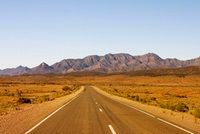
Having said that, the driving distances in Outback Australia are huge and if you are driving you will spend a lot of time in your vehicle.
If you want to drive through Outback Australia in summer do yourself a favour and make sure the car has air conditioning.
I'll tell you a "secret" for how to deal with the heat. Drink, drink, drink! Water, that is, not sweet sodas. If you go for walks always take a water bottle. As I said above, you don't feel the heat much if it is dry, but you will lose even more moisture. Drinking enough water is the single most important thing you can do to feel well in higher temperatures! It can make all the difference.
Northern Outback Australia
Northern Outback Australia is tropical and has a distinct dry and wet season. The dry season from April/May to September/October is considered to be the best time for travel with pleasant day temperatures and mild nights. Beginning and end of 'the Dry' can be hot and humid, with temperatures up to 35oC (95F) and above. On the plus side there are less tourists and lower prices.
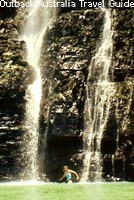
The 'Wet' is considered by many locals to be the best time of the year in the Outback in Australia.
It is the breeding season and wildlife abounds. Our red world gets covered in a lush green lacework of fresh vegetation and all the waterfalls in our favourite swimming spots are raging.
Of course it doesn't rain every day, most rains happen in the evening or wee hours of the morning. The lightning show accompanying the tropical thunderstorms has to be seen to be believed.
However, travel can be restricted. The many unsealed roads in Outback Australia are closed, and even highways get cut off at times. It is something I would only recommend to people who have a lot of time. (And did I mention another reason why we locals love the Wet? We have the place to ourselves again.)
As the USA covers several micro-climates it is difficult to pinpoint exactly when the best time to visit is. Depending on your tastes and interests the USA can be visited year-round.
The summer tourist season tends to run from Memorial Day (late May) to Labor Day (early September) with the peak period being mid June to the end of August.
May or June is generally ideal as air fares are less expensive than in July and August, the hours of daylight are at their maximum, the weather is usually mild, and recreational facilities are operating but not too crowded. September is also well worth considering.
Florida, the most visited destination for travellers, is warm throughout the year and hot in the summer months. If you do not like temperatures too high the best time to visit would be December to March.
Autumn (Fall) is the perfect time to see New England when many states come alive in orange, red and yellow.The first couple of weeks of October are the most spectacular.
maybe与may be
maybe 是副词,意思是“也许、可能”,在句中作状语,相当于perhaps,常位于句首。如:
Maybe she\'ll come this afternoon. 她可能今天下午来。
Maybe you put the letter in your pocket. 大概你把信放在衣袋里了。
而may也有可能之意,may be中的may是情态动词,be 是动词原形,两者构成完整的谓语形式,与主语形成系表结构意为“也许是......可能是......”。
I can\'t find my watch. It may be in your bag. 我找不到我的手表了,它可能在你的包里。
He may be a soldier. 他可能是个军人。
maybe 和may be有时可以互换。
He may be in the office.(=Maybe he is in the office.)他或许在办公室。
You may be right.(=Maybe you are right.)你或许是对的。
2. finish the rest activities in the workbook.
Teaching resources教学资源库
湖北省互联网违法和不良信息举报平台 | 网上有害信息举报专区 | 电信诈骗举报专区 | 涉历史虚无主义有害信息举报专区 | 涉企侵权举报专区
违法和不良信息举报电话:027-86699610 举报邮箱:58377363@163.com