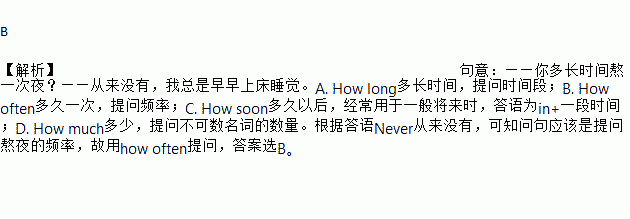
一 do you stay up?
一Never. I always go to bed early.
A. How long B. How often
C. How soon D. How much
B 【解析】句意:——你多长时间熬一次夜?——从来没有,我总是早早上床睡觉。A. How long多长时间,提问时间段;B. How often多久一次,提问频率;C. How soon多久以后,经常用于一般将来时,答语为in+一段时间;D. How much多少,提问不可数名词的数量。根据答语Never从来没有,可知问句应该是提问熬夜的频率,故用how often提问,答案选B。 ... 精英口算卡系列答案
 应用题点拨系列答案
 状元及第系列答案
 同步奥数系列答案
科目:初中英语 来源:天津市五区县2018届九年级一模英语试卷 题型:单选题
—Can you tell me _____?
—He lives in Shanghai.
A. where does Mr Green live B. where Mr Green lives
C. where did Mr Green live D. where Mr Green lived
B 【解析】句意:——你能告诉我格林先生住在哪里吗?——他住在上海。考查宾语从句。宾语从句需用陈述句语序,AC两项都是疑问句语序,可排除。根据句意语境,可知用一般现在时,Mr Green是单数第三人称,动词需用三单形式,故选B。查看答案和解析>>
科目:初中英语 来源:黑龙江省绥化市2018年中考英语试卷 题型:单选题
Would you mind ____________down the music? It's too noisy.
A. to turn B. turning C. turn
B 【解析】句意:你介意把音乐的音量调小一些吗?太吵了。本题考查动名词。A. to turn 不定式 B. turning 动名词(或现在分词) C. turn.动词原形。 mind.意为"介意;在乎"后面只能跟动名词作宾语,故选B查看答案和解析>>
科目:初中英语 来源:牛津译林版八年级下英语期末考试专题练习-阅读理解 题型:阅读单选
When I was nine years old, I wrote my first poem. My mother read the little poem and cried. “Buddy, it’s a beautiful, beautiful poem!” My mother poured out her praise.
“What time will Father be home?” I asked. I could hardly wait to show him my poem. My father had begun his movie career as a writer. He would be able to appreciate(欣赏)my poem even more than my mother. I confidently put the poem right on my father’s plate on the dining table.
My mother said he would be home around 7. But My father got home an hour later than expected. He sat down at the table and noticed his plate. “What is this?” I heard him say.
“Ben, Buddy has written his first poem. And it’s beautiful, so amazing!” Mother said.
“If you don’t mind, I’d like to decide that for myself,” Father said.
I kept my face lowered to my plate. It was only 10 lines long. But it seemed to take hours. “I think it’s bad,” my father said. I couldn’t look up. My eyes were getting wet.
“Ben, sometimes I don’t understand you,” my mother was saying. “This is just a little boy. He needs encouragement.”
“I don’t know why,”______________“Isn’t there enough bad poetry(诗歌) in the world already? No law says Buddy has to become a poet.”
I ran from the dining room, threw myself on the bed and cried.
A few months later, I read that first poem. It was a bad poem. I worked up the courage to show him a short story. My father thought it was not good but hopeful. I was learning to rewrite.
As I worked my way into other books and plays and films, I realized how lucky I was to have a mother who said, “Buddy, it’s wonderful!” and a father who shook his head “I think it’s bad.” Both are love that forces me to improve. In fact, all of us in life need both loving force.
1.What did the mother think of the Buddy’s poem?
A. She was so moved that she cried.
B. She thought the poem was well written.
C. She considered Buddy had no talent for poetry.
D. She believed Buddy needed advice from his father.
2.The underlined sentence “My father held his ground” may means ________.
A. My father began to explain his reasons
B. My father got so angry that he stood up
C. My father refused to change his thoughts
D. My father threw my poem on the ground
3.From the passage, we can infer that Father is ________.
A. loving and strict B. careful and strict
C. careful and rude D. careless and strict
4.Which of the following is right?
A. A few months later, the writer stopped writing.
B. After years the writer hated his father very much.
C. That day Father didn’t come home until a quarter past eight.
D. The writer was confident that Father would praise his poem.
1.B 2.C 3.A 4.D 【解析】试题这篇文章介绍了作者在八岁的时候写了一首诗,母亲看了之后夸奖道“精彩极了”。而父亲却毫不留情地批评道“糟糕透了”,可正是这两股力量促使我不断地努力提升。 1. 2. 3. 4.查看答案和解析>>
科目:初中英语 来源:四川省眉山市2018届九年级中考考前预测试卷(四)(无听力) 题型:补全短文5选5
Teenage life — better now,or in the past?
Does this situation sound familiar (熟悉)?
You are complaining (抱怨)to your parents about something. Maybe your computer isn't powerful enough to play the latest games. 1.Then you hear...
When I was your age, there weren’t any computers or video games. And I didn’t get a bike until I was sixteen. And it was second-hand. 2. ”
So, is it really true that life is better for teenagers now? It is certainly true that many teenagers have got more things nowadays.3. So parents have got more money to spend on each child. And many things are cheaper than they were when our parents were children.
4.Forty years ago, no one could imagine a world with tiny computers and amazing smartphones. And now these things are necessary — we can’t imagine living without them!
However, technology often means we spend more time at home. And often it's just as, with our computer or television. Teenagers don’t do enough exercise. 5.And, although young people still get on well with their friends,some people think teenagers today don’t have so many social activities as they did in the past.
What do you think? How is teenage life better these days?
A. And it was too big for me.
B. A typical family is smaller now.
C. Or your friends’ bikes are better than yours!
D. So they aren’t as healthy as they were in the past.
E. Technology is probably the greatest change in our life.
1.C 2.A 3.B 4.E 5.D 【解析】短文讲了青少年现在的生活和过去的生活做对比,详细的介绍了生活的变活之大,同时也带来一些问题等。 1.细节推理题。根据下文Then you hear…When I was your age,there weren't any computers or video games.And I didn't get a bi...查看答案和解析>>
科目:初中英语 来源:四川省眉山市2018届九年级中考考前预测试卷(四)(无听力) 题型:单选题
—Do you prefer basketball with me?
一No,I’d rather at home and watch TV.
A. play;stay B. to play;to stay
C. play;to stay D. to play;stay
D 【解析】句意:——你喜欢和我一起打篮球吗?——不,我宁愿呆在家里看电视。根据第一个空格前面的词语是prefer,因此可知第一句话考查的是prefer的用法,prefer经常用于结构"prefer to do sth."意思是"喜欢做某事";又根据第二个空前面的词语是would rather,因此可知第二个句子考查的是"would rather"的用法,意思是"宁愿,宁可",后面跟动词原形...查看答案和解析>>
科目:初中英语 来源:四川省眉山市2018届九年级中考考前预测试卷(四)(无听力) 题型:单选题
---What about these two coats, madam?
---_______ of them fits me. Could you show me ______ one?
A. Either; other B. Neither; another
C. Either; else D. Either; another
B 【解析】试题句意:--这两件大衣怎么样,女士?--这两件都不适合我,你能给我看另一件吗?either,两者中的任何一个;neither两者中任何都不。Another另一个,用于不确定数量中的另一个。根据句意,故选B。查看答案和解析>>
科目:初中英语 来源:四川省眉山市2018届九年级中考模拟英语试卷(二) 题型:单选题
The teacher speaks very loudly ________ all the students can hear her.
A. so that B. because C. Since D.as
A 【解析】 试题so that以便,所以;because因为;since由于,自从……以来;as当……时。句意:老师说的声音非常大,以便于所有的学生都能听见。结合语境可知选A。查看答案和解析>>
科目:初中英语 来源:2018年5月莆田质检英语试卷及答案 题型:单选题
Stephen Hawking ____ wrote A Brief History of Time(时间简史)is a great British scientist.
A. who B. which C. what
A 【解析】句意:写时间简史的Stephen Hawking是一个伟大的英国科学家。这是一个定语从句,先行词是Stephen Hawking ,是一个人,所以引导词用who;故选A查看答案和解析>>
湖北省互联网违法和不良信息举报平台 | 网上有害信息举报专区 | 电信诈骗举报专区 | 涉历史虚无主义有害信息举报专区 | 涉企侵权举报专区
违法和不良信息举报电话:027-86699610 举报邮箱:58377363@163.com