
25. Emergency line operators must always ________calm and make sure that they get all the information they need to send help.
A. grow B. appear C. become D. stay
24.Toyota Motor President Akio Toyoda on Monday apologized to Chinese consumers, who ________ the world's biggest auto market, over the company's massive global recall.
A. make up B. bring up C. put down D. set down
23. Not until they left school ______ how much their teachers loved them and helped them.
A. they realized B. did they realize
C. they would realize D. had they realized
22. Housing price in China is so expensive that it is_______ the reach of those with average income, so the government is taking measures to solve the problem.
A. over B. within C. beyond D. below
第一节:单项填空(共15小题;每小题1分,满分15分)
21.We are sparing no efforts to create _____ more peaceful and more advanced world, ______ place where everyone enjoys his life and freedom.
A. the; a B. /; the C. a; a D. the; the
第二节(共15小题;每小题1分,满分15分)
听第六段材料回答第6-7题:
6. What do you think the woman probably is?
A. A worker. B. A student. C. A housewife.
7. Where will they meet?
A. In front of a bookshop. B. Near the cinema. C. At the bus stop.
听第七段材料回答第 8---10题
8. What is the most probable relation between the two speakers?
A. They are friends. B. They are strangers. C. They are scientists.
9. Where does this conversation take place?
A. On a train. B. On a bus. C. On a plane.
10. Why is the woman traveling?
A. She is traveling on holiday. B. She is traveling on business.
C. She is traveling to give some lectures.
听第八段材料回答第 11---13题:
11. What does the man need?
A. A taxi. B. A time table. C. A bag.
12. When will the man leave home?
A. 2:30 B. 3:00 C.3:30
13. What does the man want the driver to do?
A. Drive carefully. B. Be on time. C. Carry his bags.
听第九段材料回答第 14---16题:
14. Why does the woman not like spring in this city?
A. Because it is very hot. B. Because it seldom rains.
C. Because it is seldom sunny.
15. Which of the following does the woman not like?
A. Taking a bus to work. B. Having a rest on the beach.
C. Climbing mountains.
16. Why does the man like climbing mountains?
A. Because he does not have to take a bus to work.
B. Because he can enjoy the beautiful scenery.
C. Because he never feels exhausted.
听第十段材料回答第17-20题:
17. Who was George?
A. He was an American visitor. B. He was a Londoner.
C. He was a hotel manager.
18. How much does the doctor usually charge his parents?
A. £2 for the first visit, and £1 for later visits.
B. £2 for the first visit, and £1.50 for later visits.
C. £1.50 for the first visit, and £1 for later visits.
19. Why did he say, “I’ve come again, doctor.” when he went to see the doctor?
A. He tried to make the doctor take pity on him.
B. He didn’t have enough money with him. C. He wanted to save 50p.
20. What do we know at the end of the story?
A. George get some good medicine from the doctor.
B. George managed to save 50p.
C. The doctor knew that he had never seen George before.
做题时,先将答案标在试卷上。录音内容结束后,你将有两分钟的时间将试卷上的答案转涂到答题卡上。
第一节 (共5小题;每小题1分,满分5分)
1. What’s the correct time?
A.8:20 B. 8:25 C. 8:15
2. Where are the two speakers?
A, On a ship. B. On a train. C. On a plane.
3. Where is the woman going now?
A. Her brother’s office B. Her own house. C. The market.
4. Why can’t the woman go to the party?
A. She is sick. B. She has to work. C. She has to stay at home.
5. What is the problem with her English?
A. Her spelling is very poor. B, Her speaking is not good.
C. Her pronunciation is not good.
34.(8分)某校生物兴趣小组在学习了课本实验“探究酵母菌细胞的呼吸方式”后,想进一步探究酵母菌细胞在有氧和无氧的条件下,酵母菌细胞产生相同的CO2时,分解葡萄糖的多少问题,进行了如下实验:将无菌葡萄糖溶液与少许酵母菌混匀后密封,按下图装置实验。如果测定甲、乙装置中CaCO3沉淀均为10g,撤去装置,将两瓶溶液用滤菌膜过滤掉酵母菌后备用。请分析回答:
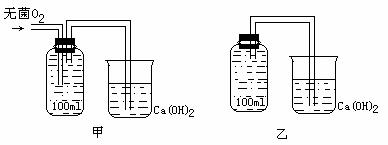 (1)若气泵提供的是无菌空气,甲装置控制有氧条件的方法是 ▲ 。乙装置控制无氧条件的方法是 ▲ 。
(2) 两瓶溶液用滤菌膜过滤掉酵母菌的目的是 ▲ 。
(3)利用提供的U型管(已知U型管底部的分隔膜,葡萄糖不能通过,其余物质能通过)、备用液等必要的实验仪器、药品,请你帮助该小组设计探究的实验步骤,并预测实验结果,得出实验结论。
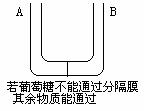 实验步骤:
实验步骤:
① ▲ ② ▲
实验结果预测及结论
① ▲ ② ▲ ③ ▲
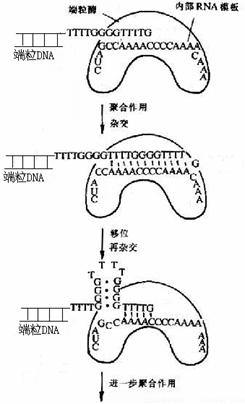
33.(7分)端粒是染色体末端的一种特殊结构,其DNA末端含有由简单的串联重复序列(如---TTTTGGGGTTTTG---)组成的单链突出段,它们在细胞分裂时不能被完全复制,因而随分裂次数的增加而缩短,除非有端粒酶的存在。端粒酶由RNA和蛋白质组成,其RNA含有与端粒DNA重复序列互补的一个片段(如-----AAAACCCCAAAAC----),是合成端粒DNA的模板;其蛋白质催化端粒DNA的合成,催化的一种机制如右下图。研究表明,端粒变短,细胞就老化;如果端粒酶活性很高,端粒的长度就能得到保持,细胞的老化就被延缓。
(1)如果细胞中端粒酶不存在活性,染色体将随每次分裂而缩短,这种变异的类型属于
▲ ,细胞的后代最终死亡的原因可能是由于染色体的缩短而丢失 ▲ 。
(2)端粒酶中,蛋白质成分的功能类似于 ▲ 酶,聚合过程中需要的原料是 ▲ 。
(3)体外培养正常成纤维细胞,细胞中的端粒长度与细胞增值能力成 ▲ 关系,衰老的成纤维细胞的染色质的变化是 ▲ 。
(4)从端粒酶及端粒的长度角度解释,癌细胞能无限增值的原因是 ▲ 。
32.(10分)下图表示几种育种方法的大致过程。请分析回答:
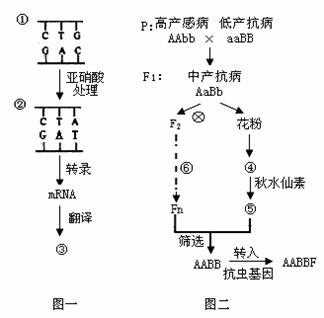 (1)在图一所示①→②过程中发生了
▲ 。若以②的碱基序列为模板经转录和翻译形成③,此过程与以①为模板相比一定发生变化的 是 ▲ 。
是 ▲ 。
A.mRNA序列 B.tRNA种类 C.氨基酸种类 D.蛋白质结构
(2)图二中控制小麦产量(A、a)和抗病与感病(B、b)的两对等位基因分别位于两对同源染色体上。F2的表现型有 ▲ 种。F2中高产抗病植株占 ▲ 。鉴别高产抗病植株是否为纯合子的最简便方法是: ▲ 。在 转入抗虫基因的过程中
 ,需要用
▲ 酶将抗虫基因与运载体(载体DNA)连接,然后导入受体细胞。
,需要用
▲ 酶将抗虫基因与运载体(载体DNA)连接,然后导入受体细胞。
(3)写出图二中步骤⑥的具体操作方法 ▲ 。
(4)某同学对图二中的④、⑤步骤的操作叙述是:花粉离体培养获得单倍体幼苗,从中选择出高产、抗病幼苗,用秋水仙素处理,得到的一定是纯合子的优良植株。请指出该同学叙述中的错误并改正: ▲ 。
湖北省互联网违法和不良信息举报平台 | 网上有害信息举报专区 | 电信诈骗举报专区 | 涉历史虚无主义有害信息举报专区 | 涉企侵权举报专区
违法和不良信息举报电话:027-86699610 举报邮箱:58377363@163.com