
2. Saul Bellow was an ______(杰出的) American writer.
I. 词汇。(10分)
A) 根据句意及汉语提示,完成下列单词的拼写。(5分)
1. There are some______(三明治) on the table.
I. 听单词,从A、B、C、D中找出你所听到的单词的反义词。(5分)
1. A. thin B. heavy C. short D. easy
2. A. free B. right C. left D. hot
3. A. finish B. have C. start D. make
4. A. south B. northern C. west D. eastern
5. A. here B. where C. home D. down
II. 听句子,判断所给图画与你听到的句意是否相符。相符的写"T", 不相符的写"F"。(5分)
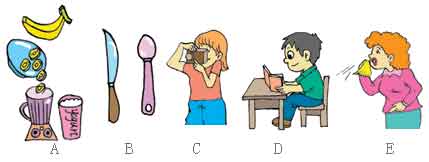
1. _________ 2._________ 3. __________ 4. _________ 5. _________
III. 听对话,根据其内容判断下列句子正(T)、误(F)。(5分)
1. Nancy is from England.
2. Nancy was born on March 20, 1990.
3. Nancy lived in London for three years.
4. Nancy's father found a job in China.
5. Nancy likes the Chinese people and the Chinese food.
IV. 听短文, 根据其内容完成下列各句。(5分)
1. From this passage we know that having a good________can help us work better.
2. Breakfast is important because you have nothing to eat for the whole ________.
3. Rice or bread, an egg, ________ and fruit would make a good breakfast.
4. A good breakfast can help us ________ better and play more happily.
5. This passage tells us a good breakfast is very________.
3. 表示方向的介词
<1>between… and… 在…和…中间
It’s between the hotel and the bank.
<2>opposite 在…对面
Jenny had sat opposite her at breakfast.
<3>next to 在…旁边
She sat down next to him on the sofa.
<4>on the corner 在拐角处,如果指街面的拐角,介词要用on
in the corner 在角落里,如:a table in the corner of the living room,在角落里时介词要用in
<5>on the left / on the right
<6>across from 从…经过
They parked across from the Castro Theater.
2. 问路的方式
<1>引起话题
Excuse me…
(1)用来礼貌的表示希望引起别人注意,特别是希望向别人问问题时
Excuse me, but are you Mr. Hong?
(2)用来向对方表达对于打扰的歉意
Excuse me interrupting, but there is a thing I feel I’ve got to say.
(3)用“Excuse me”或“If you’ll excuse me”,礼貌的表示你将要离开,或者停止谈话
“ Excuse me.” She said to Jill, and left the room.
Now if you’ll excuse me, I’ve got work to do.
(4)用“Excuse me, but”来表示将要反对某人的观点
Excuse me, but I want to know what all this has to do with us.
(5)在撞到某人或者需要从某人身旁挤过时,用来表示歉意等同于“sorry”
(6)可以用来表达对于某些窘迫的事情的歉意
(7)可以用来表示希望对方重复刚才说过的话
<2>询问路在哪里
询问方向的表达方式:
在向别人打听的时候常用“Excuse me”,在向别人提出请求时常用“Could you…?”,来表示礼貌,但是不能用“Can you…?”
(1)Excuse me, where’s the bus station?请问车站在哪?
(2)Excuse me, which is the way to the bus station?请问,哪一条是去车站的路?
(3)Excuse me, can you tell me the way to the bus station?请问,你能告诉我车站的路吗?
(4)Excuse me, how can I get to the bus station?请问,我如何能到达车站?
(5)Excuse me, is there a bus station near here?请问附近有车站吗?
<3>指点方向的表达方式
(1)Go along this street.
Walk along this street.
Go straight on.
沿这条街走
(2)Take the second turning on the left / right.
在第二个十字路口左(右)转。
(3)It’s about 4 km away from here.
离这大约4公里远。
(4)The bus station is along that road on the right.
车站是沿着这条路的右边。
(5)It’s next to the police station.
它与警察局相邻。
(6)It’s about 10 km away.
大约十公里远。
(7)It’s quite far / near from here. 离这相当远/近。
(8)It’s about five minutes’ walk from here.
从这步行大约5分钟。
如果别人问路的时候并不知道,应该说:
I’m sorry I don’t know.
<4>表示致谢:Thank you very much
Thank you all the same.
1. 一些常见的地点位置名称
bank police station library
department store post office
supermarket factory
gas station railway station
mall hospital restaurant
movie theater hotel ice rink
drugstore shoe store clothing store
school museum library
video store gym bookstore
pet shop
学会问路和指路
I. Words Study单词学习:
park street ice rink hotel department store supermarket
opposite mall post office excuse near factory movie
theater gas gas station restaurant get to drug museum
gym bookstore pet shop across from straight
past left right welcome
II. Expression Patterns常用的表达方式:
Lesson 11 Is there a restaurant near here?
Lesson 12 How do I get to the post office?
3. How many … are there的用法
A: How many bedrooms are there in your house?
B: There are three bedrooms.
结构:How many + 复数名词+一般疑问句?
对于there be句型中主语的数量如:some, five, only one等提问时,如果主语是可数名词,不管是单数还是复数,一般都用复数形式提问,因为问话人不知道具体的数量是多少,而且many只能接可数名词复数形式,所有be一定要用are,即为:
How many + 复数名词+are there+地点/时间状语?
There are seven days in a week.
How many days are there in a week?
对于how many引导的特殊疑问句要用陈述句来回答,一般情况下,数词后面的句子成分可以省略,如:
How many students are there in your class?
There are thirty-six (students in our class).
2. There be句型的用法
英语“There + be + (not)”结构表示“有(没有)某人或某物”,there是无词义的引导词,be是谓语动词,它后面的名词是主语,两者在数上必须一致。句末往往有表示地点或时间的状语。
1)肯定式(表示“有…”)
There +(助动词或情态动词)+be+主语+地点(时间)状语。
There is a picture on the wall.
There are 24 hours in a day.
如果there+be之后是并列主语,第一个主语又是单数名词时,在口语中可以用There is….
There are/is a boy and a girl in the room.
There are/is one teacher and four students in the room.
2)否定式(表示“没有…”)
There +be(助动词或情态动词)+not(any)(或+no)+主语…
There was not an underground in Beijing before.
There is nothing more for me to do now.
There won’t be a dance this weekend.
3)疑问句
①一般疑问句
A. Be+there+(any)+主语…?
B. 助动词或情态动词+there+be+(any)+主语…?
Is there anything I can do for you?
Will there be a report by an old experienced teacher this afternoon?
②特殊疑问句
疑问词(+名词)+be+there+状语?
How many months are there in a year?
What’s there in your pocket?
4)含有there的句子用seem to be,happen to be,used to be或live等词做谓语的结构
There happened to be on old friend of mine in the shop.
There used to be a temple here.
There seemed to be no point in refusing.
There once lived an old fisherman in a village by the sea.
湖北省互联网违法和不良信息举报平台 | 网上有害信息举报专区 | 电信诈骗举报专区 | 涉历史虚无主义有害信息举报专区 | 涉企侵权举报专区
违法和不良信息举报电话:027-86699610 举报邮箱:58377363@163.com