
4. always, usually, often 和sometimes
这四个副词表示行动或动作的频率。频率最高的是always(总是),其次是usually(通常,总是),often(经常,时常),sometimes(有时),使用时要注意它们在句中的位置。由于频率副词表示的是经常性的、一般性的动作或情况,不是具体指某一次,因此常常和一般现在时连用,常位于行为动词前面,其他动词(指be动词、情态动词和助动词)的后面。本单元重点学习usually“通常”。
如:When do you usually get up?
你通常什么时候起床?
I usually get up at six o’clock.
我通常六点起床。
What time does your sister usually get up?
你妹妹通常什么时候起床?
She usually gets up at 6:30.
她通常6:30起床。
3. 关于一般现在时。(语法重点)
(1)一般现在时态的意义是:①表示现在的特征或状态。如:He is at home today. 他今天在家。②表示经常性、习惯性的动作。常和频率副词always, often, usually及every day等表示时间的短语连用。如:I go to school at 7:00 every day. 我每天7点钟去上学。③表示主语具备的性格或能力。如:She likes pears very much. 她非常喜欢梨子。They speak English. 他们讲英语。
(2)肯定陈述句:当主语是第一、二和第三人称复数时,谓语动词用原形。当主语是第三人称单数时,谓语动词用第三人称单数形式。例如:
①They stay at home on Sundays.
他们星期天呆在家。
②He does his homework in the evening.
他在晚上做作业。
(3)否定句:当主语是第一、二及第三人称复数时,否定句借助助动词do+not,当主语是第三人称单数时,否定句借用does+not,并将动词第三人称单数还原。例如:
①They don’t stay at home on Sundays.
他们星期天不呆在家里。
②He doesn’t do his homework in the evening.
他晚上不做作业。
(4)疑问句:当主语是第一、第二及第三人称复数时,疑问句在句首加Do。当主语是第三人称单数时,疑问句在句首加Does,并把谓语第三人称单数还原。例如:
①Do they stay at home on Sundays?
他们星期天呆在家吗?
②Does he do his homework in the evening?
他晚上做作业吗?
△以speak为例归纳动词do的各种句式:
|
肯定式 |
否定式 |
|
I speak English. You speak English. He/She/It speaks English. We/You/They speak English. |
I do not (don’t) speak English. You do not (don’t) speak English. He/She/It does not (doesn’t) speak English. We/You/They do not (don’t) speak English. |
|
疑问式和简略答语 |
||
|
Do I speak English? Yes, you do. No, you do not (don’t). Do we speak English? Yes, we/you do. No, we/you do not (don’t). |
Do you speak English? Yes, I do. No, I do not (don’t). Do you speak English? Yes, we do. No, we do not(don’t). |
Does he/she/it speak English. Yes, he/she/it does. No, he/she/it does not (doesn’t). Do they speak English? Yes, they do. No, they do not (don’t). |
(1)We __________ (get up/gets up) at seven every morning.
(2)Jane __________ (don’t wake up/doesn’t wake up) at six every morning.
(3)My father often __________ (drink/drinks) lemonade for breakfast.
(4)____________(Does, Do)the girl often __________ (draw/draws)pictures in the park?
(5)My friend often __________ (come/comes) to school by bus.
(6)____________ (Does, Do) Sally and Ann often __________ (read/reads) English in class?
(7)Jim __________ (doesn’t do/doesn’t) his homework after supper every day.
(8)Jone __________ (go/goes) home at 4:00 in the afternoon.
答案:(1)get up (2)doesn’t wake up (3)drinks
(4)Does, draw (5)comes (6)Do, read
(7)doesn’t do (8)goes
解析:本题考查一般现在时的各种句型。
(1)主语是we,与谓语动词原形搭配。
(2)考查否定句,由于主语是第三人称单数,助动词应相应变化。
(3)主语是第三人称单数。
(4)行为动词是一般现在时的疑问句,主语the girl是第三人称单数,助动词应选相应的Does,后面的动词则用原形,选draw。
(5)此题与(3)题考点相同,选comes。
(6)此题与(4)小题考点一样,但主语Sally and Ann相当于they,不是单数,答案为Do, read。
(7)此题较难,不能丢了第二个do,它是主语的动词译为“做”,答案为doesn’t do。
(8)考点与(3)、(5)相同。
2. what time与when
what time翻译为“几点”问的是具体的时间,一般回答要具体到小时。
What time do you go to school?
你什么时候/几点上学?
I go to school at half past seven o’clock.
我七点半去上学。
回答具体到点钟,且注意在几点前边的介词用at。
when也是对时间的提问,但与what time的区别是:用when提问,回答既可以是具体的时间,也可以是不具体的时间,如:in the morning,last year,in 1998等范围大的时间,例如:When does he take a shower?他什么时候洗澡?
He takes a shower in the morning.
他在早上洗澡。
也可用具体时间:
I take a shower at 6 o’clock in the morning.
我早上六点洗澡。
例. 对下列划线部分提问,将句子变为特殊疑问句。
(1)It’s seven o’clock.
__________ __________ is it?
(2)He was born in 1992.
__________ was __________ born?
解析:本题主要考查when与what time如何询问时间。
答案:(1)What time (2)When, he
1. What time is it? It’s …
这是询问时间的惯用法,如:
A: Excuse me. What time is it, please?
请问几点了?
B: It’s nine o’clock. 九点了。
英语时间的表达
(1)整点时间可表示为“钟点数+o’clock”或直接读钟点数,省去o’clock。如:
It’s ten o’clock a. m. 现在是上午十点整。
(2)非整点时间可直接采取读数法。如:
It’s eight-thirty. 是八点三十分。
注意时间的表达方式:用数词。点与分钟之间用连字如:
eleven-thirty 十一点三十分
nine-twenty-five 九点二十五分
6:10 →six-ten 8:50→eight-fifty
9:30→nine-thirty 10:15→ten-fifteen
7:45→seven forty-five 11:05→eleven-five
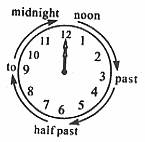
(3)非整点时间的分钟数不超过30分钟,也可用介词“past”。如:
6:10→ten past six
11:05→five past eleven
10:15→ a quarter past ten或fifteen past ten
8:15→a quarter past eight或fifteen past eight
9:30→half past nine或thirty past nine
(4)非整点时间的分钟数超过30分钟,用介词to。如:
11:50→ten to twelve
7:31→twenty-nine to eight
9:45→a quarter to ten或fifteen to ten
12:59→one to thirteen
此句话还有几种表达方式。如:
What is the time? 几点了?
What time is it by your watch? 你的手表几点了?
用英语大声说出下列表格中的时间
A: What’s the time, please?
B: It’s twelve o’clock.
|
8:05
o five. 8:10 ten. 8:15 It’s eight fifteen. 8:25 twenty-five. 8:30 thirty. |
OR |
five ten It’s a quarter past eight. twenty-five half |
|
8:35
thirth-five. 8:40 forty. 8:45 It’s eight forty-five. 8:50 fifty. 8:55 fifty-five. |
OR |
twenty-five twenty It’s a quarter to nine ten five |
△动词短语
get up 起床
get home到达家中
get to work到达工作岗位
make breakfast做早饭
make a shower schedule 做一个洗澡的安排
practice guitar 练吉它
leave home 离家
take a shower = have a shower 洗淋浴澡
take the Number 17 bus to the Santon Hotel
乘17路公共汽车去Santon 旅馆
go to class 上课
go to school 上学
go to work 上班(反义词 go home)
have breakfast/dinner/lunch 吃早、晚、午饭
go to bed 睡觉(反义词get up)
put on 穿衣服(反义词take off)
do one’s homework 做家庭作业
tell sb. about sth. 告诉某人某事
know about sth. 知道某方面的情况
love to do = like to do 喜欢干某事
listen to the early morning news on radio
听电台早间新闻
watch the early morning news on TV
看电视早间新闻
△其他短语
around six o’clock 六点左右
in the morning 在早上
in the afternoon 在下午
in the evening 在晚上
listen to 听…
5. What time is it?
It’s eight-thirty.
4. When do people usually eat dinner?
People usually eat dinner in the evening.
3. What time does she go to school?
She goes to school at eight o’clock.
2. What time does he eat breakfast?
He eats breakfast at seven o’clock.
1. What time do you get up?
I get up at six o’clock.
湖北省互联网违法和不良信息举报平台 | 网上有害信息举报专区 | 电信诈骗举报专区 | 涉历史虚无主义有害信息举报专区 | 涉企侵权举报专区
违法和不良信息举报电话:027-86699610 举报邮箱:58377363@163.com