
49. The bridge is (由……组成) the stones.
(C)
We asked thirty young people between 14 and 18 several questions. All the children had computers at home. The usual time spent on a computer in a week was about 12 hours, with the highest user about 32 hours, and the lowest user only 5 hours. Most children said they usually used computers to play games. Fourteen children told us they did some word processing(文字处理) at times. Eight people told us they kept addresses and phone numbers on their computers or used them as diaries. Only three people said they were learning to write computer programs and nobody used databases(数据库). Only two of them said computers helped with their lessons. The diagram(表格) gives all the results one by one.
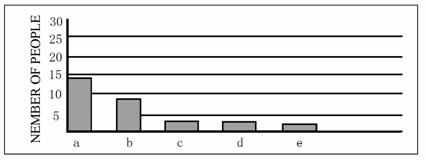
The results show that computer use is quite high among 14-18-year-old children. They also show quite clearly that computers are seen by most young people as little more than game machines. It means to us that, though computers are common(普遍) in the homes of young people, they have not yet become popular in everyday life.
( ) 41. In the diagram, what does the letter “c” show?
A. It shows three people between 14 and 18.
B. It shows only 2 of the thirty children.
C. It shows that two of them use computers to help them with their lessons.
D. It shows that three of them use computers to help them write computer programs.
( ) 42. Most of the 30 children spent about hours on computers in a week.
A.5 B.12 C.20 D.32
43.( ) There is one mistake in the diagram. What is it?
A.The number of “c” should be lower.
B.The number of “d” should be higher.
C.The number of “a” is too high.
D.There should be no number about “e”.
44.( ) In the last paragraph(段) “little more than” means .
A.almost the same as B.far more than
C.different from D.much more than
45.( ) The writer thinks .
A.children must learn to play all kinds of games
B.we should learn many other uses of computers
C.young people should spend more time on computers
puters will become much cheaper
(B)
A young American doctor was sleeping when his doorbell rang. It was already midnight, but what could the doctor do? He had to get up, put on his coat and go downstairs.
When he opened the door, he saw a man standing with a cap in his hand. “How do you do, doctor?” said the man. “Can you come to a place out of town at once? It’s quite far, but you have a car, don’t you? I can show you the way.”
“Certainly,” said the doctor. “I’m quite ready. I can come at once.” In a few minutes the car was waiting at the front door. The man got on the doctor’s car. And they drove off.
They drove on for a long time, and then the man said, “Here we are. This is my home. Now I can pay you and you can go back to town.”
“But I must see the patient,” the doctor said. “How can I go back without seeing the patient? Where is the patient?”
“There is no patient,” answered the man. “Nobody is ill. I live here, you see, and one must get home from a town, mustn’t he? There is no taxi at this time of the night. But a doctor often makes night calls. So excuse me. Here is your money. Thank you, doctor. Good night!”
( ) 36. When did the story happen?
A. In the morning. B. In the afternoon. C. In the evening. D. At midnight.
( ) 37. Where did they go?
A. The hospital. B. The man’s home.
C. The doctor’s home. D. The supermarket.
( ) 38. Is the man’s house near the doctor’s?
A. No, it isn’t. B. Yes, it is.
C. Sorry, I don’t know. D. No, it’s not for from here.
( ) 39. What does “night calls” mean in Chinese?
A. 夜间电话 B. 夜间呼叫 C. 出夜诊 D. 出夜差
( ) 40. Were there any patients waiting for the doctor?
A. No, there aren’t. B. Yes, there are.
C. Sorry, I don’t know. D. No, there weren’t.
(A)
A new library opens in the town. It’s a very big library. Some robots work there as library assistants(管理员). The robots can help you find the right books you want and do other things you tell them. But you must say “Please” when you ask for something and “Thank you” when you get something.
Li Ming wants to borrow a book from the new library. He comes to the library with Zhang Hua. They see a robot standing there.
Li: Hey, give me the book Little Tom. Why? The robot doesn’t work. There must be something wrong with it.
Zhang: No, there isn’t. When you borrow a book, you must say “Please.”
Li: Will you please give me the book Little Tom?
Zhang: Look! The robot is bringing you the book. Take it, Li Ming.
Li: What’s wrong with the robot? It won’t let me have the book.
Zhang: You must say “Thank you” .
Li: Oh, thank you, Mr. Robot.
The robot smiles and gives the book to Li Ming.
根据短文内容,判断正(T)误(F)。
( ) 31. In the library all the assistants are robots.
( ) 32. The robot will be glad to help you if you say “Please” and “Thank you” .
( ) 33. Li Ming asks for help from the robot in the library.
( ) 34. Mr. Robot is a young man.
( ) 35. People say “Please” and “Thank you” only to robots.
16. 17. 18. 19. 20.
15. Her shoes , so she has to buy a new pair.
A. wear out B. are worn out C. worn out D. old
Ⅱ.情景交际。(5分)
从方框中选择适当的句子补全对话,其中有两项是多余的。
A: Hi, Mike! Can you tell me something about Siberian tigers?
B: Of course.
A: 16
B: They are big and strong. They have bright eyes,yellow fur(皮毛) and black stripes(条纹).
A: Can they climb trees?
B: 17 But they can run very fast and are good at hunting(猎取) other animals.
A: How do they usually live?
B: They usually live as a family until the baby tigers are two or three years old.
A: 18
B: About two to four. They look lovely at birth.
A: So wonderful! 19
B: But the number of tigers is getting smaller and smaller.
A: What? How many Siberian tigers are there in the wild?
B: 20 There are fewer and fewer Siberian tigers because people hunt them for their
fur and bones.
A: Yes, I think so. Let’s do something to protect Siberian tigers.
 A. No, they can’t.
B. What’s your favorite animal?
C. I wish I could see one of them.
D. What do they look like?
E. About four hundred.
F. What do they like doing?
G. How many baby tigers can they have at a time?
14. Many people believe there are lots of treasures there, ?
A. don’t they B. aren’t there C. didn’t they D. are there
13. Someone at the door while mom in the kitchen.
A. knocked; cooked B. knocked; was cooking
C. was knocking; cooked D. was knocking; was cooking
湖北省互联网违法和不良信息举报平台 | 网上有害信息举报专区 | 电信诈骗举报专区 | 涉历史虚无主义有害信息举报专区 | 涉企侵权举报专区
违法和不良信息举报电话:027-86699610 举报邮箱:58377363@163.com