
56. A. ideas B. ambitions C. achievement D. technique
55. A. presented B. marked C. lit D. associated
54. A. familiar B. unrelated C. creative D. imaginary
53. A. skillfully B. routinely C. vividly D. deeply
52. A. equipped B. compared C. covered D. connected
51. A. put up with B. catch up with C. make use of D. keep track of
Passage 1
(09·上海)
Most people believe they don’t have much imagination. They are 50 .Everyone has imagination, but most of us, once we become adults, forget how to 51 it. Creativity isn’t always 52 with great works of art or ideas. People at work and in their free time 53 think of creative ways to solve problems. Maybe you have a goal to achieve, a tricky question to answer or you just want to expand your mind! Here are three techniques to help you.
Making connections This technique involves taking 54 ideas and trying to find links between them. First, think about the problem you have to solve or the job you need to do. Then find an image, word, idea or object, for example, a candle. Write down all the idea/words 55 with candles: light, fire, matches, wax, night, silence, etc. Think of as many as you can. The next stage is to relate the 56 to the job you have to do. So imagine you want to but a friend an original 57 ; you could buy him tickets to match or take him out for the night.
NO limits! Imagine that normal limitations don’t 58 . You have as much time/space/money, etc. as you want. Think about your goal and the new 59 .If your goal is to learn to ski, 60 , you can now practise skiing every day of your life (because you have the time and the money). Now 61 this to reality. Maybe you can practise skiing ever day in December, or every Monday in January.
Be someone else! Look at the situation from a 62 point of view. Good businessmen use this technique in trade, and so do writes. Fiction writers often imagine they are the 63 in their books. They ask question: What does this character want? Why can’t she get it? What changes must she make to get what she wants? If your goal involves other people, put yourself in their 64 . The best fishermen think like fish!
50. A. wrong B. unbelievable C. reasonable D. realistic
10.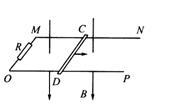 如图所示,电阻不计的平行金属导轨MN和OP水平放置,MO间接有阻值为R的电阻,导轨相距为d,其间有竖直向下的匀强磁场,磁感强度为B.质量为m、电阻为r的导体棒CD垂直于导轨放置,并接触良好.用平行于MN的恒力F向右拉动CD,CD受恒定的摩擦阻力.f,已知F>f.问:
(1)CD运动的最大速度是多少?
(2)当CD达到最大速度后,电阻R消耗的电功率是多少?
(3)当CD的速度是最大速度的1/3时,CD的加速度是多少?
解析:(1)以金属棒为研究对象,当CD受力:F=FA+f时,CD速度最大,
即:
(2)CD棒产生的感应电动势为:
回路中产生的感应电流为:
则R中消耗的电功率为:
(3)当CD速度为最大速度的1/3即 时,CD中的电流为最大值的1/3即
 则CD棒所受的安培力为:

CD棒的加速度为:
9、如图所示,两根足够长的直金属导轨MN、PQ平行放置在倾角为θ的绝缘斜面上,两导轨间距为L,M、P两点间接有阻值为R的电阻.一根质量为m的均匀直金属杆ab放在两导轨上,并与导轨垂直整套装置处于磁感应强度为B的匀强磁场中,磁场方向垂直斜面向下,导轨和金属杆的电阻可忽略·让ab杆沿导轨由静止开始下滑,导轨和金属杆接触良好,不计它们之间的摩擦.
(1)由b向a方向看到的装置如图1 5-2所示,请在此图中画出ab杆下滑过程中某时刻的受力示意图;
(2)在加速下滑过程中,当杆ab的速度大小为v时,求此时ab杆中的电流及其加速度的大小;
 (3)求在下滑过程中,ab杆可以达到的速度最大值.
解:(1)重力mg,竖直向下;支撑力N,,垂直斜面向上;安培力F,沿斜面向上.
(2)当ab杆速度为v时,感应电动势E=BLv,此时电路电流

杆受到安培力
根据牛顿运动定律,有:

(3)当
 时,ab杆达到最大速度

8、水平面上两根足够长的金属导轨平行固定放置,间距为L,一端通过导线与阻值为R的电阻连接;导轨上放一质量为m的金属杆(见图),金属杆与导轨的电阻不计;均匀磁场竖直向下.用与导轨平行的恒定力F作用在金属杆上,杆最终将做匀速运动.当改拉力的大小时,相对应的匀速运动速度v也会改变,v和F的关系如图 (取重力加速度g=10m/s 2)
(1)金属杆在匀速运动之前做作什么运动?
(2)若m=0.5 kg,L=0.5 m,R=0.5 Ω,磁感应强度B为多大?
(3)由ν-F图线的截距可求得什么物理量?其值为多少?
解: (1)变速运动(或变加速运动、加速度减小的加速运动,加速运动).
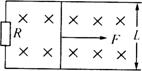 (2)感应电动势E-vBL,感应电流I=E/R
安培力
由图可知金属杆受拉力、安培力和阻力作用,匀速时合力为零
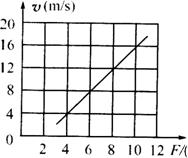


由图线可以得到直线的斜率k=2

(3)由直线的截距可以求得金属杆受到的阻力f, f=2(N).
若金属杆受到的阻力仅为动摩擦力,由截距可求得动摩擦因数 μ=0.4
湖北省互联网违法和不良信息举报平台 | 网上有害信息举报专区 | 电信诈骗举报专区 | 涉历史虚无主义有害信息举报专区 | 涉企侵权举报专区
违法和不良信息举报电话:027-86699610 举报邮箱:58377363@163.com