
2. (听录音,呈现1a内容。)
T: Boys and girls. You are all very good. Now, please listen to 1a and answer the following questions.
(用幻灯片呈现问题)
|
(1)What does Fan Zhiwei
want to do? (2)What does he do? (3)Why does he want to join the English Club? |
(再听一遍,核对答案。)
1. T: We all know, Beijing will host the 2008 Olympics. Do you want to take part in it?
Ss: Yes, of course.
T: Good. You all want to take part in it, what will you have to do?
S1: I have to do the exercise every day.
S2: I will practice running in the morning.
S3: I am going to play soccer every day.
S4: …
T: Well done! But there is another important thing. That is we must speak English well. Do you think so?
Ss: Yes, we think so.
T: Why?
Ss: Because there will be more and more foreigners in Beijing in 2008.
T: Yes. S5, do you want to speak English well?
S5: Sure.
T: Why?
S5: Because Beijing will host the 2008 Olympics.
T: Oh, that’s your reason.
(用同样的方式多问几名同学,突出生词reason,并板书。)
|
reason |
T: We all want to speak English well, but how to practice it. I think we should join the Ren’ai English Club.
(板书,也可出示一幅标有“仁爱英语俱乐部”的图片。)
|
the Ren’ai English Club |
T: S6, do you want to join the Ren’ai English Club?
S6: Yes, of course.
T: Why do you want to join the club?
S6: Because Beijing will host the 2008 Olympics.
2. (复习经常做运动的原因,导入新课。)
T: Now, who can tell me why you do exercise?
S4: I want to be strong.
S5: I want to be healthy.
S6: I want to be a sports player like Yao Ming.
S7: …
T: Good! Do you know why I exercise every day? Can you guess?
S8: I think you want to be healthy.
S9: I think you want to keep fit.
S10:…
T: Yes, you are right. But I do exercise also because Beijing will host the 2008 Olympics.
(板书并展示图片。)
|
host |
T: Beijing will host the 2008 Olympics.
(让同学们以组为单位快速复述,最后学生齐读。)
T: Great! In this Topic, we’ll talk about the 2008 Olympics.
Step 2 Presentation 第二步 呈现(时间:10分钟)
Step 1 Review 第一步 复习(时间:10分钟)
1. (复习Would you mind doing…句型,引出生词。)
T: S1, would you mind telling me your favorite sport and sports player?
S1: OK. My favorite sport is basketball, and my favorite sports player is Yao Ming.
T: Where is Yao Ming from?
S1: He is from Shanghai.
T: Oh, he is Chinese.
(让学生仿照师生的对话进行互动操练。)
S2: Would you mind telling me your favorite sport and sports player?
S3: …
S2: Where is he / she from?
S3: He / She is from…
…
T: Very good! Do you know who is my favorite sports player?
Ss: Your favorite sports player is Michael Jordan.
T: Yes. Is he Chinese?
Ss: No, he isn’t.
T: You are right. He comes from a foreign country. He is a foreigner.
(板书)
|
foreign
foreigner |
(老师出示几幅外国人的图片,罗纳尔多(Ronaldo),贝克汉姆(Beckham), 齐达内(Zidane)等。)
T: Look at this picture, who is he?
Ss: He is Ronaldo.
T: Where is he from?
Ss: He is from Brazil.
T: Yes, he is from a foreign country. He is a foreigner.
(让学生根据其他几幅图片参照示范自编对话,目的是巩固foreign和foreigner两个生词。)
录音机/图片/幻灯片
3.Practice the Simple Future Tense:
(1)Because Beijing will host the 2008 Olympics.
(2)Speaking English will help me make more foreign friends.
(3)It will be my first time in China.
(4)I will enjoy lots of delicious Chinese food.
2.Talk about how to apply to join the English club and the reasons for joining it:
(1)I want to join the Ren’ai English Club.
(2)Why do you want to join our club?
1.Learn some useful words and expressions:
foreigner, foreign, e-mail, address, reason, have fun with, lots of, maybe, duck, make friends with, perhaps, coffee
2. Key sentences 重点句子
The Olympic rings are a symbol of the Olympic Games.
Ability goals 能力目标
Enable the students to describe the symbol of the Olympic Games.
Learning ability goals 学能目标
Help the students learn how to describe the symbol of the Olympic Games.
Teaching important and difficult points 教学重难点
How to describe the symbol of the Olympic Games.
Teaching aids教具准备
A multimedia.
Teaching procedures and ways 教学过程与方式
Step I Lead in
Show a picture on the slide.
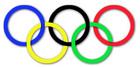
T: Do you know what it is?
S1: It’s the Olympic rings.
T: Yes. Almost everyone know it, we can see it everywhere, such as on the T-shirt, on the cup, on some machines. Do you know the meaning of it? Let’s listen to a passage. Then you will get it.
Step II Listening (1a, 1b)
Play the recorder. Then let students complete the four blanks of 1a.
T: If you understand it clearly, go on to finish 1b.
Then check the answers together.
T: The Olympic rings are a symbol of the Olympic Games. There are five rings. Rings are a universal symbol for unity. The Olympic symbol also represents the union of the five continents Africa, the Americas, Asia, Europe, and Oceania, and the meetings of athletes from throughout the world. Every national flag in the world includes at least one of the five colors. Please contrast the five mascots with the Olympic rings. Can you find something in common?
Ss: They are the same colors. The five mascots are blue, black, red, yellow and green. They are same with Olympic rings.
T: Very good. You are all very clever.
Step III Grammar (2a, 2b)
Show some sentences on the slide.
|
1. Maybe Carol will go to the
Roast Duck Shop. 2. I think I’ll sit in a quiet place in Beijing, watching what’s going on. 3. There will be more roads. |
T: Look at these sentences. Can you find out the similarity?
Students will give all kinds of answers. Then the teacher sums up.
T: We have learnt the word - will for future tense.
Give students five minutes to discuss its use in groups. Every group gives five sentences with will. Then the teacher writes five good sentences from them.
Step IV Group work (3)
Divide the students into groups.
T: Now work in groups. We’ll have a competition. Turn to Page 24. There is a crossword puzzle. When I say start, you begin to finish it. The fast group who get all the correct answers is the champion. Are you clear?
Ss: Yes.
T: Start.
After they finish it, all the students clap their hands to congratulate the champion group.
Step V Homework (5)
a. Collect information about your favorite sports and make a card about sports.
b. Review Unit One and preview Unit Two.
Teaching resources 教学资源库
OLYMPIC GAMES LOCATION The IOC, headquartered in Lausanne,
Switzerland,
sets and enforces Olympic policy. The site of the games is chosen, usually at
least six years in advance.
SITES OF THE SUMMER OLYMPIC
GAMES
1896 - Athens, Greece
1900 - Paris, France
1904 - St. Louis, Missouri USA
1906 - Athens, Greece*
1908 - London, England
1912 - Stockholm, Sweden
1916 - Not held**
1920 - Antwerp, Belgium
1924 - Paris, France
1928 - Amsterdam, Holland
1932 - Los Angeles, California USA
1936 - Berlin, Germany
1940 - Not held***
1944 - Not held***
1948 - London, England
1952 - Helsinki, Finland
1956 - Melbourne, Australia
1960 - Rome, Italy
1964 - Tokyo, Japan
1968 - Mexico City, Mexico
1972 - Munich, Germany
1976 - Montreal, Canada
1980 - Moscow, Russia
1984 - Los Angeles, California USA
1988 - Seoul, South Korea
1992 - Barcelona, Spain
1996 - Atlanta, Georgia USA
2000 - Sydney, Australia
2004 - Athens, Greece
*Games not recognized by the
International Olympic Committee.
**Games cancelled due to World
War I.
***Games cancelled due to World War
II.
The IOC, headquartered in Lausanne,
Switzerland,
sets and enforces Olympic policy. The site of the games is chosen, usually at
least six years in advance.
SITES OF THE SUMMER OLYMPIC
GAMES
1896 - Athens, Greece
1900 - Paris, France
1904 - St. Louis, Missouri USA
1906 - Athens, Greece*
1908 - London, England
1912 - Stockholm, Sweden
1916 - Not held**
1920 - Antwerp, Belgium
1924 - Paris, France
1928 - Amsterdam, Holland
1932 - Los Angeles, California USA
1936 - Berlin, Germany
1940 - Not held***
1944 - Not held***
1948 - London, England
1952 - Helsinki, Finland
1956 - Melbourne, Australia
1960 - Rome, Italy
1964 - Tokyo, Japan
1968 - Mexico City, Mexico
1972 - Munich, Germany
1976 - Montreal, Canada
1980 - Moscow, Russia
1984 - Los Angeles, California USA
1988 - Seoul, South Korea
1992 - Barcelona, Spain
1996 - Atlanta, Georgia USA
2000 - Sydney, Australia
2004 - Athens, Greece
*Games not recognized by the
International Olympic Committee.
**Games cancelled due to World
War I.
***Games cancelled due to World War
II.
Olympic Games
Creed
"The most important thing in the Olympic Games is not to win but to take part, just as the most important thing in life is not the triumph but the struggle. The essential thing is not to have conquered but to have fought well."
---- The words of the Olympic creed are attributed to Baron Pierre de Coubertin, the founder of the modern Olympic Games.
Motto
The Olympic motto "Citius, Altius, Fortius" is Latin for "Faster, Higher, Braver," but is universally accepted to mean "Swifter, Higher, Stronger." Oath
The Olympic oath is a symbolic gesture of sportsmanship that traces its origins to the 1920 Olympic Games. One athlete from the host country takes the oath at Opening Ceremonies on behalf of all the athletes. Oath: "In the name of all competitors, I promise that we shall take part in these Olympic Games, respecting and abiding by the rules which govern them, in the true spirit of sportsmanship, for the glory of sport and the honor of our teams."
Torch & Flame
One of the most enduring symbols of the Olympic Games is the Olympic flame. The flame made its first appearance at the 1936 Berlin Olympic Games and since then the lighting of the flame has become a major focal point of every Opening Ceremonies. The concept of lighting a flame for the duration of the Games comes from the ancient Greeks, who used a flame lit by the sun's rays at Olympia - the site of the original Olympic Games.
The 2008 Olympic mascots
Each of the Beijing Olympic mascots has a rhyming two-syllable name -- a traditional way of expressing affection for children in China. Beibei is the Fish, Jingjing is the Panda, Huanhuan is theOlympic Flame, Yingying is the Tibetan antelope and Nini is the Swallow.
The five elements of nature -- the sea, forest, fire, earth and sky -- can be found in their origins and headpieces, all stylistically rendered in ways that represent the deep traditional influences of Chinese folk art and ornamentation.
Each of the mascots also symbolizes a different blessing --prosperity, happiness, passion, health and good luck.
International Olympic Committee (IOC) president Jacques Rogge sent a letter of congratulation to the BOCOG. "China is lucky to have so many beautiful animals to represent the Olympic spirit," said Rogge in the letter. I love them all. And I am delighted that they will carry traditional Chinese blessings all over the world. I believe that this little group of friends -- the carp, the panda, the flame, the antelope and the swallow -- will be extremely popular and will help to spread Olympic messages throughout the world."
1. Words & phrases 生词和短语
modern, motto, fast, ring, ring … up, symbol, least, at least, fond, be fond of
湖北省互联网违法和不良信息举报平台 | 网上有害信息举报专区 | 电信诈骗举报专区 | 涉历史虚无主义有害信息举报专区 | 涉企侵权举报专区
违法和不良信息举报电话:027-86699610 举报邮箱:58377363@163.com