
3. Students read after the tape and then act out the dialogue.
(设计说明:通过这一环节的学习,学生们对火星探索计划的了解更为透彻了。而朗读与表演对话则能使教学内容得到进一步的巩固与提高。)
Step 4 Tasks (Activity 6)
2. Ask students to read the dialogue again and finish Activities 4 and 5.
1. Tell students Da Ming’s friend Tony has made a model of a space station, and now they are talking about the model. Ask students to listen and read the dialogues, then try to answer three questions: ①. Has the spacecraft to Mars arrived yet?
②. Have many astronauts been to the moon recently?
③. How do the astronauts go back to the earth from the space station?
2. Listen again and finish Activity 2: Check the true sentences.
(设计说明:本活动为听力基本能力训练,是一种听力输入理解活动。听力的相关内容对火星探索计划作了简单的介绍,为学生能更好的理解下一环节中的对话内容作了铺垫。)
Step 3 Listening and reading (Activities 3, 4, 5)
1. Tell students to listen to a piece of news about the travel mission to Mars and find the answer to the question “Have they discovered life on Mars yet?” and finish Activity 1: Listen and number the words as you hear them.
2. Ask students to answer some questions about this video.
①. How did the astronauts go to the moon?
②. How many spacecrafts has America sent to the moon by now?
③. Have they discovered life on the moon?
④. Have the scientists sent spacecrafts to Mars yet?
⑤. Have they discovered life on Mars yet?
设计说明:此环节可以帮助学生更深入地了解人类登月的历史。最后的两个问题,很自然的将讨论的话题由登月过渡到火星探索方面,由此引出了接下来的内容,起到承上启下的衔接作用。另外,这些问题的设置很自然的引出该堂课的重点句型:Have they …yet? Yes, they have just / already…. No, not yet. / No, they haven’t yet.)
Step 2 Listening (Activities 1 & 2)
Unit 1 Has it arrived yet?
|
Topic |
Space mission to Mars |
|
Aims |
To understand the conversation about the
space mission to Mars To talk about space mission to Mars To talk about the life at space station and the space research in China |
|
Key vocabulary |
earth, Mars, already, just, month,
recently, several, discover |
|
Key structures |
Have they… yet? Yes, they have just / already…. No, not yet. (No, they haven’t yet.) |
|
Tasks |
Information gap Writing competition |
|
Grammar |
The present perfect tense |
|
Teaching aids |
Tape recorder, video, multi-media |
Step 1 Lead-in
1. Word map construction
Show students a video about humans landing on the moon, and ask students to say out the things they see. Help students to answer: astronauts, spacecraft, the moon and so on. Then ask students to work in groups of four. Try to think out more related words like: earth, scientists, stars, space shuttle, sun, planet, universe, space station, air, space and so on.
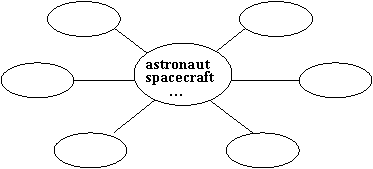
(设计说明:这个环节的设置旨在培养学生的自主学习、合作学习与发散思维的能力。学生在观看录像之后,说出已知的单词,并尝试联想相关词汇,这有利于学生发散思维能力的培养。若涉及未学过的词汇,学生可以通过小组互助合作查找出来,改变了由老师教,学生学的传统的单词教学的模式。学生通过合作探究,自学新的知识,若在反馈中出现错误,老师可适当纠正。这些都为下面的听力环节解决了语言上可能出现的困难。)
第二课时 Unit 2 We haven’t found life on other planets yet.
第三-四课时 Unit 3 Language in use & workbook
第一课时 Unit 1 Has it arrived yet?
2.教学难点
(1)用现在完成时描述人类已经实施的太空探索计划。
(2)have been to与have gone to的区别。
湖北省互联网违法和不良信息举报平台 | 网上有害信息举报专区 | 电信诈骗举报专区 | 涉历史虚无主义有害信息举报专区 | 涉企侵权举报专区
违法和不良信息举报电话:027-86699610 举报邮箱:58377363@163.com